
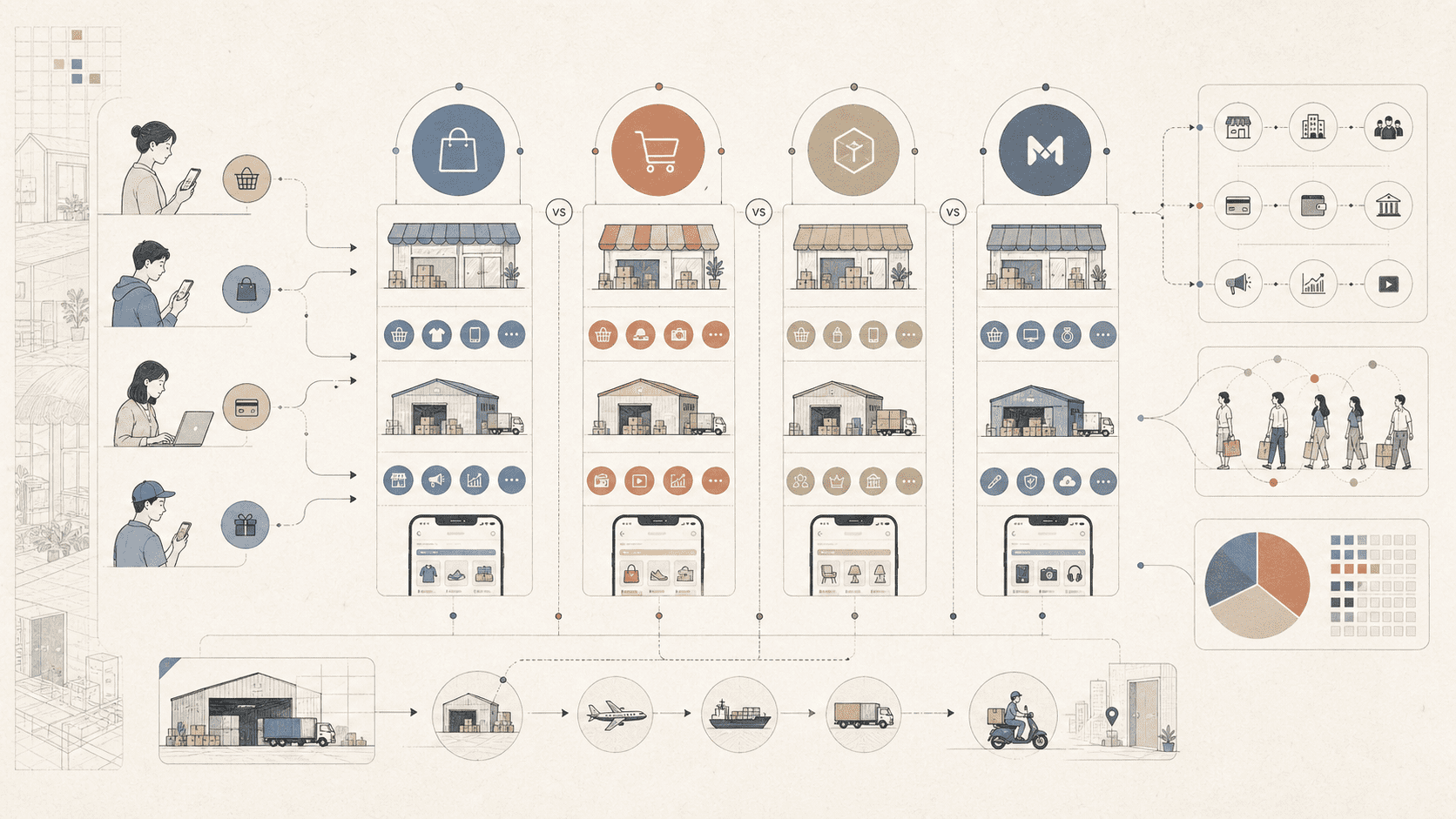
Shopee owns Southeast Asia ecommerce. Coupang owns Korea. Rakuten still owns Japan. Alibaba’s Taobao and Tmall own China. Flipkart owns India. Amazon — the global e-commerce default everywhere from the US to Western Europe to Australia — doesn’t crack the top three marketplaces in a single one of them. That isn’t a quirk. It’s the structural feature of Asia ecommerce & marketplaces that Western coverage consistently underplays: this is a regional market, not a global one, and the platforms that win Asia are platforms that started here, raised here, and built logistics for the specific geography of here.
The accessibility map for AI in Asia, which DIA tracked in Which LLMs Work in Your Market, runs roughly parallel: foreign frontier models reach most markets but lose ground to local specialists at the deployment edge. E-commerce went further. The local specialists didn’t just win the deployment edge — they won the platforms themselves. Lazada (now Alibaba), Shopee (Sea Group, Singapore), Coupang (Korea), Rakuten (Japan), Flipkart (Walmart’s Indian acquisition), Tokopedia (now merged with TikTok Shop in Indonesia), the Chinese Big Three (Taobao/Tmall, JD, Pinduoduo): every leading platform across fifteen Asian markets is either Asian-headquartered or has been so thoroughly acquired into the Asian operating context that the distinction barely matters.
This is a working tracker of who owns e-commerce across fifteen Asian markets as of May 2026. It will be updated as the picture moves — and in e-commerce, the picture moves slower than AI, but the moves matter more when they happen.
The Asia E-commerce Master Comparison
The headline reference. Best platform by GMV share, runner-up for context, and total market size for each of fifteen Asian markets.
Legend: – GMV Share is platform share of total market e-commerce GMV (gross merchandise value), rounded. Methodologies vary across sources; cited inline where significant. – Total Market GMV is total e-commerce gross merchandise value, latest available year (2024-2025 depending on market reporting cadence). – For markets where two platforms run effectively neck-and-neck, both are shown as joint leaders.
| Market | Best Platform | GMV Share | Runner-up | Share | Total Market GMV | Notes |
|---|---|---|---|---|---|---|
| Mainland China | Taobao + Tmall (Alibaba) | ~44% | JD.com | ~24% | $2.16T (2024) | World’s largest; Pinduoduo 19%, Douyin live-commerce ~$477B GMV |
| Hong Kong | HKTVmall | <15% (fragmented) | Taobao (cross-border) | n/a | ~$10B | Cross-border-heavy, no clear domestic leader |
| Japan | Rakuten Ichiba | ~20% | Amazon Japan | ~18% | $258B (2025) | Top 3 (incl. Yahoo!/LINE Yahoo) ~55-60% combined |
| South Korea | Naver Shopping | ~22% | Coupang | ~20% | $268B (2025) | Two-horse race; Coupang #1 by direct sales, Naver #1 by GMV |
| Taiwan | Shopee Taiwan | ~30% | Momo | ~27% | $53B (2026) | Top 3 (incl. PChome) ~60% combined |
| Vietnam | Shopee | ~50% | TikTok Shop | ~30% | ~$25B (2025) | TikTok Shop fastest-growing in SEA |
| Indonesia | Shopee | ~36% | TikTok Shop + Tokopedia | ~37% (combined) | ~$67B (2025) | TikTok Shop / Tokopedia merger created joint leader |
| Thailand | Shopee | ~49% | Lazada | ~30% | ~$24B (2025) | TikTok Shop ~21%, growing fast |
| Philippines | Shopee | ~52% | TikTok Shop | ~27% | ~$11B (2025) | One of world’s most social-commerce-heavy markets |
| Singapore | Shopee | ~48% | Lazada | ~22% | ~$5.5B (2025) | Cross-border share unusually high |
| Malaysia | Shopee | ~57% | Lazada | ~21% | ~$11B (2025) | TikTok Shop ~22%, displacing Lazada |
| India | Flipkart Group | ~48% | Amazon India | ~30-35% | $125-400B (2024-25)* | Meesho 3rd by orders; ONDC adding alternative rails |
| Cambodia | Khmer24 / Smile Shop / La Rue | n/a (fragmented) | Shopee / Lazada (cross-border) | n/a | $1.78B (2025) | 6.7% of GDP; 11.7M Facebook + 10M TikTok users dominate informal commerce |
| Bangladesh | Daraz (Alibaba) | leading reach | Chaldal (grocery) / Pickaboo (electronics) | n/a | $7.41B (2025) | Daraz cut 35% of BD staff in 2024; Chaldal in liquidity crisis Q1 2026 |
| Myanmar | Shop.com.mm (Alibaba) | <5% formal | rgo47 / City Mart Online | <5% formal | ~$4.5B (2025, est.) | Facebook commerce dominates; sanctions limit Western platform entry |
India e-commerce GMV figures vary dramatically by methodology — Bain estimates $125B (2024), some sources project $400B (2025) including total retail-adjacent activity. The $125-130B figure is the more conservative platform-GMV reference.
Three patterns jump out of the table.
First, the China exception is structural. Mainland China is roughly half of global e-commerce by itself. Alibaba (Taobao + Tmall combined ~44%), JD.com (~24%), and Pinduoduo (~19%) jointly control close to 87% of the Chinese e-commerce market. Douyin’s live-commerce GMV hit ~$477 billion in 2024 — larger than the entire e-commerce market of any other Asian country except possibly India by some measures. No Western platform plays in any of this. Amazon left China in 2019. This isn’t a market with foreign competition for share; it’s a closed domestic ecosystem with its own gravitational pull.
Second, the Korea exception runs in the other direction — extreme concentration around domestic players, with foreign challengers (AliExpress, Temu, Amazon Cross-Border) holding less than 2% market share each. Coupang and Naver between them control roughly 65% of the consumer e-commerce market by usage frequency. The 2024 collapse of Tmon and Wemakeprice — two former top-five platforms that went bankrupt within months of each other — confirmed Korea’s winner-take-all dynamics. Mid-tier survival is no longer viable.
Third, the Sea Group story is genuinely remarkable. Shopee, the consumer-facing arm of Singapore-based Sea Group, leads all six Southeast Asian markets covered here (Vietnam, Indonesia, Thailand, Philippines, Singapore, Malaysia) plus Taiwan — seven of fifteen Asian markets in this tracker. No other regional or global platform has comparable depth. Shopee’s regional GMV reached $32.2 billion in Q3 2025 alone, growing 28.4% year-on-year. The closest cross-Asia challenger is Alibaba, but Lazada has slipped to second across most of SEA, and Alibaba’s regional bet (Daraz in South Asia) is much smaller scale.
One important caveat: the numbers in the table mix B2C platform share, total e-commerce GMV, and retail share depending on what each market’s published research measures. The notes column flags significant methodology differences. This is unavoidable in cross-Asia e-commerce data — there’s no equivalent of the AI benchmarks ecosystem standardising measurement. What the table captures reliably is the ranking and the structural picture; the precise percentages should be read as directional rather than absolute.
Why Asia E-commerce Looks Different
Standard Western framings of e-commerce — Amazon, marketplace vs first-party, FBA vs merchant fulfilled, Buy Box dynamics, Prime as platform lock-in — translate badly to Asia. Six structural differences shape the actual market.
Super-app integration. In China, Alibaba’s Taobao runs alongside Alipay, Cainiao logistics, Ant Group financial services, and a content layer (Taobao Live) inside the same ecosystem. Tencent’s commerce play sits inside WeChat’s mini-programs. In Korea, Coupang ties together fast-fulfilment commerce, Coupang Play (video streaming), and Coupang Eats (food delivery). In Indonesia, GoTo combines Tokopedia commerce with Gojek mobility and GoPay financial services. These aren’t e-commerce companies bolting on adjacent services; they’re integrated digital platforms where commerce is one of several mutually reinforcing revenue layers. The unit of competition is the ecosystem, not the marketplace.
Live commerce as core retail format. China invented modern live commerce. Korea is the most developed market outside China — 6 in 10 Seoul consumers have purchased via live broadcast, and Naver Shopping Live commands roughly 73.6% of mobile shoppers as primary live-commerce destination. Taiwan’s live commerce already accounts for ~25% of regional GMV. Southeast Asia caught up fast through TikTok Shop. Japan and India remain the notable laggards, though for very different reasons (cultural in Japan, infrastructure in India). Live commerce isn’t an emerging channel in Asia — it’s a core format that any platform without it is structurally disadvantaged.
Cash-on-delivery still matters in emerging Asia. India, Indonesia, Vietnam, the Philippines, Bangladesh, Cambodia, Myanmar — all of them retain meaningful COD share, often 30-50% of total e-commerce volume. That changes the unit economics fundamentally. Returns are higher. Working capital cycles are longer. Logistics need to handle cash collection. Western platform playbooks designed around card payments and frictionless checkout don’t survive contact with these markets without major adaptation.
Mobile-first to mobile-only. Korea’s e-commerce is 75% mobile, China 85%+ mobile, Indonesia and Vietnam closer to 90%. Japan is the outlier — desktop still meaningfully present, especially among older shoppers, who are an enormous and growing demographic. For the rest of Asia, mobile is e-commerce. Web parity isn’t an afterthought — it’s a thing platforms might not bother with. Taiwan was 85% desktop e-commerce as recently as 2018; by 2026 mobile dominates.
Logistics heterogeneity is extreme. Korea has 99% of Coupang orders delivered within 24 hours nationwide. India’s quick-commerce sector reaches under-20-minute fulfilment in metros. Indonesia spans 17,000 islands. Cambodia and Myanmar are still building basic logistics infrastructure. The cost-to-serve curve across these fifteen markets is wider than in any comparable region globally — Coupang’s same-day infrastructure and Bangladesh’s COD-heavy informal logistics are essentially different industries operating under the same nominal “e-commerce” label.
Cross-border varies dramatically. Singapore is overwhelmingly cross-border (small population, no domestic manufacturing scale, premium imports drive high AOV). Japan is barely cross-border at all (Mercari’s Global App in 2025 was a notable strategic pivot; Temu and AliExpress have only recently broken through on low-ticket categories). Korea is heavily protected by language plus Coupang’s logistics moat. India is cyclical with regulatory FDI rules. China runs both directions through Tmall Global (inbound) and AliExpress (outbound). The specific customs de minimis threshold for low-value imports — Indonesia’s $3 for restricted categories vs Japan’s ¥10,000 vs Thailand’s recent VAT-on-import-under-1500-baht change — has become one of the most operator-relevant numbers in regional e-commerce.
The combination produces a market where Western platform playbooks fail more often than they succeed, and where local specialists with intimate market knowledge can — and consistently do — out-compete much larger global players on local turf.
Mainland China: Three Giants Plus Douyin’s Content-Native Disruption
China is the world’s largest e-commerce market by a substantial margin: $2.16 trillion in online retail sales in 2024, approximately 50% of global e-commerce, with e-commerce penetration of 47% — the highest in the world. Nearly one billion Chinese consumers shopped online in 2024. Mobile dominates: over 85% of Chinese e-commerce transactions happen on mobile.
Three platforms control most of this. Alibaba’s combined Taobao and Tmall ecosystem holds around 44% market share by GMV. Taobao runs as a C2C and SME marketplace at roughly $585 billion GMV (2025 estimate); Tmall serves as Alibaba’s B2C premium platform at roughly $568 billion GMV — Alibaba reports their GMV together because they share the same user base and app infrastructure, even though they target different commercial purposes. JD.com runs as the country’s leading first-party retailer at roughly $547 billion GMV (2025), with a 1,400-warehouse network ensuring 90% next-day coverage in tier-1 and tier-2 cities. Pinduoduo has emerged as the C2M and group-buying disruptor, hitting $655 billion GMV in 2024 (per ECDB data), with over 540 million MAU and a stronghold in lower-tier cities and price-sensitive categories — making it the second-largest e-commerce marketplace globally after Amazon by 2024.
Douyin, ByteDance’s TikTok-equivalent in China, has emerged as the fourth force without operating as a traditional marketplace. Douyin’s e-commerce GMV reached an estimated $477 billion in 2024, growing more than 60% year-on-year. The format is content-native — shoppable short-form videos, livestream selling, and embedded purchase flows that don’t depend on category pages or search. In September 2025, a single L’Oréal beauty campaign on Douyin generated CNY 1.2 billion (USD 167 million). This is the future of social commerce executed at a scale that Western markets have not yet experienced.
Singles’ Day (November 11) generated an estimated $197 billion in sales across major platforms in 2024 — a 26.6% year-on-year increase. The figure is larger than the annual e-commerce GMV of any Asian country except possibly India by some measures.
For non-Chinese businesses, the relevant question isn’t “how do I sell in China through Amazon-equivalents” — it’s “do I work with Tmall Global’s cross-border channel, partner with a domestic operator on Taobao/JD, or build a direct DTC presence on WeChat mini-programs?” Each route has different unit economics and different scale ceilings. None resemble Amazon’s seller flywheel. DIA covered the broader China digital economy capability picture in Inside China’s AI Machine; the e-commerce angle reinforces the China-as-its-own-internet thesis from a different vector.
Hong Kong: Cross-Border Fragmentation, No Clear Domestic Leader
Hong Kong is the smallest market in this tracker by domestic e-commerce GMV — roughly $10 billion (2024) — and the most fragmented. There is no dominant local marketplace with anything close to the share Coupang holds in Korea or Shopee holds in SEA. HKTVmall is the largest local pure-play platform but operates at much smaller scale than its Asian peers.
The structural reason is that Hong Kong consumers behave as cross-border shoppers by default. Taobao, Tmall, and JD are accessible directly (no Great Firewall constraint), and Hong Kong’s internet infrastructure makes mainland Chinese shopping seamless. Yahoo! Hong Kong, ZALORA, and a long tail of vertical specialists (electronics, fashion, beauty) split the formal marketplace category, with Carousell handling the C2C segment. Amazon ships to Hong Kong but operates through Amazon Global rather than a localised Amazon HK presence.
For cross-Asia operators, Hong Kong reads less as an e-commerce market and more as a cross-border logistics and payments hub serving Greater China. Live commerce is less developed than mainland China or Taiwan. The market matters more for what flows through it than for what gets transacted on Hong Kong-domiciled platforms.
Japan: Three Champions, No Foreign Disruption
Japan is the third-largest e-commerce market globally after China and the US, at roughly $258 billion in 2025 GMV. Three domestic platforms dominate: Rakuten Group, Amazon Japan (which counts as domestic in operational terms despite the parent company), and Yahoo! Shopping under LINE Yahoo. Together they control approximately 55-60% of consumer e-commerce GMV.
Rakuten Ichiba, Japan’s largest pure marketplace, reported gross merchandise sales of $40.7 billion for the twelve months to March 2025, with over 100 million registered members. The platform’s competitive moat isn’t logistics — Japan’s logistics infrastructure is universal and excellent — but the Rakuten Points loyalty ecosystem, which spans the company’s e-commerce, fintech (Rakuten Card, Rakuten Bank, Rakuten Pay), mobile network (Rakuten Mobile), and digital media businesses. Cumulative points issued exceeded three trillion yen-equivalent by 2022. For Japanese consumers, the points ecosystem creates a switching cost that purely logistical or product-range competition can’t easily attack.
Amazon Japan generated approximately $27.4 billion in revenue in 2024 (Amazon’s reporting metric, not a directly comparable GMV). Japanese consumer behaviour on Amazon differs from Western markets — research consistently finds Japanese shoppers visit Amazon.co.jp with specific products in mind, while they explore Rakuten and Yahoo! more for category browsing and discovery. Amazon’s Prime ecosystem in Japan extends to video streaming (Amazon Prime Video Japan is one of the largest streaming services in the country), reinforcing the ecosystem-as-moat pattern.
Yahoo! Shopping reported approximately $30 billion GMV in 2023 under what is now LINE Yahoo (the merged Z Holdings and LINE Corp entity, formed October 2023). Yahoo! Shopping nests storefronts inside the PayPay wallet ecosystem, monetising payment data through personalised offers — a different ecosystem play than Rakuten Points but structurally similar in turning a non-commerce primary asset (PayPay) into a commerce demand engine.
Beyond the top three, ZOZO commands fashion category mindshare (and acquired UK-based Lyst for $154 million in April 2025), Mercari handles C2C re-commerce with growing cross-border traction (fiscal 2025 cross-border GMV hit ¥90 billion / $600 million, a 15-fold expansion in three years), MonotaRO leads industrial supplies, and Oisix captures organic grocery niches. Japanese e-commerce is more category-specialised than most Asian markets — vertical leaders hold meaningful share that aggregator marketplaces don’t easily disintermediate.
The disruption story in Japan is cross-border. Temu and AliExpress have been increasingly visible in low-ticket categories. Shein’s aggressive entry has spurred debate over import taxes on low-value parcels. TikTok began an e-commerce pilot in April 2025. Whether these foreign challengers hold or fade remains the open question of the Japan e-commerce market through 2026-2027.
South Korea: Coupang vs Naver, and the Death of Mid-Tier
South Korea’s e-commerce market reached approximately $268 billion in 2025 — the third-largest in Asia and one of the most mobile-first (75% of transactions). The market exhibits winner-take-all dynamics: two platforms hold roughly 65% combined share, and the mid-tier has been actively dying.
Coupang generated $34.5 billion in net revenues in 2025 — a 14% YoY increase on a reported basis, 18% on an FX-neutral basis — reaching the largest annual revenue in the country’s retail market overall, including offline. Coupang’s Rocket WOW membership programme has over 14 million subscribers, covering roughly two-thirds of Korean households. The competitive moat is logistics: 99% of Coupang orders are delivered within 24 hours, and the platform reaches roughly 70% of Korea’s population with its Rocket Delivery network plus 98% of the country with 24-hour fresh-grocery fulfilment. Coupang’s Product Commerce Active Customers reached 24.6 million by year-end 2025 — roughly one in two Korean adults. In a market where Seoul Capital Area density allows same-day economics, Coupang has converted that density into the closest thing to an Amazon Prime moat anywhere in Asia.
Naver Shopping reached an estimated 50+ trillion won (~$34 billion) in GMV for 2024. Naver’s edge is the opposite of Coupang’s — it’s discovery and traffic, not logistics. Naver search commands 48.45% of Korea’s search market (April 2025), and Naver Shopping integrates directly into search results with a 600,000-merchant Smart Store ecosystem and Naver Pay running across 1.6 million online partners. Naver Shopping Live commands roughly 73.6% of mobile live-commerce shoppers as primary destination. The Naver Plus Membership bundles shipping, video streaming (in partnership with Netflix), and food delivery (Yogiyo) — same ecosystem-as-moat playbook as Rakuten or PayPay, executed in Korean.
The collapse of mid-tier is the structural story. Tmon (TMON) and Wemakeprice — both former top-five Korean e-commerce platforms — went bankrupt within months of each other in 2024. SSG.com and Gmarket (both Shinsegae Group) saw 2024 sales drop 6-16%. SK Group exited 11Street in 2024-2025. Lotte On posted sustained losses. The pattern is consistent: at Coupang and Naver’s scale, Korean e-commerce no longer has economic room for #3 through #5 players to operate profitably.
Foreign challengers have made limited progress. AliExpress and Temu both expanded aggressively in 2024-2025; AliExpress Korea’s monthly active users reached 9.5 million by 2023 (doubled from the previous year). But both platforms hold less than 2% Korean e-commerce market share by GMV. Korea’s combination of language, logistics infrastructure, regulatory data localisation requirements, and Coupang/Naver’s loyalty ecosystems make it one of the hardest Asian markets for foreign platforms to penetrate at scale. Shinsegae Group’s 2024 strategic partnership with Alibaba for Gmarket signals one possible route — local incumbent borrowing foreign cross-border capability rather than foreign platform competing direct — but the strategic significance is still being worked out.
Taiwan: Shopee, Momo, and the PChome Squeeze
Taiwan’s e-commerce market reached approximately $53 billion in 2026 (Mordor Intelligence) or $64.3 billion in 2022 (other estimates) — methodology variation again, but a useful directional figure. Three platforms lead: Shopee Taiwan, Momo, and PChome, with combined share around 60%.
Shopee Taiwan dominates mobile-first commerce. Mobile shopping app data shows Shopee at roughly 43-48% of mobile pageviews, ahead of Momo (~27%) and PChome 24H (~19%). Shopee added AI chatbots and seller tools through 2024-2025, boosting core marketplace revenue 52.8% year-on-year. On Sea Group’s regional reporting, Taiwan sits within Sea’s broader $32.2 billion Q3 2025 regional GMV — Taiwan is one of the most lucrative individual markets in the Sea Group portfolio.
Momo (operated by Momo Com Inc) serves the B2C category leadership in beauty, household goods, and electronics, with revenue and brand recognition that often outpaces Shopee in those specific categories. Statista’s 2023 data put Momo at ~26.7% of Taiwan B2C e-commerce share. Momo lifted R&D spending 20% in early 2025 to refine inventory orchestration; its same-day delivery reach in metro Taipei has been a meaningful competitive response to Shopee.
PChome, the longest-tenured Taiwanese platform, has struggled in the post-Shopee competitive era. PChome posted a 2024 net loss as delivery-wage inflation and price competition compressed margins. The platform retains strength in electronics and home goods, with same-day fulfilment from its Linkou hub, but its broader market share has slipped.
Live commerce is unusually mature for Taiwan’s market size — surveys show 7 in 10 local internet users have bought via live video, split across Facebook, YouTube, and Shopee live sessions. LINE Shopping handles 12 million monthly shoppers through chat-native commerce flows. Pinkoi (designer/artisanal) and 91APP (white-label e-commerce SaaS) differentiate the niche tier from the price-led mass market.
For cross-Asia operators, Taiwan is a useful market to watch as a leading indicator for how SEA-style platform competition translates into a higher-GDP, more mature consumer environment. Many of the platform features and consumer behaviours visible in Taiwan today (live commerce as core retail, mobile-first, super-app integration) are emerging in other Asian markets along similar trajectories.
India: Flipkart vs Amazon, Plus the Quick-Commerce Disruption
India’s e-commerce market is the fastest-growing in Asia and arguably the most contested. Bain & Company estimates roughly $125 billion (2024) in platform e-commerce GMV; some sources project $345-500 billion by 2027-2030. The market’s defining feature is that despite its size, e-commerce penetration remains low (only 30% of Indians shopped online in 2025, vs China at 92% and the US at 74%) — meaning the upside is large but the conversion challenge is real.
Walmart-owned Flipkart Group leads with roughly 48% market share by GMV. Flipkart’s FY2023 GMV was approximately $29 billion, with 21% year-on-year user growth. The Flipkart Group includes Myntra (~65-68% of online fashion market share), Flipkart Minutes (quick commerce), and Shopsy (social commerce). Walmart’s $35 billion India investment commitment announced in late 2024 — including digitisation of 12 million SMBs and logistics infrastructure expansion — signals strategic intent to consolidate the lead rather than defend it.
Amazon India holds approximately 30-35% market share, with GMV in the $18-20 billion range. Amazon’s Indian growth has trailed Flipkart (about 13% YoY user growth vs Flipkart’s 21%), partly due to Amazon’s positioning toward more premium, urban customers. Amazon Now, Amazon’s quick-commerce service, was reported by CEO Andy Jassy in April 2026 as growing 25% month-over-month with Prime members tripling shopping frequency once they adopt it. Amazon’s structural challenge in India is that the price-sensitive Tier-2/3 mass market — the next 200 million online shoppers — doesn’t match Amazon’s preferred customer profile.
Meesho is the third force and arguably the most distinctive. Originally a social-commerce reseller platform enabling individuals (often housewives and micro-entrepreneurs) to sell products via WhatsApp, Meesho transitioned to a direct B2C model with a zero-commission seller programme. GMV exceeded $5 billion in 2023, with 120 million monthly active users and industry-leading 32% user growth. Meesho dominates Tier-2 and Tier-3 cities for unbranded and value-tier products in ways neither Flipkart nor Amazon has matched. The 2025-2026 monetisation introductions (mandatory advertising, logistics fees) have professionalised the platform — total seller cost is now closer to 10-15% of product price — but Meesho remains the cheapest mass-market option for Indian sellers.
Reliance’s e-commerce ventures (JioMart, AJIO) generated approximately $5.7 billion in online GMV (2022-23), making Reliance the #3 player by sales. Vertical specialists (Nykaa for beauty, Myntra for fashion, FirstCry for kids, IndiaMART for B2B) hold meaningful category share but smaller absolute GMV than the horizontal leaders.
Two structural forces are reshaping the picture. Quick commerce — defined in India as sub-20-minute delivery — has gone from emerging category to mainstream in 18 months. Eternal (formerly Zomato), Swiggy Instamart, Blinkit (Eternal-owned), and Zepto have built dark-store networks across major cities. The category is growing 70-80% CAGR. Q-commerce now accounts for ~18% of Indian e-commerce GMV (the grocery and FMCG category specifically), growing 38% year-on-year — the fastest of any major category. Flipkart Minutes and Amazon Now are both responses; the structural question is whether incumbents can match purpose-built q-commerce unit economics.
ONDC — the Open Network for Digital Commerce — is the wild card. The government-backed, open protocol for e-commerce crossed 10 million transactions per month in 2026. Think of it as the UPI of e-commerce: a shared infrastructure that allows any buyer and seller to transact without depending on a single platform. ONDC won’t disintermediate Flipkart and Amazon overnight, but it’s the structural alternative that could meaningfully lower the cost of platform-independent commerce for SMEs and Tier-2/3 sellers. Whether ONDC reaches escape velocity is the open question for the next 24 months.
For cross-Asia operators, India is the only major Asian market where neither a Chinese nor a Korean nor a Japanese platform dominates. It’s also the only one where a Western platform (Amazon) is in real contention. The Walmart-Flipkart vs Amazon contest plays out as a Western-platform-by-proxy duopoly in a way that doesn’t have direct equivalents elsewhere in Asia.
Vietnam: Shopee Leads, TikTok Shop Closes Fast
Vietnam’s e-commerce market reached approximately $25 billion in 2025 — one of the fastest-growing in Southeast Asia. The market is structurally a Shopee story with TikTok Shop closing rapidly: Shopee holds approximately 50% market share, TikTok Shop has surged to roughly 30%, and Lazada has slipped to a distant third.
DIA’s SEA Ecommerce Market Overview and Shopee vs TikTok Shop pieces cover the SEA-wide platform-level dynamics in depth; the Vietnam-specific story emphasises three local features. First, payment friction matters more than in Singapore or Malaysia — domestic payment rails (MoMo, ZaloPay) and cash-on-delivery still account for meaningful order volume share. Second, live-commerce penetration is unusually high relative to SEA averages, driven by TikTok Shop’s content-native format. Third, the local-platform tier is thin — there’s no Vietnamese equivalent of Indonesia’s Tokopedia or Thailand’s local incumbents. The market is essentially a regional-platform contest with a small domestic vertical layer (Tiki, Sendo) that has lost ground steadily through 2023-2025.
For cross-border sellers, Vietnam is one of the most accessible SEA markets via Shopee’s seller programmes. The cross-border story going outward — Vietnamese-made goods sold to other markets — is smaller and primarily handled through Alibaba/Taobao for B2B and Shopee International / TikTok Shop’s cross-border seller programme for B2C.
Indonesia: The Tokopedia / TikTok Shop Merger Reshaped the Map
Indonesia’s e-commerce market reached approximately $67 billion in 2025 — the largest in Southeast Asia and the fifth-largest in Asia overall. The market structure was redrawn in 2024 by one of the most consequential platform events in regional e-commerce history: the merger of Tokopedia and TikTok Shop’s Indonesian operation.
Background: TikTok Shop launched in Indonesia in 2021 and grew explosively, capturing significant market share before being shut down by the Indonesian government in October 2023 over predatory pricing concerns and impact on offline merchants. In December 2023, TikTok Shop returned through a $1.5 billion investment in GoTo’s Tokopedia subsidiary, with TikTok taking a controlling 75% stake. The combined entity now operates under a unified back-end while maintaining separate consumer-facing brands.
In market share terms, the combined TikTok Shop + Tokopedia entity holds approximately 37% of Indonesian e-commerce GMV — narrowly ahead of Shopee’s 36%. Lazada sits in a distant third position around 10%. Bukalapak, formerly a top-three Indonesian platform, has retreated to a much smaller specialist position. This makes Indonesia the only major SEA market where Shopee isn’t the clear #1, and where the market structure resembles a duopoly rather than a Shopee-led pyramid.
The Indonesian government’s regulatory posture has been notable. The October 2023 TikTok Shop ban was followed by the merger structure that effectively brought TikTok Shop back under Indonesian-controlled corporate ownership. The de minimis import threshold for restricted product categories sits at $3 — among the most protective in Asia — which constrains the cross-border-only entry strategy that platforms like Temu and Shein have used in other markets. Live commerce, particularly via TikTok Shop, has been the fastest-growing format and now drives a substantial share of fashion, beauty, and household-goods sales.
For cross-Asia operators looking at Indonesia, the strategic question shifted in 2024: instead of “Shopee or Lazada or Tokopedia,” it’s now “Shopee or TikTok Shop / Tokopedia, with the regulatory permission to operate domestically.” The regulatory layer has become a first-order strategic consideration, not a side compliance question.
Thailand: Shopee Dominant, TikTok Shop Disrupting
Thailand’s e-commerce market reached approximately $24 billion in 2025. Shopee leads with roughly 49% market share; Lazada holds approximately 30%; TikTok Shop has reached approximately 21% and is the fastest-growing platform. The structural story is a Shopee-Lazada duopoly being disrupted by TikTok Shop on the live-commerce side.
Thailand’s market is the SEA market where TikTok Shop has performed strongest as a percentage of total e-commerce GMV. The Thai consumer base’s high engagement with social platforms, particularly Facebook and TikTok, made Thailand fertile ground for content-native commerce. SCB 10X’s domestic Typhoon LLM (covered in DIA’s benchmark piece) and the broader Thai digital-economy investment thesis are reinforced by Thailand’s consumer e-commerce maturity.
The key local players outside the platform tier are vertical specialists in beauty (Konvy), fashion (Pomelo), and books / media (B2S Online). Foodpanda + Uber Eats hold roughly 90% combined share of meal delivery — a concentration that drew regulatory attention, with Uber’s $950 million bid for foodpanda terminated in March 2025 over antitrust concerns. The lesson generalises: Thai regulators have been more active than most SEA peers in policing platform concentration.
Philippines: Shopee Plus the Most Social-Commerce-Heavy Market in Asia
The Philippines’ e-commerce market reached approximately $11 billion in 2025. Shopee leads with roughly 52% market share; TikTok Shop has surged to approximately 27%; Lazada has slipped to third around 15%.
What distinguishes the Philippines isn’t the platform ranking — that’s broadly similar to other Shopee-led SEA markets — but the country’s unusual social-commerce intensity. Filipino consumers conduct one of the highest shares of e-commerce activity through social platforms (Facebook, Instagram, TikTok) versus dedicated marketplace apps anywhere in Asia. This social-commerce maturity made the Philippines an early TikTok Shop success market and continues to shape platform competition in ways that don’t apply equally elsewhere.
ChatGPT Plus prices at ₱1,100 in the Philippines as the lowest in Asia by some methodologies (covered in DIA’s accessibility tracker) reflects the same broader pattern: platforms running PPP-adjusted strategies for the Filipino mass market. The lesson for e-commerce operators is similar — pricing for purchasing power matters more in the Philippines than in higher-GDP SEA peers.
Singapore: Cross-Border Driven, Premium AOV
Singapore’s domestic e-commerce GMV is approximately $5.5 billion — the smallest among SEA major markets in absolute terms, reflecting the country’s small population (~6 million). Shopee leads with roughly 48% market share; Lazada holds around 22%; the long tail includes Amazon SG, Qoo10 Singapore (Korean-origin), and category specialists.
The structural distinction is cross-border share. Singapore’s high-income consumers shop heavily on Taobao for affordable imports, on Amazon US for Western goods, and on Japanese and Korean platforms for premium fashion and beauty — patterns made viable by efficient logistics and the absence of meaningful import friction. Estimates of cross-border share of Singapore e-commerce vary, but figures of 30-40% are commonly cited, well above SEA peers.
For cross-Asia operators, Singapore is less interesting as a destination market (it’s small) and more interesting as a regional hub for SEA operations, headquarters location, and cross-border logistics flow. Shopee parent Sea Group is Singaporean. Lazada’s regional headquarters is Singaporean. The platform decisions for SEA are made in Singapore even when the GMV gets transacted elsewhere.
Malaysia: Shopee Dominant, TikTok Shop Outpacing Lazada
Malaysia’s e-commerce market reached approximately $11 billion in 2025. Shopee leads dominantly with roughly 57% market share; TikTok Shop has surged to approximately 22%, displacing Lazada into third place at roughly 21%. Malaysia is one of the SEA markets where TikTok Shop has most clearly overtaken Lazada in market position.
The Malaysia-specific story is similar to Thailand’s: Shopee-led platform tier, fast-growing TikTok Shop, structurally weaker Lazada, and a small but meaningful local vertical layer (Mudah for classifieds, PG Mall for Bumiputera-focused commerce). Cross-border activity is moderate — neither as dominant as Singapore nor as restricted as Indonesia.
Cambodia: Social Commerce Dominates a $1.78B Market
Cambodia’s e-commerce market reached $1.51 billion in 2024 — 6.7% of GDP — and is projected to hit $1.78 billion in 2025, according to the Ministry of Commerce’s iTrade Bulletin. That’s a real market, and one growing meaningfully faster than its absolute size suggests: ~18% YoY in revenue terms, with mobile and internet subscriptions hitting 21.9 million in a country of 17 million people.
The structural feature of Cambodian e-commerce is that no formal marketplace dominates. Cambodia recorded 11.65 million Facebook users and 9.96 million TikTok users in 2024, and these social platforms are the country’s primary commerce infrastructure — not auxiliary discovery channels but the actual buy/sell rails. Average ticket sizes sit between $11 and $50, frequencies are at least monthly, and fashion / cosmetics / food dominate baskets. Taobao plays an important cross-border role, particularly for Cambodian consumers seeking lower-priced goods than local channels can offer.
Domestic platforms exist but operate at sub-scale relative to the social channels. Khmer24 started as a classifieds site and has evolved into Cambodia’s most-recognised local marketplace, particularly strong in used goods, vehicles, and property. Smile Shop (founded by ex-Haier executive Jack Lee) targets B2C with super-app ambitions. La Rue offers a full-line catalogue across electronics, fashion, beauty, and home goods. MyPhsar (“phsar” = market in Khmer) targets local SMEs with low-cost storefront tools. Liberty Carz runs the dominant automotive vertical. None has Shopee or Lazada-level platform scale, and both Shopee and Lazada operate cross-border into Cambodia without the same local depth they hold in Vietnam or Thailand.
For operators considering Cambodia entry, the architecture is unusual: Facebook Shops plus targeted TikTok content reaches the bulk of digitally-active consumers; partnerships with Khmer24 or Smile Shop add transactional reliability for higher-AOV categories; cross-border via Shopee or Lazada handles the long tail. The forthcoming Khmer LLM efforts (Angkor Intelligence’s Apache 2.0 model and AI Forum Cambodia’s SEA-LION partnership, both covered in DIA’s benchmark piece) will eventually give domestic platforms better discovery and search infrastructure. Until then, the social-commerce dominance is structural, not transitional.
Bangladesh: A $7.4B Market Under Severe Funding Stress
Bangladesh’s e-commerce market reached $6.84 billion in 2024 and is projected to hit $7.41 billion in 2025, according to ResearchAndMarkets’ Q4 2025 update. That’s smaller than the casual “$8-10 billion” estimate the older draft used, but it’s verified data tied to a specific methodology. Forecast trajectory is 6.8% CAGR through 2029, reaching $9.65 billion — a deceleration from the 11.2% CAGR Bangladesh delivered through 2020-24. A 170 million-person market with rising mobile internet penetration ought to grow faster; the slowdown reflects something real about platform health.
Daraz (Alibaba) is the platform leader by reach and infrastructure across electronics, fashion, and general merchandise — but the leader-by-default reading misses what’s happened to Daraz operationally. In February 2024, Daraz announced its second major round of layoffs in 13 months, cutting roughly 35% of Bangladesh staff (from ~900 full-time) and an unspecified share of contractors, after an earlier 11% global cut in 2023. CEO James Dong (who simultaneously runs Alibaba’s Lazada) framed it as cost-structure rationalisation against “unprecedented challenges in the market.” Daraz still leads on visible metrics — 50,000 sellers, ~100,000 daily orders, 30 million regional shoppers across its five-market footprint — but it leads a smaller and more fragile operation than two years ago.
The non-Daraz layer carries category strength rather than horizontal scale. Chaldal, founded 2013, pioneered Bangladesh’s online grocery model and reached $55 million annual revenue at peak — but as of Q1 2026 was in acute liquidity crisis, with employees protesting unpaid wages at its Jashore facility, workforce cut from 3,300 to ~2,200, and a Tk40 crore (~$3.4M) state-bridge financing request pending. Pickaboo holds top-three positioning in electronics and general goods. Evaly, the disgraced 2018-launched marketplace that grew on aggressive discounting, was charged with fraud and remains operationally suspended. Ajkerdeal runs general merchandise. The long tail includes 2,500+ registered e-commerce platforms, 95% of which are small businesses per e-CAB data.
The structural story is the ShopUp → SILQ Group merger in April 2025: ShopUp (Bangladesh’s largest B2B commerce platform) merged with Saudi-based Sary, creating SILQ with $110 million in funding led by Sanabil Investments (Saudi PIF) and Peter Thiel’s Valar Ventures. ShopUp founder Afeef Zaman became SILQ Group CEO. Combined network: 600,000+ retailers served, $5 billion+ historical transaction volume, $750 million+ embedded financing. That single deal accounted for ~89% of Bangladesh’s $124 million 2025 startup funding total — every other Bangladeshi platform combined raised about $14 million. The merger signals real ambition (Gulf-South Asia trade corridor is projected to hit $682 billion in coming decades) but also tells you the domestic ecosystem couldn’t deliver the capital independently.
The mobile-money payment ecosystem (bKash, Nagad, Rocket) substitutes for credit cards in ways that make local payment integration as important as platform selection. The Bangla-language LLM ecosystem (TituLLMs, TigerLLM, BnMMLU benchmark — covered in DIA’s benchmark piece) gives Bangladesh a more developed domestic AI tier than Cambodia or Myanmar; the question is whether that translates into platform innovation through 2026-2027 or whether the funding crunch keeps domestic e-commerce defensive rather than expansive.
Myanmar: Facebook Commerce Plus a Small Formal Layer
Myanmar’s e-commerce picture is the most distinctive in this tracker because the formal market and the actual market diverge sharply. Various estimates put Myanmar e-commerce at $1.5 billion (Verified Market Research) to $4.5 billion (2025 projected, broader social-commerce-inclusive estimates), with Statista projecting growth to $5.5 billion by 2029 at 11.2% CAGR. The wide range reflects a methodology problem: the formal platform layer is small, and most Myanmar commerce activity happens through Facebook, Messenger, Viber, and TikTok rather than through marketplace platforms.
Mobile penetration sits at 116% of population with ~63 million active mobile connections. Roughly 80% of internet usage is mobile, and mobile internet has been the primary on-ramp for most users — Myanmar leapfrogged desktop entirely. The platform structure follows from these constraints: low banking penetration, frequent power blackouts, currency depreciation eating margins, and cash-on-delivery as the dominant payment mode.
Shop.com.mm (originally Rocket Internet’s, now owned by Alibaba via the 2018 acquisition) is the largest formal platform — daily site visitors estimated around 296,000 at peak. rgo47 (Daiwa PI investment, 2019) handles fashion and lifestyle. City Mart Online is the established grocery/retail digital arm with Burmese-language support. Ezay targets rural retailers. Kyarlay.com specialises in baby products. None has the scale of Shopee or Lazada in regional comparison; together they probably represent under $500 million of formal GMV.
Facebook commerce is the actual dominant channel. Roughly 40% of Myanmar’s population is on Facebook; Messenger handles real-time order coordination and price negotiation; Facebook groups and pages function as decentralised marketplaces; live commerce on Facebook is increasingly common. TikTok and Viber-based commerce are growing fast. For a Myanmar entrepreneur with no physical storefront, Facebook is preferred for familiarity, mobile optimisation, and zero startup cost. The structural challenge for any operator: formal platforms in Myanmar can’t easily compete with informal Facebook channels on cost-of-acquisition or cost-of-operation, and Myanmar’s underdeveloped digital payment infrastructure (KBZPay, Wave Money are the leading local wallets, but credit card penetration is minimal) makes platform-mediated transactions structurally more expensive than peer-to-peer COD.
International sanctions exposure further constrains Western platform participation (covered in DIA’s accessibility tracker). Combined with Myanmar’s third year of civil conflict, the ecosystem has hardened around informal channels in ways that won’t easily reverse even if regulatory conditions normalise. For any operator targeting Myanmar, the architecture is heavily Facebook-led plus direct logistics partnerships with KBZ Express, Royal Express, or similar — marketplace integration is meaningful only at the periphery.
Cross-Border vs Domestic: The Other Asia E-commerce Map
Beyond who leads each market, cross-border share is a structural variable that varies dramatically and shapes how operators think about market entry.
| Market | Cross-Border Share (estimate) | Primary Cross-Border Channel | De Minimis Threshold |
|---|---|---|---|
| Mainland China | High inbound via Tmall Global | Tmall Global, Kaola | RMB 5,000 (~$700) |
| Hong Kong | Very High (>50%) | Taobao, JD direct | None (free port) |
| Japan | Low historically, rising | Temu, AliExpress, Shein | ¥10,000 (~$65) |
| South Korea | <5% by GMV | AliExpress Korea, Amazon Cross-Border | KRW 150,000 (~$110) |
| Taiwan | Moderate | Shopee Cross-Border, Taobao | NTD 2,000 (~$60) |
| Vietnam | Moderate | Shopee International, TikTok Shop | VND 1M (~$40) |
| Indonesia | Restricted | Limited; protectionist regs | $3 (restricted categories) |
| Thailand | Moderate | Shopee International, Temu | THB 1,500 + VAT (post-2024) |
| Philippines | Moderate | Shein, Temu, Shopee International | PHP 10,000 (~$180) |
| Singapore | Very High (~30-40%) | Taobao, Amazon US, regional cross-border | SGD 400 (~$300) |
| Malaysia | Moderate | Shopee, Lazada cross-border | RM 500 (~$110) |
| India | Tightly regulated | Restricted by FDI rules | INR 10,000 (~$120) |
| Bangladesh | Moderate | Daraz cross-border, Taobao informal, Gulf flows post-SILQ | Variable, weakly enforced |
| Cambodia | High (informal) | Taobao for low-AOV imports, Vietnamese/Thai cross-border | Variable, weakly enforced |
| Myanmar | Predominantly informal | Facebook/Messenger cross-border, regional Shopee/Lazada via grey channels | Variable, sanctions complications |
The de minimis threshold — the customs value below which goods enter without duty or simplified processing — has emerged as one of the most operator-relevant numbers in regional e-commerce. Indonesia’s $3 threshold for restricted-category goods has effectively closed the market to Temu and Shein-style ultra-low-AOV cross-border models. Thailand’s 2024 introduction of VAT on imports under 1,500 baht has compressed cross-border margins. India’s combination of FDI restrictions plus high de minimis enforcement makes cross-border-only strategies effectively non-viable. China’s RMB 5,000 threshold for personal cross-border imports has shaped Tmall Global’s entire business model.
For sellers thinking about which Asian markets to target, the de minimis number is often a faster filter than market size or platform leader: any cross-border ultra-low-AOV strategy needs Indonesia, India, and Thailand to be off the candidate list for the primary go-to-market route, with domestic platform partnerships as the alternative.
TikTok Shop: The Cross-Asia Reshape
The single most disruptive force in Asian e-commerce 2024-2026 is TikTok Shop. Its market position varies dramatically across the fifteen markets in this tracker — and the variation tells a structural story about how regulatory, competitive, and consumer-behaviour factors interact.
Where TikTok Shop has won big: – Indonesia: ~37% GMV share through the TikTok Shop / Tokopedia merger (joint leader with Shopee) – Vietnam: ~30% GMV share, fastest-growing platform – Thailand: ~21% GMV share – Philippines: ~27% GMV share – Malaysia: ~22% GMV share, has displaced Lazada for second place
Where TikTok Shop has been restricted or remains marginal: – Mainland China: Different entity (Douyin) operates in a different format; ByteDance keeps Chinese and international TikTok Shop operations separate – Hong Kong: Operates via cross-border, not as dominant local platform – Taiwan: Limited rollout, much smaller than Shopee/Momo/PChome – Japan: April 2025 e-commerce pilot; impact still small – South Korea: Limited footprint; Coupang/Naver dominance plus regulatory data localisation requirements – India: TikTok itself remains banned in India since 2020; TikTok Shop has no Indian presence – Singapore: Operates but smaller share than in larger SEA neighbours – Cambodia: TikTok itself is dominant (9.96 million users in 2024) but TikTok Shop’s formal commerce layer is nascent — most TikTok-driven commerce flows through link-out to other channels rather than in-app checkout – Bangladesh: TikTok has limited footprint (was banned briefly in 2021); TikTok Shop has not formally launched – Myanmar: TikTok-based informal commerce growing fast alongside Facebook, but formal TikTok Shop infrastructure essentially absent
The structural lesson: TikTok Shop has succeeded most where Sea Group’s Shopee has been least dominant or where regulators allowed integration with domestic incumbents (Indonesia’s Tokopedia merger). It has succeeded least where domestic incumbents are too entrenched (Korea, Taiwan, Japan), where regulators have explicitly restricted (India), or where the market structure doesn’t favour content-native commerce yet (Bangladesh, Cambodia, Myanmar).
The next 24 months are likely to see TikTok Shop continue gaining share in SEA (where the trajectory is established), make targeted progress in Japan and Taiwan (where pilots are running), and remain blocked or marginal in Korea and India (where structural barriers are strong). Whether TikTok Shop becomes a structural Shopee-equivalent across SEA or remains a fast-growing #2 / #3 in most markets is the open question.
DIA’s Shopee vs TikTok Shop and SEA platform fees pieces cover the platform-level dynamics in more detail; the cross-Asia view here adds the geographic patterning.
What This Map Tells You
Five cross-market patterns emerge from the fifteen-market view.
First, the China exception is structural and unbridgeable. Mainland China is its own e-commerce ecosystem at $2.16 trillion GMV — half of global e-commerce — with no foreign platform competing for share at scale. The Chinese platform model (super-app integration, content-native commerce, Singles’ Day-style mega-events) has become the regional R&D lab for what e-commerce looks like elsewhere in Asia, but the market itself is closed to foreign competition. Operators selling into China use Tmall Global or domestic partnerships; the question of “competing with Alibaba on its home turf” doesn’t seriously arise.
Second, the regional-platform thesis has won across most of Asia outside China. Sea Group’s Shopee leads seven of fifteen markets in this tracker (six SEA + Taiwan). Coupang and Naver dominate Korea. Rakuten and Yahoo!/LINE Yahoo lead Japan alongside Amazon. Daraz (Alibaba) leads Bangladesh by reach if not by uncontested share — a leadership that has narrowed materially through 2023-2025 layoffs. The Walmart-Flipkart group leads India. The pattern: in Asian e-commerce, regional or domestically-grounded operators consistently out-compete global Western platforms (with Amazon’s India position the partial exception, and even that is contested). The cluster pattern matches what the AI tracker showed: the regional/sovereign model layer is real, measurable, and procurement-relevant.
Third, the disruption vector is content-native commerce, and TikTok Shop is its champion. Live commerce and short-video shoppable formats reshaped Chinese e-commerce starting around 2018. The same format is now reshaping SEA e-commerce. It’s making targeted progress in Japan and Taiwan. It’s blocked in India and structurally constrained in Korea. The platforms that don’t have a credible content-native commerce layer through 2026-2027 will lose ground in markets where consumers have learned to discover products through video. The platforms that build it well (Shopee Live, Naver Shopping Live) consolidate position; the platforms that don’t (Lazada in many SEA markets, mid-tier Korean platforms) lose share.
Fourth, regulatory and de minimis variation makes cross-border strategies market-specific in a way they aren’t in Western markets. Singapore is open. Indonesia is closed below $3 for restricted categories. India is restricted by FDI rules. Thailand added VAT on small imports in 2024. China runs cross-border separately from domestic e-commerce. For any operator considering cross-Asia expansion, the customs and regulatory map matters as much as the platform map — and possibly more.
Fifth, capital is now the binding constraint for emerging-Asia platforms. Bangladesh’s startup funding fell from $434 million in 2021 to $124 million in 2025, with 89% of that single year’s total tied to one deal (the ShopUp / Sary merger that became SILQ Group). Chaldal — a flagship grocery platform — entered acute liquidity crisis in early 2026. Daraz cut 35% of Bangladesh staff in 2024. The retreat of foreign capital from frontier-market e-commerce is structural rather than cyclical, and it shapes the question of who can sustain platform-scale operations in markets like Bangladesh, Cambodia, and Myanmar over the next three years. The capital-light model — Facebook commerce, informal Telegram channels, single-vertical specialists — is winning by default in the markets where formal platform capital has dried up.
This is a working document. Markets shift. Indonesia’s Tokopedia / TikTok Shop merger reshaped a major market in 2024. Korea’s mid-tier collapsed in the same year. Quick commerce went from emerging to mainstream in India over 18 months. The next material update will land when the picture moves meaningfully. If you’re tracking a specific market or platform and the data here is wrong or stale, hit me up.
Related DIA coverage: – Southeast Asia Ecommerce: A $159 Billion Market in 2026 – Shopee vs TikTok Shop: The SEA Platform War – Shopee vs Lazada vs TikTok Shop Fees in 2026 – Which LLMs Work in Your Market? An Asia-by-Asia Accessibility Tracker – How Well Do LLMs Actually Speak Asian Languages? A Benchmark Tour – Inside China’s AI Machine: Models, Chips, Strategy, and What Comes Next
{“@context”: “https://schema.org”, “@type”: “Dataset”, “name”: “Asia Ecommerce & Marketplace Tracker”, “alternateName”: “Asia E-Commerce GMV and Platform Leadership Tracker”, “description”: “A working tracker of e-commerce gross merchandise value, market share, and platform leadership across fifteen Asian markets. Documents who owns e-commerce GMV from Shopee and Lazada in Southeast Asia to Coupang in Korea, Rakuten in Japan, Taobao in China, and Flipkart in India.”, “url”: “https://digitalinasia.com/asia-ecommercemarketplace-tracker/”, “keywords”: [“Asia ecommerce”, “Asia e-commerce GMV”, “Southeast Asia ecommerce”, “Shopee market share”, “Lazada market share”, “Coupang Korea”, “Rakuten Japan”, “Taobao China”, “Flipkart India”, “TikTok Shop”, “Asian marketplaces”], “creator”: {“@id”: “https://digitalinasia.com/#organization”}, “publisher”: {“@id”: “https://digitalinasia.com/#organization”}, “license”: “https://digitalinasia.com/credits/”, “isAccessibleForFree”: true, “spatialCoverage”: [{“@type”: “Country”, “name”: “China”}, {“@type”: “Country”, “name”: “Japan”}, {“@type”: “Country”, “name”: “South Korea”}, {“@type”: “Country”, “name”: “India”}, {“@type”: “Country”, “name”: “Vietnam”}, {“@type”: “Country”, “name”: “Singapore”}, {“@type”: “Country”, “name”: “Malaysia”}, {“@type”: “Country”, “name”: “Thailand”}, {“@type”: “Country”, “name”: “Indonesia”}, {“@type”: “Country”, “name”: “Philippines”}, {“@type”: “Country”, “name”: “Taiwan”}, {“@type”: “Country”, “name”: “Hong Kong”}, {“@type”: “Country”, “name”: “Bangladesh”}, {“@type”: “Country”, “name”: “Pakistan”}, {“@type”: “Country”, “name”: “Sri Lanka”}], “temporalCoverage”: “2024-01-01/..”, “variableMeasured”: [“E-commerce GMV”, “Market share by platform”, “Leading marketplace by country”, “Year-over-year growth”], “citation”: “Digital in Asia, Asia Ecommerce & Marketplace Tracker (2026)”}Sources & Further Reading
Discover more from Digital in Asia
Subscribe to get the latest posts sent to your email.
