
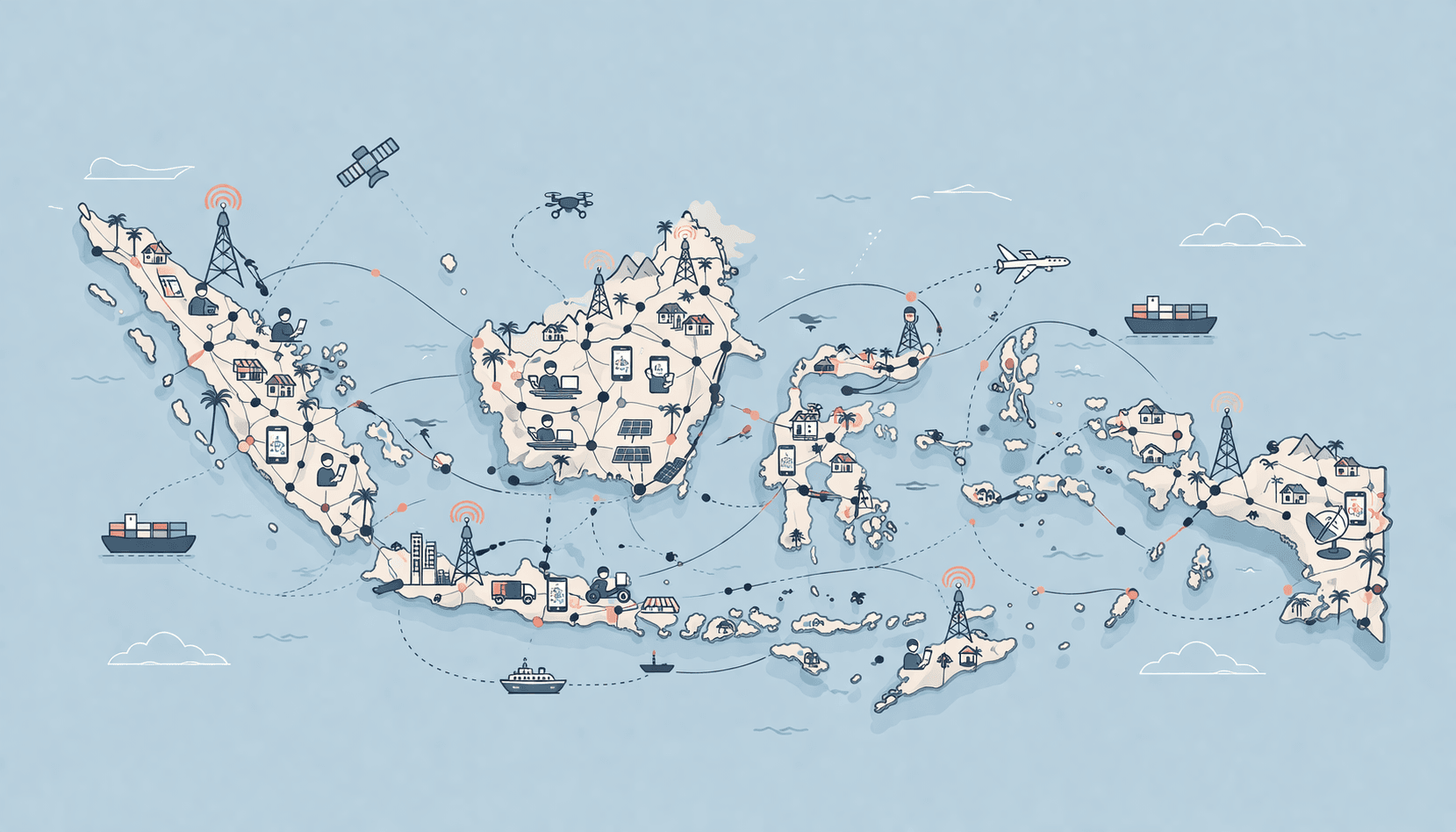
Indonesia’s digital economy is closing in on $130 billion in value, powered by 229 million internet users across an archipelago of 17,000 islands (DataReportal, 2025). With a population of 284 million — median age just 30.4 — and e-commerce GMV on track to break $100 billion by end of 2026, this is Southeast Asia’s largest digital market by every meaningful measure (Mordor Intelligence, 2026). It’s also the market where the gap between potential and execution remains widest. Geography, infrastructure, and regulatory complexity make Indonesia the hardest country in the region to scale — and the most rewarding when you do.
This overview covers every major vertical in Indonesia’s digital economy: the platforms, the payments infrastructure, the regulatory landscape, and the trends shaping the market through 2027.
How big is Indonesia’s digital economy?
Indonesia’s internet penetration reached 80.66% in 2025, with 229 million users online (APJII, 2025). Smartphone penetration sits at 86%, projected to hit 91.3% by 2028. But the averages mask a stark divide: 69.5% of internet users are in urban centres, with rural penetration at just 30.5%. The digital economy is real, but it isn’t evenly distributed.
The numbers at the top are large and growing. E-commerce GMV exceeded $75 billion in 2024 and is forecast to surpass $100 billion by 2026 (Mordor Intelligence). Indonesia contributes roughly 44% of Southeast Asia’s total e-commerce GMV — more than the next three markets combined (SellerCraft, 2026). Digital activities account for nearly 10% of national GDP, and the broader digital transformation market is valued at $29 billion in 2026, growing at 19.1% CAGR to $69.6 billion by 2031 (Mordor Intelligence).
What makes these numbers distinctive isn’t just scale — it’s the mobile-first intensity. With 121 mobile broadband subscriptions per 100 inhabitants and a median age of 30.4, Indonesia doesn’t have a desktop internet legacy. Everything was built for the phone from the start. Millennials (89.1% internet penetration) and Gen Z (87.8%) are the dominant user groups, and they’ve grown up with Shopee, GoPay, and TikTok as default infrastructure.
What role does AI play in Indonesia’s digital economy?
The adoption numbers are striking: 92% of Indonesian knowledge workers report using generative AI, and 92% of business leaders see AI as critical for competitiveness (Introl, 2025). The caveat is that 81% of companies cite poor data quality as their biggest implementation barrier. Indonesia is enthusiastic about AI but still building the data infrastructure to make it work at enterprise scale.
Investment tells a more grounded story. Indonesia attracted $542.9 million in AI startup investment by 2024, growing 141.5% over five years — ranking first in Southeast Asia for AI investment attraction with $4.6 billion between 2020 and 2024 (SecondTalent, 2026). The AI market is projected to reach $10.88 billion by 2030. Key players include Nodeflux (AI-powered video analytics for smart cities), eFishery (which became a unicorn with its Azure OpenAI-powered “Mas Ahya” aquaculture advisor), and Ruangguru (AI-personalised learning for over 22 million users).
Foreign tech companies are investing heavily. Microsoft committed $1.7 billion with plans to upskill 840,000 Indonesians and build cloud infrastructure across Java. Nvidia and Cisco joined Indosat to establish an AI centre of excellence. The government published its AI National Roadmap White Paper in July 2025, positioning Indonesia as a regional AI leader by 2030, with sector-specific regulations planned for finance, healthcare, and HR.
How advanced is Indonesia’s mobile and connectivity infrastructure?
Indonesia’s telco market is a three-player system worth $13.74 billion in 2025 (Mordor Intelligence). Telkomsel dominates with 45% subscriber share and the country’s best 5G speeds across all Opensignal categories. Indosat Ooredoo Hutchison holds 28%. The third player is a new entrant: XL Axiata completed a $6.5 billion merger with Smartfren in January 2025, forming XLSmart with 94.5 million subscribers and IDR 45.4 trillion in revenue.
5G rollout is proceeding but not at the pace of regional peers. Telkomsel operates over 3,000 5G base stations across 56 cities, but only 360 MHz of mid-band spectrum has been assigned for mobile use — less than half the APAC average of 850 MHz (GSMA, 2025). 4G is the backbone: Telkomsel achieved 97% population coverage with 4G services by end of 2024.
Android dominance is overwhelming at 86.8%, driven by affordable handsets and the e-commerce ecosystem that runs on them. Mobile data service revenue is growing at 5.3% CAGR, with 5G pilots expanding to new economic clusters around the Nusantara capital relocation. The government incentives linked to the new capital are accelerating fibre trenching and tower builds in areas that previously had limited connectivity.
Who is winning Indonesia’s e-commerce war?
Shopee retains the lead at 52% market share, but the story is TikTok Shop‘s velocity. TikTok Shop became the second-largest market globally in Indonesia with $6.2 billion GMV in 2024, recording the fastest growth of any platform in the country. Lazada achieved its first-ever monthly profit in mid-2024. Tokopedia and Shopee together capture over 60% of all online sales.
The bigger structural shift is live commerce. 60% of Indonesian online buyers now purchase through live sessions, up from near-zero three years ago. Video commerce drove 20% of online GMV in 2025, compared to less than 5% in 2022 (SellerCraft, 2026). Conversion rates for live commerce average triple those of catalogue-based listings. This isn’t a niche behaviour — it’s becoming the default shopping format for younger consumers.
Social commerce is the adjacent story. Indonesia’s social commerce market is valued at roughly $5 billion, with social platforms accounting for nearly 80% of digital transactions in 2024 (Ken Research, 2025). Live shopping and social commerce combined are projected to reach $22 billion GMV by 2028. About 25% of Indonesia’s total e-commerce volume already flows through social channels.
The combined sales picture: Indonesia’s e-commerce market is valued at $104.21 billion in 2026, growing at 15.3% CAGR to $212.58 billion by 2031 (Mordor Intelligence). Rising disposable incomes, improving logistics, and greater trust in online payments are the drivers — but the format shift from browse-and-buy to watch-and-buy is what’s reshaping how the growth actually happens.
How big is Indonesia’s digital advertising market?
Indonesia’s digital ad market generated $3.23 billion in 2025, growing to $3.41 billion in 2026 and forecast to reach $4.51 billion by 2031 at 5.7% CAGR (Mordor Intelligence, 2026). Video is the largest format at 34% of spend, reflecting the live commerce and short-video consumption patterns that define the market.
Social media is the fastest-growing ad format, boosted by the TikTok-Tokopedia merger which created a unified commerce-advertising experience. E-commerce companies are the biggest spenders, commanding 22.2% of total digital ad spend. Healthcare and pharma is the fastest-growing vertical at 5.86% CAGR.
The most significant trend is the budget migration: national advertisers moved 7 percentage points from analogue to digital between 2023 and 2025. That shift is accelerating as brands chase the attention that’s now concentrated in short-form video and livestream formats.
What does Indonesia’s gaming market look like?
Indonesia’s gaming market generated $4.28 billion in revenue in 2025, projected to reach $6.37 billion by 2033 at 8.3% CAGR (IMARC/Inkwood Research). The market is overwhelmingly mobile — smartphones are the sole gateway to digital entertainment for most Indonesians. Indonesia recorded 3.37 billion mobile game downloads in 2022, ranking third globally.
The esports scene is built around mobile titles. PUBG Mobile, Free Fire, and Mobile Legends dominate both casual play and competitive esports. The esports market reached $11.75 million in 2024, growing at 5.87% CAGR to $18.54 million by 2032 (Stellar MR). These numbers are small relative to the gaming market overall, but esports viewership and cultural relevance far exceed the direct revenue figures.
What drives the market is the combination of a young population, high mobile penetration, and rising disposable incomes. In-game spending is climbing, particularly in battle royale and MOBA genres where cosmetic purchases and battle passes are the primary monetisation models. PC and console gaming remain niche — this is a mobile-first, mobile-only market for the vast majority of players.
How does fintech work in Indonesia?
Indonesia’s fintech services market is valued at $19.15 billion in 2025, growing at 9.3% CAGR through 2033 (Trade.gov). Digital payments are surging at 17.3% CAGR toward $256.45 billion by 2030. The e-wallet ecosystem is the most competitive in Southeast Asia: GoPay leads at 88% usage, followed by DANA at 83%, with OVO and ShopeePay maintaining strong positions. Urban e-wallet usage exceeds 60% for daily purchases.
QRIS — Indonesia’s national QR code payment standard — is the infrastructure story. As of Q1 2025, QRIS recorded 56.3 million users and 2.6 billion transactions valued at 262.1 trillion rupiah ($15.6 billion), with transaction volumes surging 154.9% year-on-year. There are 38.1 million merchants accepting QRIS, 93% of which are MSMEs (Antom Knowledge, 2025). QRIS Tap, using NFC technology, gained traction since its March 2025 introduction. Bank Indonesia’s BI-FAST national real-time payment infrastructure connects over 135 banks and payment providers for 24/7 instant transfers.
BNPL is booming, particularly among Millennials and Gen Z. The market reached $8.59 billion in 2025, growing at 13.5% annually. OJK formalised BNPL licensing in December 2025 (POJK 32/2025), capping monthly interest at 0.5% and mandating 5% loan-loss coverage — a sign that the regulator sees the sector as big enough to need proper guardrails. Leading providers include Tokopedia’s Pay Later, Kredivo, and Akulaku.
Foreign ownership limits shape the market’s structure. P2P lending platforms face a 49% foreign ownership cap. Financial aggregators are capped at 85% under OJK Reg. 4/2025, with minimum paid-up capital of IDR 500 million. All are required to locate data and recovery centres in Indonesia.
Which social media and content platforms dominate in Indonesia?
Indonesia has 143 million social media user identities, equivalent to 50.2% of the population (DataReportal, 2025). The platform hierarchy: Instagram leads at 84.8% internet user penetration (173.6 million users), followed by Facebook at 81.3%, TikTok at 63.1% (108 million users aged 18+), and X at 58.3%. YouTube has the highest potential reach at 139 million users.
TikTok commands the most attention. Indonesians average 38 hours 26 minutes per month on TikTok — the highest of any platform. Overall, Indonesians spend 3 hours 17 minutes daily on social media.
The creator economy is massive and growing. Indonesia has over 12 million content creators producing up to 1 million pieces of content monthly — the highest output in Southeast Asia (Campaign Asia, 2025). The country has 3,000 YouTube channels with over 1 million subscribers, more than any other market in the region. The creator economy market is expanding from $38.5 billion in 2025 to $112.7 billion by 2031 (SociaBuzz). Creative economy exports hit $12.36 billion in H1 2024, a dramatic leap from $540 million the previous year.
This isn’t just a content story. In Indonesia, creator and commerce are deeply intertwined. The 12 million creators are increasingly the storefront — selling through live sessions, affiliate links, and branded content in a model that blurs the line between entertainment and retail.
What digital infrastructure supports Indonesia’s growth?
Indonesia is experiencing a data centre construction boom. The market is expected to reach $3.05 billion in 2025, growing to $7.11 billion by 2030 at 18.4% CAGR (Mordor Intelligence). The colocation segment alone hit $460 million in 2024, projected to reach $1.15 billion by 2030. Cloud spending is at $2.44 billion in 2025, growing at 14.5% CAGR.
The investment is coming from everywhere. Tencent committed $500 million to Indonesian digital infrastructure. Nvidia invested $200 million in a GPU centre with Indosat. BDx is building a 500MW renewable-powered AI campus. Digital Realty entered the market through a joint venture with Bersama Digital Infrastructure Asia, acquiring two data centres in Jakarta in March 2025. Batam is emerging as a promising location — cheap land, proximity to Singapore, and Special Economic Zone availability.
Indonesia is connected to approximately 57 operational submarine cables, with 10 new cables under development in 2025. New landings in Jakarta and Batam are shortening latency targets and unlocking land for hyperscale campuses.
E-commerce logistics is a market unto itself at $5.27 billion in 2025, growing to $8.56 billion by 2031 (Mordor Intelligence). J&T Express, JNE, and SiCepat each handle over 1 million daily parcels. SiCepat raised $170 million in a Series B round in March 2025 from Telkom Indonesia’s MDI Ventures, Temasek subsidiary Pavilion Capital, and Falcon House Partners. Shopee’s April 2025 switch to J&T Cargo illustrates how marketplaces are asserting leverage to renegotiate logistics fees.
What’s happening in healthtech and edtech?
Indonesia’s connected healthcare market is valued at $890 million in 2025, growing at 27.4% CAGR to $3.81 billion by 2031 (Mordor Intelligence). Telemedicine is projected to reach $2.4 billion by 2029 at 28.2% CAGR. Halodoc and Alodokter dominate, with usage rates of 46.5% and 35.7% respectively. Halodoc has grown from a basic teleconsult service to a health ecosystem serving over 20 million users, backed by a $100 million Series D that’s funding pharmacy delivery expansion and chronic-care remote patient monitoring kits.
Data interoperability is the next battleground: compliance with SATUSEHAT — Indonesia’s national health data exchange — is emerging as a decisive buying criterion for health IT solutions. Cloud platforms captured 64.9% of the connected healthcare market in 2025.
Edtech remains substantial despite the post-hype reset. Indonesia’s edtech market is valued at $3.2 billion (Ken Research, 2025). Ruangguru served over 20 million students in 2023 with 30% user growth, and has expanded into professional learning through Skill Academy. Zenius reported 25% revenue growth in 2023. The market is shifting from pure K-12 tutoring toward corporate upskilling and vocational training — a more sustainable model with clearer monetisation.
How is Indonesia’s regulatory environment shaping the digital market?
Indonesia’s Personal Data Protection Law (Law No. 27 of 2022) has been fully enforced since October 2024, with the implementing regulation currently in its fourth harmonisation process. The PDP Agency, which will formulate policy, supervise, and enforce, is targeted to be operational in 2026. Until then, enforcement remains somewhat uncertain.
Content moderation tightened significantly. The SAMAN system, piloted from October 2024, requires platforms to respond to government content removal notifications within 4 to 24 hours, with fines up to IDR 500 million per content item. Full SAMAN implementation covering all prohibited content types began in October 2025.
Social media age restrictions arrived in March 2026: Government Regulation PP TUNAS restricts “high risk” social media access for under-16s, designating YouTube, TikTok, Facebook, Instagram, X, Bigo Live, and Roblox as high-risk platforms. Platforms must deactivate underage accounts or implement robust age verification.
Fintech regulation is detailed and prescriptive. OJK and Bank Indonesia share supervision under Law 4/2023. Foreign ownership caps at 49% for P2P lending and 85% for financial aggregators. BNPL licensing (POJK 32/2025) caps interest rates and mandates loan-loss provisions. Data localisation is required for aggregators.
AI regulation is still forming. The government published draft national AI ethics guidelines in 2025, with a formal Presidential Regulation planned. The approach is lighter-touch than Vietnam’s standalone AI law — a self-assessment mechanism empowers developers while maintaining regulatory oversight.
What should you watch over the next 12 to 18 months?
Three dynamics will define the next phase.
First, live commerce as the new default. Video commerce went from 5% to 20% of online GMV in three years. With 60% of buyers purchasing through livestreams and conversion rates tripling catalogue listings, the question isn’t whether this trend continues — it’s whether traditional marketplace search-and-browse interfaces become structurally disadvantaged. Brands that haven’t built live commerce capabilities by end of 2026 are falling behind.
Second, the infrastructure catch-up. Indonesia has the demand (229 million internet users, $100 billion e-commerce) but the supply side — data centres, submarine cables, cloud capacity, last-mile logistics — is only now being built to match. The $500 million Tencent commitment, $200 million Nvidia GPU centre, and Google/AWS/Alibaba data centre builds are all 2025–2027 deliverables. When this capacity comes online, it unlocks use cases (AI inference, real-time personalisation, same-day delivery outside Java) that the current infrastructure can’t support.
Third, regulatory clarity versus regulatory burden. Indonesia is simultaneously enforcing a new data protection law, implementing content moderation with fines, restricting social media for minors, licensing BNPL, and drafting AI ethics guidelines — all within a 12-month window. Whether this reads as mature digital governance or regulatory overload depends entirely on execution. The PDP Agency’s operationalisation in 2026 is the single most important test: if enforcement is predictable and proportionate, it builds confidence. If it isn’t, foreign investment decisions slow down.
Indonesia’s digital economy is growing at 15–19% annually with 284 million people, a median age of 30, and a government that’s actively building the regulatory and physical infrastructure to sustain that growth. The scale is there. The question has always been execution — across 17,000 islands, that’s never been simple. But the trajectory points one direction.
