
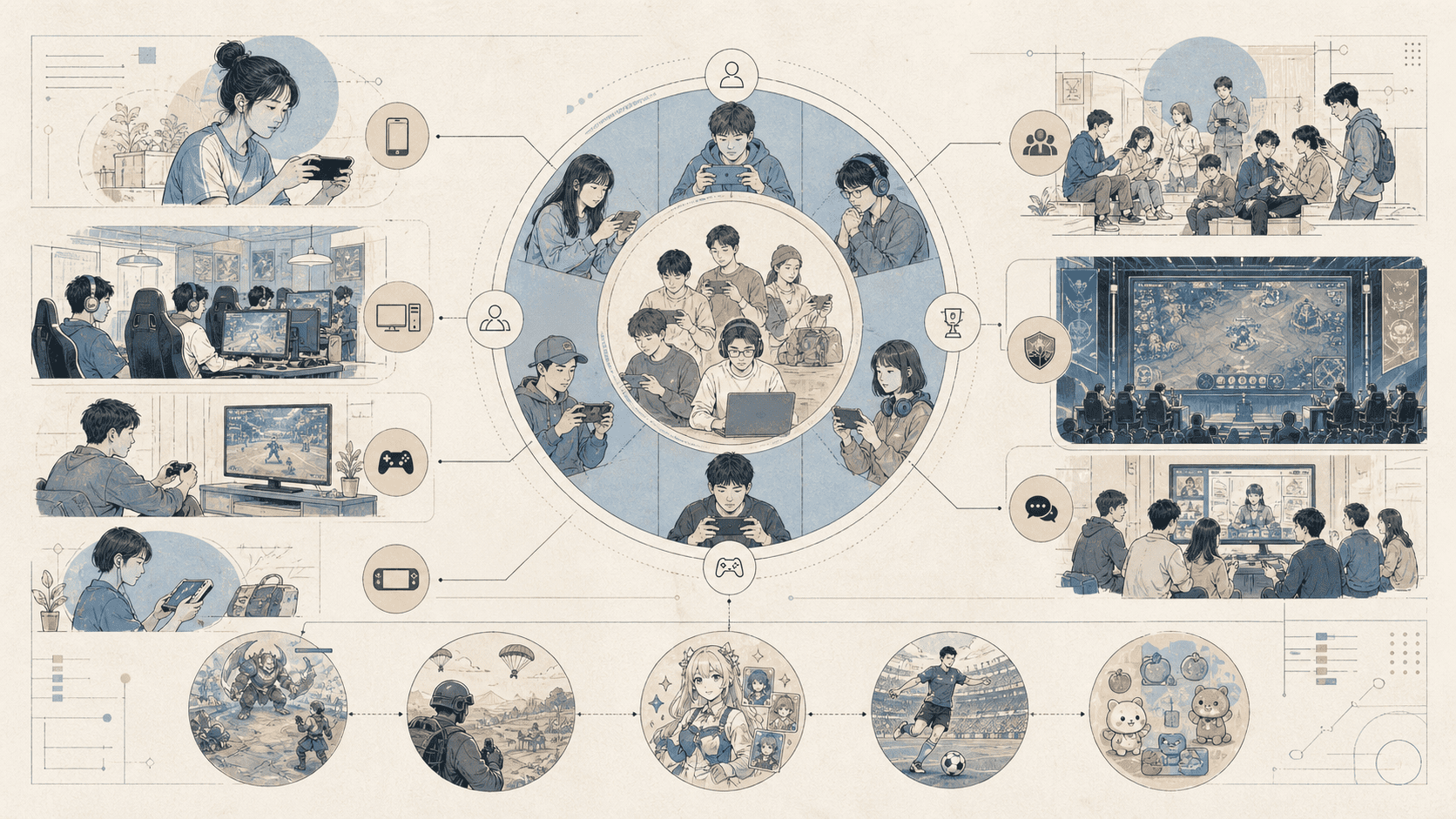
In October 2025, Honor of Kings hit 139 million daily active users in China — more daily consumer engagement than the FIFA World Cup has across an entire month-long tournament. Mobile Legends: Bang Bang, the regional MOBA built for Southeast Asia, has 130+ heroes and a competitive league structure spanning the Philippines, Indonesia, Malaysia, Singapore, Cambodia, and Myanmar. League of Legends has held the top spot in Korean PC bangs (the country’s iconic gaming cafés) for 323 consecutive weeks. T1, the Korean LoL team built around the player Faker, has won the Worlds championship five times and trades in transfer markets with serious six-figure deals. The biggest games in Asia aren’t just popular — they’re cultural infrastructure. People play them at lunch, after school, on the train, in cafés, at family gatherings. Gaming is the dominant entertainment activity for most of the Asian population under 40.
This is a guide to what those games are, market by market, and what each market’s gaming culture looks like in practice. It’s the consumption side of the story. Who builds these games, where the money flows, and how the production economics work — that’s the gaming monetisation tracker we’ll publish next. This piece is about what people actually play.
The picture is regionally textured in ways that don’t always come through in global rankings. Honor of Kings dominates China but isn’t even available everywhere in Asia. Mobile Legends dominates SEA but not Korea or Japan. League of Legends is the cultural touchstone of Korean gaming but a much smaller force in SEA. Pokemon Legends: Z-A sold over 2.5 million physical copies in Japan in 2025 but is barely visible in Indonesia or Vietnam. Cricket games are a meaningful genre in India and almost nowhere else. The MOBA Belt of Southeast Asia — six countries where Mobile Legends is the cross-market default — has no real parallel anywhere outside Asia. The consumption picture is fragmented in ways the production picture (covered in DIA’s gaming monetisation tracker) is not.
This is a working tracker of what fifteen Asian markets actually play, why those games dominate, where people play them, and how each market’s gaming culture has its own distinctive shape.
The Asia Gaming Master Comparison
The headline reference. Total gamers per market, gaming penetration of internet users, and top three titles by active player count or cultural prominence.
Notes on methodology. Total gamers includes mobile, PC, and console gamers, drawn from Newzoo Global Gamer Study, Statista Research Department, Sensor Tower country-level reports, Niko Partners’ 2025 Asia & MENA market models, and government-affiliated industry bodies (Indonesia’s Ministry of Communication and Information, Vietnam’s Ministry of Information and Communications, etc.). Where credible sources span a range, we’ve used the upper-credible end consistent with industry reporting standards rather than the most conservative analyst estimate. Penetration is calculated as total gamers ÷ internet users — controlling for digital infrastructure access. Title-level active player figures use the best available metric per format: DAU for free-to-play mobile titles; MAU where DAU isn’t public; PC bang playtime share for Korea; physical sales for Japan’s console anchors. SEA national MLBB MAUs draw from Sensor Tower 2024 country breakdowns triangulated against Moonton’s 110M global MAU disclosure and IconEra/Buffget tracker data through November 2025.
| Market | Internet Users | Total Gamers | Penetration | #1 Title (Active Players) | #2 Title (Active Players) | #3 Title (Active Players) |
|---|---|---|---|---|---|---|
| Mainland China | 1.30B | 722M | 56% | Honor of Kings (139M China DAU, Oct 2025) | Game for Peace (50M DAU) | Honkai: Star Rail (~30M global MAU, 36% from China) |
| Hong Kong | 7M | 5.5M | 79% | League of Legends (PCS tier; $104 annual ARPU — highest in Asia) | Honor of Kings + Genshin Impact (gacha-strong, multi-rail) | PUBG Mobile / Switch 2 / PS5 mix |
| Japan | 110M | 75M | 68% | Pokemon TCG Pocket (~17M Japan MAU est., 45% of 39M global MAU) | Monster Strike (~10M Japan MAU est., $290M H1 2024) | Mario Kart World (2.67M Switch 2 sales, 2025) |
| South Korea | 50M | 37M | 74% | League of Legends (36% PC bang share, 323-week streak) | FC Online (9% PC bang share) | PUBG / Battlegrounds (8.4% PC bang share) |
| Taiwan | 22M | 17M | 77% | League of Legends (PCS tier, $94 ARPU — second highest in Asia) | Honkai: Star Rail / Genshin Impact (gacha-strong) | Switch 2 / PS5 console |
| Vietnam | 80M | 65M | 81% | Garena Liên Quân Mobile (top mobile MOBA; AoG one of Asia’s most-watched circuits) | Free Fire / Free Fire MAX | PUBG Mobile VN |
| Indonesia | 212M | 175M | 83% | Mobile Legends: Bang Bang (35M+ MAU, Sensor Tower 2024) | Free Fire (Indonesia among top global markets of 130M MAU) | Honor of Kings (post June 2024 SEA relaunch — top of Indonesian Google Play) |
| Thailand | 63M | 45M | 71% | Free Fire / Free Fire MAX (Thailand top-three Free Fire market) | RoV / Arena of Valor (Thailand’s signature mobile MOBA) | Mobile Legends: Bang Bang (5M+ MAU) |
| Philippines | 97.5M | 80M | 82% | Mobile Legends: Bang Bang (15M+ MAU, regional est. “tens of millions”) | Free Fire (Philippines top-three global Free Fire market by spending) | PUBG Mobile / ROBLOX |
| Singapore | 5.7M | 4.5M | 79% | Mobile Legends: Bang Bang (1M+ MAU; smallest national MLBB esports market) | Genshin Impact / Honkai: Star Rail (high ARPU) | Console / PC (Switch 2, PS5 — multi-rail) |
| Malaysia | 32M | 24M | 75% | Mobile Legends: Bang Bang (10M+ MAU) | Free Fire (Malaysia top-five Free Fire market) | Honor of Kings (MKL launched 2025) |
| India | 1.03B | 591M | 57% | Free Fire MAX (India 40-60M MAU, 10-15M DAU; tier-2/3 dominant) | Battlegrounds Mobile India (BGMI ~10-15M DAU current; 16M DAU peak; 34M+ registered) | Real Cricket 22 / EA Sports cricket (India’s distinctive vertical genre) |
| Cambodia | 14M | 10M est. | 71% | Mobile Legends: Bang Bang (M7-qualifying via MPL KH) | Free Fire | PUBG Mobile |
| Bangladesh | 80M | 40M | 50% | Free Fire MAX | PUBG Mobile / BGMI (India cross-spillover) | Mobile Legends: Bang Bang |
| Myanmar | 28M | 15M | 54% | Mobile Legends: Bang Bang (M7-qualifying via MSL Myanmar) | Free Fire | PUBG Mobile |
Five cross-market patterns are visible in the data.
First, gaming penetration of internet users is genuinely high across most of Asia. Top-tier penetration (above 75%): Indonesia (83%), Philippines (82%), Vietnam (81%), Hong Kong (79%), Singapore (79%), Taiwan (77%), Malaysia (75%). In these markets, gaming is genuinely mass digital behaviour — four out of every five internet users play games. Indonesia is the headline number at 175M gamers, but Vietnam at 65M / 81% penetration and the Philippines at 80M / 82% are equally striking. Strong-tier (65-75%): Korea (74%), Cambodia (71%), Thailand (71%), Japan (68%). Mature gaming markets where penetration has plateaued at high but not universal levels. Mid-tier (50-65%): China (56%), India (57%), Myanmar (54%), Bangladesh (50%). China and India both sit here despite their gaming populations being the world’s two largest in absolute terms — a function of sheer internet user base size rather than cultural penetration weakness. India’s 591M gamers represent a market larger than any single SEA country plus Korea plus Japan combined.
Second, the headline scale comparison: China’s Honor of Kings has more daily active users in China alone (139M) than Korea, Japan, and Vietnam have gamers combined (177M total — and that’s MAU vs DAU comparison). Honor of Kings’ single-day Chinese player base exceeds the entire Korean gaming population (37M) by nearly 4x. The single Chinese mobile MOBA represents a player base larger than any individual Asian country’s total gaming market outside China and India.
Third, the SEA MOBA Belt is the most coordinated regional gaming pattern globally. Mobile Legends has 35M+ MAU in Indonesia, 15M+ in the Philippines, 10M+ in Malaysia, 5M+ in Thailand, 1M+ in Singapore, plus M7-qualifying esports presence in Cambodia and Myanmar. Six to seven SEA markets share Mobile Legends as a top-three mobile game with cross-market esports infrastructure (MPL Indonesia/Philippines/Malaysia franchises, M7 World Championship, SEA Games medal event). Across these markets that’s roughly 350M gamers with shared MOBA-Belt cultural infrastructure. No other game in any other regional cluster — globally — has this kind of cross-border player density and infrastructure integration.
Fourth, the gap between #1 and #2 titles tells different stories about each market’s competitive structure. Korea’s LoL at 36% PC bang share with #2 (FC Online) at 9% is a 4x gap — extreme winner-take-all dynamics, and LoL has held that gap for 323 consecutive weeks. China’s Honor of Kings at 139M DAU vs Game for Peace at 50M DAU is a 2.8x gap — concentrated but with a credible #2. Indonesia’s MLBB at 35M+ MAU vs Free Fire (still tens of millions of Indonesian players within the 130M global MAU base) is a tighter ratio — competitive but MLBB-led. India’s Free Fire MAX at 40-60M MAU vs BGMI at ~10-15M DAU represents the cleanest two-game duopoly in any major Asian market. Hong Kong, Singapore, Taiwan are the most multi-rail markets — gacha + console + PC + mobile MOBA all coexist without a single dominant title.
Fifth, the per-user revenue gradient runs in the opposite direction to the gamer-count gradient. Hong Kong leads Asia at $104 annual mobile gaming ARPU; Taiwan at $94; Korea at $68. The mass-scale markets (India, Indonesia, Philippines) operate at substantially lower per-user spending. Niko Partners’ 2025 East Asia ARPU figures put Korea at $30.77 — the highest among Asian markets they track — and Japan at $21.82. SEA-6’s $18.8 average ARPU (2024) is roughly half of Korea’s. The result: a 100M+ MAU mass-scale title in India can generate less revenue than a 5M MAU title in Korea or Japan. The implications for which markets reward which monetisation strategies are direct — and we’ll explore them in detail in the gaming monetisation tracker.
The Five Pillars of Asian Gaming Culture
Standard Western framings of gaming — console-PC duopoly, AAA blockbuster releases, individual single-player narrative experiences, esports as adjacent to mainstream culture — translate badly to Asian gaming consumption. Five structural features shape the regional reality.
Esports is mainstream, not niche. League of Legends in Korea fills the LoL Park stadium and sells tickets out within hours. Mobile Legends in the Philippines has players who are A-list celebrities, with national team gold medals at the SEA Games (2022, 2025). Honor of Kings in China runs the KPL with $10M+ prize pools. Vietnam’s Arena of Glory esports circuit had MLBB-comparable viewership in 2025. Across most of Asia, professional gaming sits inside mainstream sports media coverage, with team transfers, contract negotiations, and individual player celebrity treated identically to football or basketball. A British gamer might play League of Legends; a Korean gamer reads about Faker’s contract extension in newspapers. The relationship to esports is fundamentally different.
Live ops culture follows local cultural moments. Lunar New Year skin drops in China. Songkran events in Thailand. Eid events for Indonesia, Malaysia, and Bangladesh. Diwali events for India. Honor of Kings released five Tiger-themed skins for the 2026 Year of the Tiger. The cultural integration runs deeper than Western live-service equivalents — these aren’t seasonal cosmetics tacked onto existing games, they’re often structurally tied to how the games communicate with their player base across regional cultural cycles. For non-Asian operators trying to enter Asian markets, missing the live-ops cultural calendar is one of the most common ways to fail.
Where people play matters as much as what they play. Korean PC bangs (지방 PC방). Vietnamese internet cafés (quán net). Indonesian warnet (warung internet). Filipino computer shops. Cambodian internet shops. These aren’t dying-out venues — Korea’s PC bangs still logged 780 million hours of usage in 2025 (down 6% YoY but still extraordinary scale), and Vietnam’s quán net market is large enough that PC hardware adoption growth (14.4% projected CAGR through 2030) is downstream of café gaming. Where gaming happens shapes what gets played and how — PC bangs reward team play (LoL, Valorant, Battlegrounds). Cybercafés keep PC titles relevant in markets where personal hardware is expensive.
Gender balance is real but variable. Asian mobile gaming is meaningfully more gender-balanced than Western console gaming, but with sharp variation. Vietnam: 57% male, 43% female (mobile). Indonesia: closer to 50/50 mobile gaming, particularly in the casual genre. Korea: roughly 50/50 in mobile, more male-skewed in PC competitive titles. Japan: gacha and Pokemon gaming notably gender-balanced. India: heavily male-skewed (battle royale dominance). Female gamers in Asian markets spend approximately 8.5% more monthly than men in some segments — meaningful for monetisation. Gaming as a culturally male activity is much less true in most Asian markets than the Western default assumption suggests.
Streaming and viewing is a parallel ecosystem, not a side activity. Bilibili in China. Twitch and YouTube Gaming in Korea, Japan, and Taiwan. AfreecaTV (now SOOP) for Korean gaming streamers. Garena Streams in SEA. Game streamers across Asia have audience scales that compare favourably with film and TV stars — Korean LCK casters are recognised celebrities; Chinese Bilibili gaming creators have follower counts in the tens of millions; Filipino MLBB streamers anchor major brand campaigns. The consumption of gaming as spectator content is structurally different from the Western pattern where Twitch viewing and game playing are roughly the same audience. In Asia, the audiences overlap but viewing is a much larger total addressable market.
The combination produces a regional gaming culture that operates on different foundations from Western gaming markets — different platforms (mobile-led with PC and console as secondary), different formats (MOBA-dominant with battle royale and gacha as the main complements), different venues (cafés as much as homes), and different relationships to esports (mainstream sport rather than niche entertainment).
Mainland China: Honor of Kings, Game for Peace, and Black Myth’s Cultural Moment
China is the world’s largest gaming market by player count — around 722 million Chinese gamers, roughly half the population — and the most distinctive in regulatory and cultural terms. The National Press and Publication Administration (NPPA) controls game licensing through ISBN approvals; foreign games face 6-12 month review processes; minor playtime is capped at 3 hours per week; and Tencent and NetEase together command the lion’s share of mobile gaming traffic. Within these constraints, China has built the world’s most concentrated mobile gaming ecosystem.
Honor of Kings (王者荣耀) is the central title. Developed by Tencent’s TiMi Studio Group, released 2015, it reached 139 million daily active users in China by October 2025 and 260 million global monthly active users. It generated $1.7 billion in IAP revenue in 2025 alone, $13 billion in lifetime revenue, and remains the highest-grossing mobile game of all time. The game integrates with WeChat’s social graph, hosts limited-edition skins (one Zhao Yun general skin reportedly earned $22M in a single day), runs the King Pro League (KPL) with $10M+ prize pools, and collaborates with major celebrities — JJ Lin, Lionel Messi, Lee Chong Wei. In January 2025, NPPA approved Honor of Kings: World, an open-world action RPG spinoff currently in development. Honor of Kings isn’t just popular — it’s culturally embedded the way football clubs are in Britain or baseball in Japan.
Game for Peace (和平精英) — Tencent’s Chinese-licensed PUBG Mobile equivalent — has 50 million daily active users and remains the dominant battle royale in China. Like Honor of Kings, it operates inside the Tencent ecosystem with deep WeChat integration and a major esports league structure.
Black Myth: Wukong (黑神话:悟空) is China’s first AAA console-grade game and represents a structural shift in Chinese gaming. Released August 2024, it sold 10 million copies in three days and accumulated 2.2 million concurrent Steam players at launch — a record exceeding Elden Ring and Cyberpunk 2077. Black Myth’s cultural moment was significant: Chinese gaming had been mobile-first for over a decade, and Black Myth proved that Chinese studios could compete globally in console AAA development. The Honor of Kings: World release planned for 2026 will test whether the Black Myth playbook can be repeated.
Other significant titles: Genshin Impact (miHoYo, $335M IAP 2025), Honkai: Star Rail (miHoYo, $423M), CrossFire mobile (Tencent), Naruto Mobile, MapleStory M, Mobile Legends: Bang Bang (re-entered China April 2023 as 决胜巅峰, generated 4M+ downloads in days). Tencent and NetEase between them publish or own most of the top 20 mobile games. Foreign games that succeed in China (League of Legends, Honor of Kings: Arena of Valor variants) typically do so through Tencent partnership.
Esports infrastructure is the most developed in Asia. KPL (Honor of Kings), League of Legends Pro League (LPL), Game for Peace Pro League. Tencent invested $15M in 2025 to expand Honor of Kings esports leagues internationally — to the Philippines (PKL), Malaysia (MKL), Indonesia (IKL), and beyond. Chinese esports teams trade in transfer markets that look like top-tier European football clubs.
Where people play: Mobile is dominant, but PC gaming retains structural importance through internet cafés (网吧) and dedicated PC users. Console gaming is constrained by NPPA approval requirements; foreign consoles (PlayStation, Xbox, Switch) are available but operate at scale far below Japanese or Korean consumption.
For non-Chinese audiences trying to understand China’s gaming culture: imagine a country where the most-played game is more popular than any sport, where esports celebrities have follower counts rivalling pop stars, where the central social messaging app (WeChat) is also the main gaming distribution platform, and where regulatory licensing decides which games even reach the market. That’s China.
Hong Kong: A Hybrid Market Without a Single Dominant Title
Hong Kong’s gaming culture mixes Cantonese, mainland Chinese, and international influences in a way that produces a more fragmented landscape than mainland China. The market is small (~7M population) but commercially developed. PUBG Mobile, League of Legends, Mobile Legends: Bang Bang, Honor of Kings, Genshin Impact, and Switch / PS5 console gaming all hold meaningful share without any single title dominating.
Hong Kong’s esports scene runs at smaller scale than the mainland or Korea. The League of Legends Hong Kong-Taiwan League has historical roots; the Pacific Championship Series (PCS) covers both Hong Kong and Taiwan. MLBB has a Hong Kong tournament structure but smaller than Indonesia or Philippines. Honor of Kings is available in Hong Kong (separately licensed from mainland) but doesn’t have the same cultural dominance.
Console gaming is more present in Hong Kong than mainland China, though still smaller than Japan or Korea. Switch 2, PS5, and Xbox Series X|S all sell in Hong Kong; Japanese RPGs and Western AAA titles have meaningful audiences.
For operators: Hong Kong is a small, sophisticated multi-platform market where the right answer is multi-rail. There’s no equivalent of Mobile Legends in the Philippines or Honor of Kings in mainland China — no single must-integrate title. The structural distinction from mainland China runs through gaming the way it runs through almost every other digital vertical.
Japan: Console Gaming Still Mainstream, Mobile Gacha Dominant
Japan is the only Asian market where console gaming retains real cultural prominence in 2026. Nintendo Switch 2 sold 3.78 million units in Japan in 2025 alone (despite supply scarcity), with the original Switch family adding 1.52 million more. PS5 sold 879K. Xbox Series X|S sold 31K — basically a rounding error. The combined Switch and Switch 2 install base in Japan is now approaching 40 million units, anchored by Nintendo’s first-party portfolio.
Top-selling Japan games of 2025 (physical sales, Famitsu data): 1. Mario Kart World (Switch 2) — 2,668,381 2. Pokemon Legends: Z-A (Switch) — 1,529,823 3. Pokemon Legends: Z-A Switch 2 Edition — 1,004,154 4. Monster Hunter Wilds (PS5) — 838,319 5. Super Mario Party Jamboree (Switch) — 498,397
The pattern: Nintendo first-party + Pokemon + Monster Hunter is the cultural anchor. Pokemon Legends: Z-A’s combined sales across both Switch versions hit 2.5M+ in two months from October 2025, demonstrating that Pokemon’s Japan dominance hasn’t waned. Monster Hunter Wilds was the highest-grossing PS5 title of 2025 in Japan but didn’t break 1M sales — Japanese console gaming is concentrated in Nintendo’s ecosystem.
Mobile gaming still represents 55.21% of Japan’s video game revenue, larger than console in dollar terms but secondary in cultural prominence. The mobile market is gacha and IP-driven. Top performers in 2025:
- Pokemon TCG Pocket — top revenue in Japan; card battler genre saw 305% YoY growth driven largely by this title
- Monster Strike (Mixi) — long-running flagship gacha, multiplayer team-based
- Fate/Grand Order (Aniplex) — gacha RPG with deep narrative depth
- Last War: Survival (FunFly/FirstFun) — 4X strategy, crossing into Japan from Chinese developer (Japan was its second-largest market with $294M IAP in 2025)
- Whiteout Survival (Century Games) — same Chinese 4X strategy genre, similar performance pattern
- Umamusume: Pretty Derby (Cygames) — horse-girl racing/idol training, anime-aesthetic
- Dragon Quest Walk — AR location-based RPG, mainstream Japanese audience
Esports is smaller in Japan than Korea, China, or SEA. Japan’s MLBB scene returned to the M World Championship for the first time since M2 in 2026. PUBG Mobile esports has Japanese representation. League of Legends has a domestic league but smaller than LCK. Pokemon Worlds is the major cultural esports anchor — Pokemon competitive play has its own distinct ecosystem.
Where people play: Home console gaming is more prominent in Japan than anywhere else in Asia. Mobile gaming is everywhere but less culturally central than in other Asian markets. PC gaming is a distinct minority. Arcades remain a viable format particularly for fighting games and rhythm games — Japan’s arcade culture is the world’s most preserved.
For operators: Japan is the Asian market where the right answer is “build for Switch and PlayStation if you can, gacha mobile if you can’t.” Japanese players are loyal, high-ARPU, and conservative — established IP wins (Pokemon, Final Fantasy, Monster Hunter, Mario, Yakuza). New IPs face structural disadvantages.
South Korea: League of Legends’ 323-Week Streak and the PC Bang Empire
Korea’s gaming culture is the most professional in Asia and the most concentrated around PC competitive titles. The country has 96% smartphone penetration and ~50 million internet users, but PC bangs (PC방) — gaming café venues that emerged from the late-1990s economic crisis — remain the cultural infrastructure of competitive gaming. Korea’s PC bangs logged 780 million hours of usage in 2025, down 6% YoY but still operating at a scale that has no parallel anywhere else.
League of Legends is the central Korean game. LoL has held the #1 spot in Korean PC bangs for 323 consecutive weeks — over six years. In 2025, LoL accounted for 36.01% of total PC bang playtime, more than the next four games combined (FC Online 9.06%, Battlegrounds/PUBG 8.42%, Valorant 8.03%, MapleStory 5.43%). Among teenagers (10-19), Valorant has emerged as the leader at 34.44% — Riot Games’ Korean portfolio runs deep. MapleStory had a moment in December 2025 with its Hot Time event, hitting 45.07% market share on December 21 — the first time MapleStory had topped the chart in 22 years.
The LCK (League of Legends Champions Korea) is the top-tier Korean LoL league. Franchised in 2021 (eliminating relegation, raising sponsorship, professionalising team operations). T1 — the team built around Lee “Faker” Sang-hyeok — has won the World Championship five times (2013, 2015, 2016, 2023, 2024), with their fifth Worlds title in November 2024 cementing T1 and Faker as Korean cultural icons in the way Lionel Messi is in Argentina or Michael Jordan was in 1990s America. Gen.G (formerly Samsung Galaxy), KT Rolster, and Hanwha Life Esports round out the major Korean LoL franchise teams. Korean LCK matches sell out LoL Park (the dedicated 400-seat stadium) within hours; Worlds finals viewership in Korea routinely exceeds 1M concurrent viewers.
Mobile gaming is enormous in Korea but culturally secondary to PC competitive gaming. Top mobile titles in 2025 include Last War: Survival ($153M Korea IAP), MapleStory M, Lineage M / W (NCSoft’s mobile MMORPG flagships), Honkai: Star Rail (miHoYo), and Genshin Impact. The mobile market is high-ARPU and concentrated around Korean MMORPG-style gameplay (long progression curves, deep monetisation).
Other PC games in the top 20 (2025 PC bang data): Sudden Attack (Nexon FPS, 5.15%), Overwatch 2 (4.55%), Dungeon & Fighter (4.29%), Lost Ark (3.25%), StarCraft (still showing in the top 10 — yes, in 2025), Maple Story 2.
Esports infrastructure is the world’s most developed for PC titles. Major training houses, professional coaches, sports psychologists, contract negotiations covered by mainstream Korean media. Korean LoL, Valorant, PUBG, and StarCraft players have been recruited by international teams as a default talent pipeline for nearly two decades.
Where people play: PC bangs remain culturally and commercially central. The standard Korean PC bang offers high-end gaming PCs (RTX-tier GPUs), low-ping connections to Korean game servers, in-game bonuses (extra XP for LoL, free champions), comfortable seating, food and drink service, and 24-hour operation. Pricing is around ₩1,000-2,000 per hour — cheaper than building a comparable home rig. Korean cities are saturated with PC bangs the way Japanese cities are saturated with convenience stores.
For operators: Korea is the Asian market where the answer is “build for PC competitive (LoL, Valorant, FPS) first, mobile MMORPG second, and recognise that PC bangs are the cultural infrastructure your title needs to be relevant in.” Console gaming is much smaller than in Japan — Korea is functionally a PC + mobile market.
Taiwan: A Hybrid Market Bridging Japan, China, and the West
Taiwan’s gaming culture mixes Japanese console sensibility, mainland Chinese mobile preferences, and Western AAA exposure. The market is small (~24M population) but commercially developed. League of Legends has strong PC presence, Mobile Legends and Honor of Kings have mobile presence, gacha titles (Genshin Impact, Honkai: Star Rail, Pokemon TCG Pocket) are popular, and console gaming (Switch, PS5) is meaningful.
League of Legends is well-established in Taiwan through the Pacific Championship Series (PCS), which covers Taiwan and Hong Kong. PCS sits in the second tier of LoL leagues globally (below LCK, LPL, LCS, LEC) but produces competitive teams that regularly qualify for international tournaments.
Mobile gaming in Taiwan trends toward Japanese-style gacha and mainland Chinese mobile titles. Last War: Survival had Taiwan as a top-five market in 2025 ($40M IAP). Gacha games from miHoYo (Genshin Impact, Honkai: Star Rail, Zenless Zone Zero) have meaningful Taiwanese audiences. LINE Pop and Japanese-style casual titles also retain share.
Console gaming is more prominent in Taiwan than mainland China but smaller than Japan. Switch and PS5 are widely available; Western AAA titles (Cyberpunk 2077, Elden Ring, Black Myth: Wukong) have larger Taiwanese audiences than mainland China or Korea proportionally.
Where people play: Taiwanese gaming culture is more home-centric than Korean or Vietnamese — PC bang equivalents exist but at smaller scale than Korea. Mobile is the dominant platform for everyday play.
For operators: Taiwan is a small but valuable market that rewards multi-rail support. The hybrid Japan / China / West gaming sensibility means most major Asian and Western titles can find an audience.
Vietnam: Internet Cafés, Liên Quân Mobile, and an Esports Culture Punching Above Its Weight
Vietnam’s gaming culture is shaped by mobile-first consumption (86.6% of Vietnamese gamers play on mobile, Android dominant at 84% of installs) layered over a deep internet café (quán net) culture that originated in the early 2000s. The country has the highest esports awareness in SEA — 94% of Vietnam’s population is aware of esports, 59% watch regularly, compared to a 32% SEA average. DIA covered the Vietnam gaming market deeply in Vietnam’s Gaming Market in 5 Data Points.
Garena Liên Quân Mobile (Arena of Valor) is Vietnam’s top mobile MOBA. Arena of Valor — Tencent’s international Honor of Kings variant — sits at the centre of Vietnamese mobile competitive gaming. The Arena of Glory professional league is one of Asia’s strongest esports circuits: when Saigon Phantom and Team Flash met in the Arena of Glory Spring 2025 group stage, viewership peaks rivalled the LCK in Korea.
Free Fire and Free Fire MAX are the dominant battle royale titles. Free Fire MAX has 620M+ global downloads with Vietnam as a major market.
PUBG Mobile (PUBG Mobile VN) is published in Vietnam through VNG Corporation, in partnership with Tencent’s LightSpeed Studios.
League of Legends is published by VNG (Riot’s exclusive Vietnamese partner), with strong PC café presence.
Other significant titles: Coin Master (top grossing in Vietnam in 2025), Free Fire x Naruto Shippuden crossover, Roblox VN, Last War: Survival VN, Rise of Kingdoms.
Vietnamese-developed mobile games are now meaningful — 4,045 Vietnamese-developed games were live on Google Play as of February 2025, with cumulative downloads of Vietnamese-developed mobile games reaching 4.2 billion from 2019 to early 2024. Studios like iKame Global, ABI Games, and Amanotes have export-driven growth (Vietnamese game exports went from $315M in 2024 to a projected $430M in 2025 — 36.4% YoY). NCSOFT’s $103.8M acquisition of Indygo Group in Q4 2025 was the largest disclosed Vietnamese gaming M&A. The production side belongs in the gaming monetisation tracker; the consumption side reflects how Vietnamese audiences increasingly play Vietnamese-developed games.
Where people play: Internet cafés (quán net) charge approximately ₫5,000 ($0.20) per hour for high-spec PC access, training a generation of Vietnamese gamers on hardware specs they couldn’t afford at home. The PC hardware market is forecast for 14.4% CAGR through 2030 as rising household incomes convert café familiarity into home rig investment. Mobile is dominant for daily play; PC for competitive sessions; console gaming is a small minority.
For operators: Vietnam is a strong-fit market for mobile MOBA, battle royale, and 4X strategy titles. The esports awareness rate (94%) is structurally rare — Vietnamese audiences engage with competitive gaming as mainstream entertainment, which makes the market unusually deep for esports-anchored business models.
Indonesia: The Centre of the MOBA Belt
Indonesia is the largest Mobile Legends market globally and one of the most concentrated mobile gaming markets in Asia. The country’s 277 million population, smartphone penetration above 80%, and young demographic structure (median age 30) create the largest single MLBB national audience. MPL Indonesia is the most-watched MLBB league globally — Season 15 hit 1.84 million peak concurrent viewers in Q1 2025, second only to League of Legends’ LCK Cup in global esports viewership for the quarter.
Mobile Legends: Bang Bang is culturally embedded in Indonesia in a way few games are anywhere globally. The game has 130+ heroes, MPL franchise leagues (MPL Indonesia is one of three franchised MLBB leagues alongside Philippines and Malaysia, with the M7 World Championship hosted in Jakarta in January 2026), and player celebrity culture. Bigetron Esports — one of Indonesia’s most decorated organisations — was acquired by Team Vitality (a major European esports organisation) in May 2025 and rebranded to Bigetron by Vitality. Saudi Arabian organisations Team Falcons and Twisted Minds also bought into Indonesian MLBB rosters.
Free Fire has historically had a strong Indonesian presence; market share has shifted toward MLBB and other titles in 2024-2025.
Honor of Kings launched its Indonesian league (IKL — Indonesia Kings Laga) in 2025 as part of Tencent’s $15M international expansion. The IKL is the structural challenger to MLBB’s regional dominance, though MLBB’s incumbency advantage in Indonesia is substantial.
PUBG Mobile retains meaningful share among battle royale fans.
Other significant titles: Genshin Impact, Honkai: Star Rail, Roblox (large Indonesian audience), gacha and casual games (Coin Master, Candy Crush).
Esports infrastructure is among the most developed in SEA. MPL Indonesia is franchised. The MLBB SEA Games 2025 medal event saw the Philippines men’s team win gold, with Indonesia in close pursuit. Indonesia’s mobile esports broadcasting infrastructure (regional partnerships with Garena, Moonton’s Moonton Studios) creates a scaled live-event infrastructure rare in similarly-sized markets globally.
Where people play: Indonesian gaming is mobile-first (overwhelming majority of play) with warnet (warung internet — internet cafés) retaining a meaningful but declining role. Console gaming is a small minority. Live mobile esports viewing is genuinely mainstream — Indonesian YouTube and Facebook are saturated with MLBB streaming content.
For operators: Indonesia is the must-integrate Asian market for mobile MOBA. The MPL Indonesia ecosystem represents the highest-engagement mobile esports audience in Asia. Localisation matters — the Indonesian MLBB community has developed its own player nicknames, slang, and meta conventions that feel domestic rather than imported.
Thailand: Free Fire Strong, RoV Persistent, and Roblox’s Rise
Thailand’s gaming market is mobile-first with strong battle royale and MOBA penetration. Free Fire MAX has substantial Thai audiences. RoV (Realm of Valor — Tencent’s international Arena of Valor variant) has historic strength in Thailand though mainland Chinese Honor of Kings dominance has reshaped the regional MOBA picture. Roblox has grown significantly in 2025, particularly among younger Thai audiences.
Free Fire / Free Fire MAX has been one of Thailand’s dominant mobile battle royales. The Free Fire World Series has had Thai team representation; the monetisation model (cosmetic-led, low-friction) fits Thai gaming culture well.
RoV (Arena of Valor) retains meaningful share for Thai MOBA players, though Honor of Kings’ international expansion (and the Tencent-led KME Honor of Kings Major East League covering MENA, Asia, and CIS) has consolidated some of the AoV/HoK split.
ROBLOX has grown to become a top-grossing platform in Thailand among younger audiences, with strong UGC creation activity.
Mobile Legends: Bang Bang has a presence in Thailand but smaller than Indonesia, Philippines, or Malaysia. Thailand’s Mobile Legends Super League Season 1 launched in 2026.
Other significant titles: Genshin Impact, gacha games, casual mobile (Coin Master), 4X strategy (Whiteout Survival, Last War). PUBG Mobile retains share.
Esports is meaningful but smaller than Indonesia or the Philippines. PUBG Mobile and Free Fire have Thai team participation in regional and international tournaments.
Where people play: Mobile dominates. Thai cybercafés (often called “internet shops” or operated as part of larger entertainment venues) retain a presence but smaller than Korean or Vietnamese equivalents.
For operators: Thailand is mobile-first with battle royale and gacha as the dominant genres. ROBLOX integration is increasingly important for younger audiences.
Philippines: Mobile Legends as National Pastime, GCash for Microtransactions
The Philippines is the most concentrated MLBB market globally and arguably the most MLBB-obsessed culture in Asia. Filipino MLBB players are A-list celebrities — newspaper coverage of MPL Philippines transfers reads identically to NBA player movement. The Philippine men’s MLBB team won gold at the 2022 SEA Games and again at the 2025 SEA Games (with Malaysia winning the women’s gold). MPL Philippines Season 17 was the second-most-watched MLBB league globally in early 2025, behind only MPL Indonesia.
Mobile Legends: Bang Bang is the cultural anchor. The game is integrated into Filipino consumer culture in ways that go far beyond Western gaming brand recognition — MLBB tournaments are broadcast on national TV, MLBB players appear in celebrity endorsement campaigns, and MLBB-themed McDonald’s promotions, Jollibee partnerships, and telco bundles have become standard Filipino marketing.
The MPL Philippines franchise system — separate from but parallel to MPL Indonesia and MPL Malaysia — is the most prestigious MLBB league outside Indonesia. Team Liquid PH and Aurora Gaming represent the Philippines at M7 World Championship in January 2026; Team Falcons (Saudi Arabian) bought into the league at MPL Philippines Season 15. Filipino MLBB tournaments routinely sell out venue tickets.
Honor of Kings (PKL — Philippines Kings League) launched in 2025 as Tencent’s challenger to MLBB dominance. Honor of Kings has a structural disadvantage entering the Philippines — MLBB’s incumbent player base is enormous — but the Filipino market is large enough that PKL can grow without displacing MPL.
Free Fire has historic Filipino presence; market share has consolidated toward MLBB.
PUBG Mobile, Genshin Impact, Honkai: Star Rail and major gacha/RPG titles have meaningful Filipino audiences.
Where people play: Computer shops (PC rental venues, sometimes called “computer shops” or “pisonet” for time-charged use) remain culturally important particularly for younger Filipinos without home PCs. Mobile is overwhelmingly dominant for everyday play. GCash and Maya wallet integration makes mobile microtransactions frictionless — the Philippines’ wallet-led payment infrastructure (covered in DIA’s payment rails tracker) is structurally well-suited to mobile gaming microtransactions.
For operators: Philippines is must-integrate for mobile MOBA. The MPL Philippines audience is the most engaged mobile esports community in Asia by some metrics. Localisation through Filipino streamers, Filipino tournament hosting, and Filipino cultural moments (Christmas events, fiesta-themed live ops) is structurally important.
Singapore: A Multi-Platform Market with Regional Esports HQ Status
Singapore is a small (~6M population) but commercially important Asian gaming market. The country is wealthy enough to support multi-platform consumption (mobile, PC, console all meaningful) and serves as the regional headquarters for major gaming companies — Riot Games’ Asia-Pacific operations, Tencent regional offices, Garena (Sea Group’s gaming arm).
Mobile Legends: Bang Bang has Singapore as one of the smaller MPL markets — MPL Singapore is franchised and competitive but the audience scale is much smaller than Indonesia or Philippines. The Singaporean team Selangor Red Giants won the inaugural EWC MSC title in 2024.
Genshin Impact, Honkai: Star Rail and major gacha titles have Singapore-strong audiences (Singapore is a top miHoYo market by spending per capita).
Console gaming is more prominent in Singapore than in most of SEA. PS5, Xbox, Switch, and PC gaming all retain meaningful audiences.
League of Legends has Singapore-based audiences but smaller than Korea or even Taiwan.
Esports infrastructure is among the most professionalised in SEA in operational terms but smaller in audience scale than Indonesia or Philippines. Singapore-based companies (Sea Group, Razer) shape regional esports operations.
For operators: Singapore is small in addressable market terms but strategically important because of its role as regional HQ for many major operators. Multi-rail support is the right answer.
Malaysia: MLBB Strong, Multi-Cultural Gaming Audience
Malaysia is one of the three MPL franchised markets (alongside Indonesia and Philippines), with MPL Malaysia serving as a structurally competitive league. The Malaysian women’s MLBB team won gold at the 2025 SEA Games, beating the Philippines in a memorable seven-game final.
Mobile Legends: Bang Bang is the dominant Malaysian mobile MOBA. MPL Malaysia is franchised. Malaysian teams qualify for M7 World Championship through the league.
Honor of Kings (MKL — MY Honor of Kings League) launched in 2025 as part of Tencent’s international expansion.
Free Fire retains meaningful Malaysian share particularly in cross-ethnic Malaysian audiences.
Other titles: Mobile Legends, PUBG Mobile, Genshin Impact, gacha titles, casual mobile.
Where people play: Mobile dominates. Internet cafés exist but at smaller scale than Vietnam or Indonesia. Console gaming has small but meaningful audience.
For operators: Malaysia is MLBB-led with a strong franchised league ecosystem. Honor of Kings as the rising challenger. Multi-cultural Malaysian audiences (Malay, Chinese, Indian) require nuanced localisation but the gaming consumption picture is fairly unified across ethnic lines around mobile MOBA + battle royale.
India: Battlegrounds Mobile India, Free Fire MAX, Cricket Gaming, and the Online Gaming Bill
India is the gaming market that diverged from regional Asian patterns most dramatically in 2025, when the Online Gaming Bill 2025 (passed in Lok Sabha on August 20, 2025) banned operating, facilitating, and advertising online games played with money — including Dream11 (valued at $8 billion), MPL, My11Circle, RummyCircle, WinZO, and other real-money gaming (RMG) platforms — while explicitly protecting esports and cosmetic-revenue games. The bill established the National Online Gaming Commission (NOGC) to oversee licensing. It affected approximately 4 lakh (400,000) companies and 2 lakh (200,000) jobs in the RMG ecosystem, but explicitly preserved BGMI, Free Fire MAX, EA Sports FC, and Real Cricket as protected esports/cosmetic-monetised categories.
Battlegrounds Mobile India (BGMI) — Krafton’s Indian-localised PUBG Mobile — has 100+ million downloads and remains the dominant Indian battle royale. BGMI was banned twice over data security concerns but relaunched both times after Krafton complied with Indian data localisation rules. The game is structurally protected under the 2025 Online Gaming Bill (cosmetic monetisation, no real-money betting).
Free Fire MAX has 620+ million global downloads with India as a major market. The game’s shorter 10-minute matches suit India’s on-the-go gaming culture and the country’s $0.26-per-GB data costs (the cheapest globally). Free Fire (the original) was banned in India in February 2022 over data security concerns; Free Fire MAX continues operating with the 2025 Online Gaming Bill carve-out for cosmetic monetisation.
Real Cricket 22 and EA Sports cricket titles are India’s distinctive vertical. Cricket gaming is a meaningful genre in India and almost nowhere else in Asia. Real Cricket 22 features IPL-style tournaments, realistic physics, and career mode building — 3.6M+ downloads with strong ratings. The 2025 Online Gaming Bill specifically protects cricket gaming under the esports/cosmetic category.
Honkai: Star Rail, Genshin Impact and other gacha titles have meaningful Indian audiences but smaller than the BR + cricket mainstream.
The Indian gaming market is approximately $3.9 billion with 650 million users, 77.9% mobile-driven. Median user age is 28. Female gamers spend approximately 8.5% more monthly than men in some segments. Tier 2 and Tier 3 cities now account for 46% of India’s online gaming engagement.
Esports infrastructure received structural support through the 2025 Online Gaming Bill — the bill formally distinguishes esports from gambling-based platforms, and the National Online Gaming Commission has explicit mandate to promote esports. NODWIN Gaming and other Indian esports organisations have expanded their tournament infrastructure post-bill.
Where people play: Mobile is overwhelmingly dominant. PC gaming has small but growing presence. Console gaming is minor. Cybercafés are less developed than in SEA — Indian gaming infrastructure leapfrogged the café phase by going directly from cash-only mobile to digital wallet mobile.
For operators: India is must-integrate for battle royale and cricket gaming. The 2025 Online Gaming Bill regulatory architecture creates structural advantages for cosmetic-monetised titles and disadvantages for any business model that involves real-money gaming. The market is enormous (650M users) but the monetisation per user is lower than China, Japan, or Korea. India is gaming’s volume play.
Cambodia: MLBB Through M7, Free Fire Strong, Mobile-Only Market
Cambodia is the smallest of SEA’s franchised MLBB markets but has earned representation through the M7 World Championship via MPL Cambodia (KH). Cambodia’s 17M population plus mobile-first infrastructure plus the MOBA Belt’s regional integration produces a small but real esports audience.
Mobile Legends: Bang Bang is Cambodia’s dominant mobile MOBA. MPL Cambodia operates as a franchise league connecting Cambodian teams to the broader MLBB international ecosystem. Cambodian teams have qualified for M7 World Championship through MPL.
Free Fire retains meaningful Cambodian share, particularly in lower-end smartphone markets.
Other titles: PUBG Mobile, casual mobile games, Coin Master.
Where people play: Mobile is overwhelmingly dominant. Internet shops (smaller than Vietnamese quán net or Indonesian warnet) provide some PC gaming access. Console gaming is minor.
For operators: Cambodia is small but real. The MOBA Belt regional dynamics mean MLBB is the must-integrate title; broader regional esports infrastructure benefits Cambodia even at small scale.
Bangladesh: Free Fire Dominates a Mobile-Only Market
Bangladesh is one of Asia’s largest mobile-only gaming markets. Smartphone penetration is rising rapidly; PC gaming is a small minority; console gaming is minor. The country’s 170M+ population plus low data costs (Bangladesh has among the world’s cheapest mobile data) creates a substantial mobile gaming audience that’s underserved by international gaming infrastructure.
Free Fire MAX is the dominant Bangladeshi mobile battle royale. The lower-spec hardware requirements (Free Fire works on cheaper Android handsets than PUBG Mobile or BGMI) makes it structurally well-suited to Bangladeshi smartphone distribution.
Mobile Legends: Bang Bang has Bangladeshi presence but smaller than the SEA MOBA Belt countries.
PUBG Mobile / BGMI has Bangladeshi audience though without Bangladesh-specific localisation as deep as India’s.
Other titles: Coin Master, casual mobile, gacha titles to a lesser extent.
Where people play: Mobile-overwhelmingly. Cybercafés less developed than in SEA.
Esports infrastructure is earlier-stage than India or SEA but growing. Community-led tournaments and Free Fire competitive events have built audience scale; Bangladeshi teams have qualified for international tournaments through BR titles.
For operators: Bangladesh is mobile-only, BR-dominant, and low-monetisation per user but high-volume. Free Fire is the must-integrate title for the broader population; Mobile Legends and PUBG Mobile reach the higher-end smartphone segment.
Myanmar: KBZPay, MLBB, and Resilient Gaming Through Conflict
Myanmar’s gaming market continues operating despite the country’s third year of civil conflict following the 2021 coup. Mobile penetration is approximately 116% (multiple SIMs per user is common). Smartphone penetration is approximately 80%. Mobile-only gaming dominates.
Mobile Legends: Bang Bang is Myanmar’s dominant mobile MOBA. MSL Myanmar (Mobile Legends Super League Myanmar) provides Myanmar representation in M7 World Championship through Wild Card qualification. Myanmar’s MLBB community has developed its own competitive ecosystem despite infrastructure challenges.
Free Fire has meaningful Myanmar audience; the lower hardware bar suits Myanmar smartphone distribution.
Other titles: PUBG Mobile, casual mobile, Coin Master.
Where people play: Mobile-overwhelmingly. Some internet shops in Yangon and Mandalay; broader PC gaming infrastructure is minimal.
Cross-border operations: Myanmar gaming operates under sanctions-related complications for international operators. Most major mobile games are accessible but international payment integration is constrained.
For operators: Myanmar is small, mobile-only, and operationally complex due to sanctions exposure. MLBB and Free Fire represent the practical addressable audience; broader operator strategy requires sanctions-compliance review independent of gaming-specific decisions.
The MOBA Belt of Southeast Asia
Six Southeast Asian markets — Indonesia, Philippines, Malaysia, Singapore, Cambodia, and (to some extent) Myanmar — share Mobile Legends: Bang Bang as their dominant mobile MOBA. The pattern has no real parallel anywhere globally and produces a regional gaming culture that’s genuinely cross-market.
The franchise league structure: MPL Indonesia, MPL Philippines, and MPL Malaysia are the three major franchised MLBB leagues. MPL Cambodia (KH) and MPL Singapore are smaller but recognised. The leagues operate with shared global broadcast infrastructure (Moonton’s broadcasting team, regional commentary in English, Bahasa Indonesia, Tagalog, Burmese, Khmer, Malay, Tamil) and culminate in the annual M World Championship.
M7 World Championship (Jakarta, January 2026) is the seventh annual MLBB World Championship, hosted in Indonesia for the second time. Teams from Indonesia, Philippines, Malaysia, Singapore, Cambodia, Latin America, China, Myanmar, Turkey, EECA, MENA, plus regional qualifiers (Japan, Mongolia, Vietnam, Mekong) compete. Vietnam earned a direct slot to M7 — a recognition of growing MLBB presence beyond the core SEA MOBA Belt. Japan returned to the World Championship for the first time since M2.
SEA Games 2025 medal event: MLBB was an official medal event at the 2025 SEA Games. Philippines won gold in men’s MLBB; Malaysia won gold in women’s MLBB after a memorable seven-game final against the Philippines.
Cross-market influencer culture: Filipino MLBB streamers stream to Indonesian audiences and vice versa. Tournament casters travel across the region. Player transfers between MPL leagues are reported in mainstream regional media. Celebrity endorsement deals span markets — major brand campaigns are designed for cross-MOBA-Belt audiences rather than single-market campaigns.
Tencent’s $15M Honor of Kings investment to expand into Philippines (PKL), Malaysia (MKL), and Indonesia (IKL) in 2025 represents the first serious challenger to MLBB’s MOBA Belt dominance. The structural challenge: MLBB has 5+ years of incumbency advantage in player base, sponsor relationships, and broadcast infrastructure. Honor of Kings has Tencent’s deeper pockets and the world’s largest mobile MOBA audience by global MAU. The MOBA Belt’s gaming politics over 2026-2028 will be one of the most-watched competitive dynamics in Asian gaming.
For operators thinking about SEA: the MOBA Belt is best understood as a single integrated regional gaming market with national variants rather than six separate national markets. Cross-market operations, cross-market live events, and cross-market influencer partnerships compound across the Belt in ways they don’t in markets where each country operates as a self-contained ecosystem.
Esports Prize Pools and Tournament Reference Sidebar
Quick reference for major Asian esports tournaments and approximate prize pool scales:
| Tournament | Game | Region | 2025-2026 Prize Pool |
|---|---|---|---|
| LCK Worlds (League of Legends) | LoL | Korea / Global | $2.25M+ Worlds 2024 prize pool |
| KPL Grand Finals (Honor of Kings) | HoK | China | $10M+ across season |
| M7 World Championship | MLBB | SEA / Global | ~$900K (M5/M6 historical) |
| MSC at EWC 2025 (MLBB) | MLBB | SEA / Global | $3M Esports World Cup MSC |
| MPL Indonesia Season 17 | MLBB | Indonesia | Franchise revenue + prize |
| Arena of Glory (Vietnam) | Arena of Valor | Vietnam | Major regional viewership |
| BGMI Series 2025 | BGMI | India | ₹1+ crore tournaments |
| Free Fire World Series | Free Fire | Global | $2M+ historical peaks |
| LCK Cup 2025 | LoL | Korea | 1.9M peak viewers Q1 2025 |
| MPL Philippines | MLBB | Philippines | Most prestigious regional MLBB league |
Prize pools are smaller in Asia than peak global Western esports tournaments (Riot’s Worlds, Dota’s The International) but viewership scales meet or exceed Western peaks. The Asian esports economy compensates for lower direct prize pool through deeper sponsorship, league franchise revenue, brand integration, and live event monetisation.
What This Map Tells You
Three forward-looking observations follow from the fifteen-market view.
First, the MOBA dominance pattern is structural, not transitional, and the SEA MOBA Belt is unlikely to break apart. Mobile Legends has 5+ years of incumbency in six SEA markets. Honor of Kings’ $15M international expansion represents a credible competitor but unlikely to displace MLBB at scale. League of Legends will remain the Korean standard. Arena of Valor / Liên Quân will remain Vietnam’s. The MOBA-led gaming culture isn’t a phase Asian gaming will grow out of — it’s the structural default for the next decade. For operators, MOBA infrastructure (5v5 mobile, esports leagues, cosmetic-led monetisation, cross-market regional integration) is the must-build foundation for SEA gaming strategy.
Second, India’s Online Gaming Bill 2025 has reshaped the regulatory architecture in ways that create structural advantages for esports + cosmetic-monetised titles and structural disadvantages for any real-money gaming model. The bill banned Dream11, MPL, RummyCircle, and the broader RMG sector while explicitly protecting BGMI, Free Fire MAX, Real Cricket, and EA Sports FC. The National Online Gaming Commission will shape Indian gaming through 2026-2030. Operators planning Indian market entry need to understand the regulatory architecture as foundational, not as a compliance overlay — the bill is now the structural feature that determines which business models can scale in India.
Third, esports as mainstream entertainment is the under-appreciated cultural fact about Asian gaming. Korean LCK matches sell out within hours. Filipino MLBB players are A-list celebrities. Vietnamese Arena of Glory commentary attracts viewer scales rivalling traditional sports broadcasting. Chinese KPL prize pools rival European football. Western coverage of Asian gaming consistently underplays this — esports gets treated as adjacent to gaming culture in Western framings, while in most of Asia esports IS gaming culture for the under-40 demographic. For operators, content marketing, brand partnerships, influencer strategy, and live event programming all benefit from treating esports as the mainstream sports equivalent it has become rather than the niche entertainment it remains in Western framings. The generational shift is structural and won’t reverse.
This is a working document. Player counts shift, esports leagues realign, and new titles enter the cultural conversation regularly. The next material update will land when the picture moves meaningfully — Honor of Kings: World launching globally, Project L (Riot’s fighting game) launching, MLBB’s regional dominance facing serious competition, or the post-Online Gaming Bill Indian market settling into its new equilibrium. If you’re tracking a specific market and the data here is wrong or stale, hit me up.
Related DIA coverage: – Vietnam’s Gaming Market in 5 Data Points – Who Owns E-commerce in Asia? An Asia-by-Asia Marketplace Tracker – Who Owns Payment Rails in Asia? An Asia-by-Asia Mobile Payments Tracker – Which LLMs Work in Your Market? An Asia-by-Asia Accessibility Tracker – How Well Do LLMs Actually Speak Asian Languages? A Benchmark Tour – Inside China’s AI Machine: Models, Chips, Strategy, and What Comes Next
{“@context”: “https://schema.org”, “@type”: “Dataset”, “name”: “Asia Gaming Tracker”, “alternateName”: “Asia-Pacific Gaming Market and Top Titles Tracker”, “description”: “A working tracker of how Asian gamers actually spend their time and money across fifteen markets. Documents market size, leading titles, monetisation patterns, and player counts — mobile MOBAs and gacha in Southeast Asia, mobile gacha and console in Japan, premium PC and console in Korea, and the regulated mainland Chinese market that sets the global pace.”, “url”: “https://digitalinasia.com/what-asia-actually-plays-gaming-tracker/”, “keywords”: [“Asia gaming market”, “Asia-Pacific gaming”, “mobile gaming Asia”, “China gaming market”, “Vietnam gaming”, “Japan gaming”, “Korea gaming”, “Southeast Asia gaming”, “esports Asia”, “gaming monetisation”, “Tencent miHoYo Garena Krafton”], “creator”: {“@id”: “https://digitalinasia.com/#organization”}, “publisher”: {“@id”: “https://digitalinasia.com/#organization”}, “license”: “https://digitalinasia.com/credits/”, “isAccessibleForFree”: true, “spatialCoverage”: [{“@type”: “Country”, “name”: “China”}, {“@type”: “Country”, “name”: “Japan”}, {“@type”: “Country”, “name”: “South Korea”}, {“@type”: “Country”, “name”: “India”}, {“@type”: “Country”, “name”: “Vietnam”}, {“@type”: “Country”, “name”: “Singapore”}, {“@type”: “Country”, “name”: “Malaysia”}, {“@type”: “Country”, “name”: “Thailand”}, {“@type”: “Country”, “name”: “Indonesia”}, {“@type”: “Country”, “name”: “Philippines”}, {“@type”: “Country”, “name”: “Taiwan”}, {“@type”: “Country”, “name”: “Hong Kong”}, {“@type”: “Country”, “name”: “Bangladesh”}, {“@type”: “Country”, “name”: “Pakistan”}, {“@type”: “Country”, “name”: “Sri Lanka”}], “temporalCoverage”: “2024-01-01/..”, “variableMeasured”: [“Gaming market revenue”, “Player count by market”, “Top games by market”, “Mobile vs PC vs console split”, “Monetisation model preference”], “citation”: “Digital in Asia, Asia Gaming Tracker (2026)”}Frequently asked questions
What is the most popular game in Asia?
By daily players, Honor of Kings in China — it hit 139 million daily active users in October 2025. Mobile Legends: Bang Bang dominates Southeast Asia, and League of Legends is the cultural anchor of Korean gaming.
How many gamers are there in Asia?
Hundreds of millions across the region — China has around 722 million gamers, India 591 million, Indonesia 175 million, and high penetration across Southeast Asia, where four of every five internet users play games in the top markets.
Which country has the biggest gaming market in Asia?
China by player count and revenue, followed by Japan and South Korea on value. India and Indonesia lead on player numbers in their tiers. See our country-by-country gaming deep-dives for each market.
What is the Mobile Legends ‘MOBA Belt’?
The cluster of six to seven Southeast Asian markets — Indonesia, the Philippines, Malaysia, Thailand, Singapore and more — where Mobile Legends: Bang Bang is a top-three game with shared cross-border esports infrastructure. No other game has this regional density anywhere in the world.
Sources & Further Reading
- Newzoo — Global Games Market Report — Player counts and market sizing by country
- Sensor Tower — Game Intelligence — Top mobile game rankings by market
- Esports Earnings — Tournament Prize Pools — Esports prize pool data referenced
- NPPA China — Game Approvals — China game licensing data and approval lists
- Niko Partners — Asia Games Market Report — Japan, Korea, China gaming market analysis
- VinaResearch — Vietnam Gaming Insights — Vietnamese gaming culture and player data
Discover more from Digital in Asia
Subscribe to get the latest posts sent to your email.
