
China delivered 199 billion parcels in 2025 — up 13.7% year-on-year — generating express delivery revenue of 1.5 trillion yuan ($215 billion), according to the State Post Bureau. That’s more than 6,200 parcels processed every second. Add Southeast Asia’s booming volumes — J&T Express alone hit a record 30 billion parcels globally in 2025 with 22.2% growth (PR Newswire) — and the scale of Asian ecommerce logistics starts to come into focus. The ASEAN ecommerce logistics market stands at $10.25 billion in 2025 and is forecast to reach $18.33 billion by 2030, growing at a 12.32% CAGR (Mordor Intelligence). The Asia-Pacific ecommerce logistics market overall reached $250 billion in 2025 (Precedence Research).
These aren’t abstract numbers. Behind every delivered parcel is a system of warehouses, sorting centres, line-haul trucks, motorbike couriers, and increasingly sophisticated software stitching it all together across some of the world’s most geographically fragmented markets. Understanding how that system works — and who controls it — matters because logistics is now the competitive battleground where ecommerce winners and losers are decided.
How does a parcel get from seller to buyer across thousands of islands?
The journey starts at a fulfilment centre or a seller’s own warehouse. In China, JD Logistics operates over 3,600 warehouses and delivers 95% of first-party orders within 24 hours (JD Corporate Blog). In Southeast Asia, the path is messier. A seller in Jakarta lists a product on Shopee. The order triggers a pickup — either from the seller’s home or from one of SPX Express’s thousands of neighbourhood collection points, often run by homemakers, retirees, and students earning S$0.50 per parcel (Yahoo Finance).
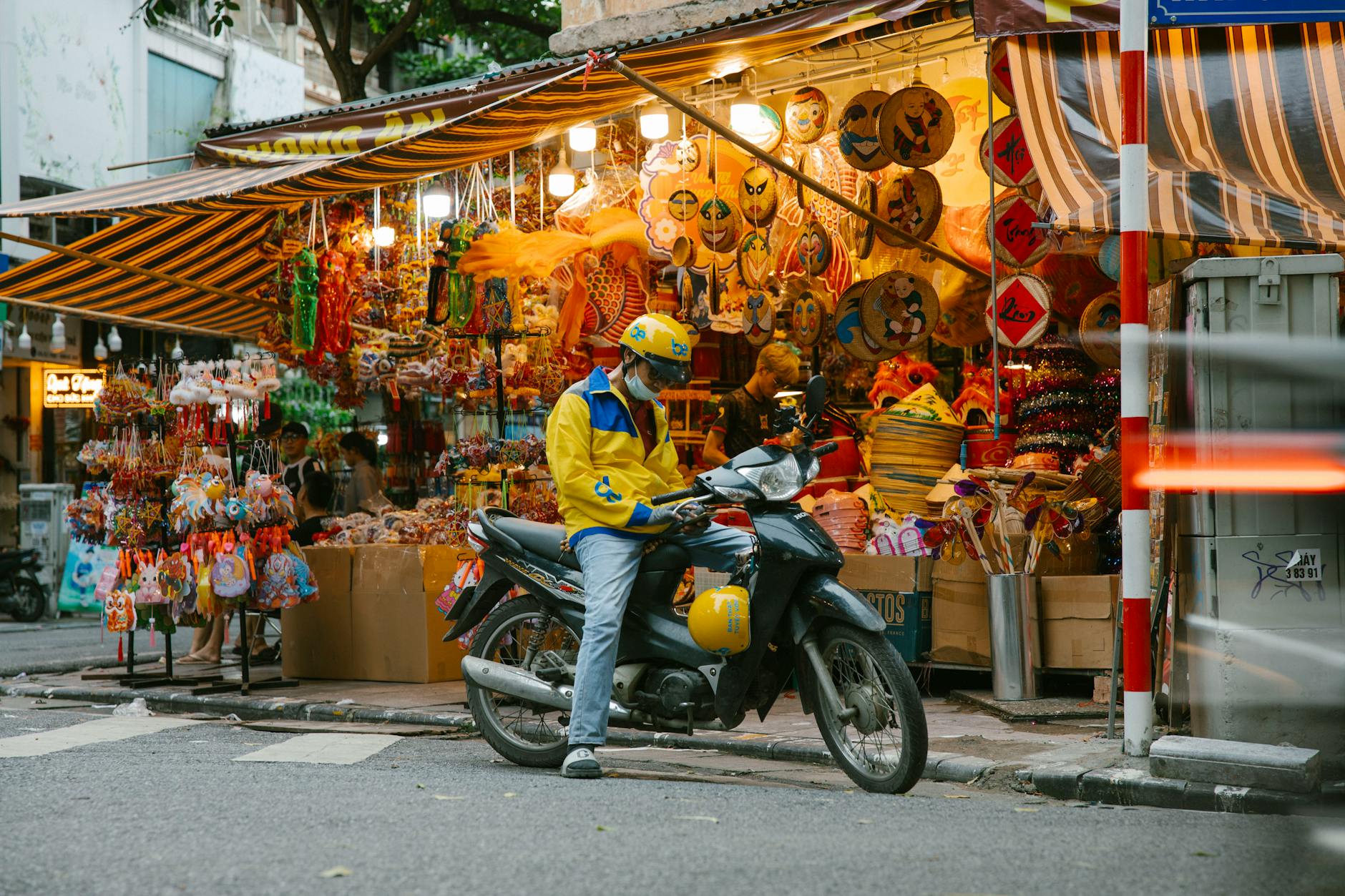
Parcels move to sorting centres — SPX Express’s SOC 5 facility in Calamba, Philippines spans 25,000 square metres and processes more than three million parcels per day (Philstar). From there, line-haul trucks carry parcels between cities or, in archipelago markets, onto ferries and cargo flights. The final stage — last-mile delivery — is where the real complexity lives. A rider on a motorbike navigates unmarked alleyways in Ho Chi Minh City. A driver finds a house with no formal address in Manila. That last leg accounts for roughly 53% of total shipping cost (SmartRoutes), making it the single most expensive part of the chain. How Super Apps Work in Asia: The Business Model Behind Grab, WeChat, and GoJek
Why are platforms building their own logistics?
Three years ago, most ecommerce platforms outsourced delivery to third-party logistics providers. That model is dying. The shift toward in-house logistics is one of the most consequential structural changes in Asian ecommerce, and it’s driven by a simple calculation: whoever controls the delivery experience controls the customer relationship.
Shopee’s SPX Express captured 25% of Southeast Asia’s logistics market by 2024 and now moves the majority of Shopee’s billions of parcels annually (Momentum Works). The results speak for themselves — a 6% reduction in logistics cost per order in Asia in Q1 2025, 90% on-time delivery during peak seasons, and a 30% improvement in delivery times for parcels leaving Malaysia’s Klang Valley after the Bukit Raja Sorting Centre opened in January 2024 (Logistics Asia). SPX Express operates over 1,000 warehouses and delivery centres across Southeast Asia.
Coupang in South Korea has pledged 3 trillion won ($2.23 billion) to expand its Rocket Delivery service nationwide by 2027, with eight new fulfilment centres being built by 2026 (Korea Herald). Currently covering 70% of the country with overnight delivery, the target is 88%. An AI-powered logistics centre in Jecheon is scheduled for completion in June 2026.
JD Logistics announced plans in October 2025 to procure three million robots, one million autonomous vehicles, and 100,000 drones over five years (TechNode). Its “Asia No. 1“ fully automated warehouse in Shanghai spans 40,000 square metres and integrates receiving, storage, picking, and packing with virtually no human intervention. JD’s iWMS system boosts operational efficiency by 3x.
The logic is consistent across all three: own the logistics, own the data, compress the costs, and make it nearly impossible for sellers to leave your platform.
How does cross-border logistics work?
Cross-border ecommerce logistics in Southeast Asia is projected to reach $9.08 billion in 2025 and grow to $15.39 billion by 2030 at an 11.14% CAGR (Mordor Intelligence). The dominant flow is China-to-Southeast Asia, and two operators are shaping the corridor.
Cainiao, Alibaba’s logistics arm, expanded its “Global 5-Day Delivery“ service to Vietnam, Singapore, and the Philippines by end of 2025 (Xinhua). It signed an MOU with Singapore Post to share capacity and enhance last-mile capabilities, and it’s planning large-scale smart logistics warehouses abroad for 2026.
J&T Express has been the dominant express delivery company in Southeast Asia for five consecutive years. In 2025, J&T’s Southeast Asia parcel volume hit 7.66 billion — up 67.8% year-on-year — giving it a 32.8% market share by mid-year (PR Newswire). Revenue reached $12.2 billion globally, up 19% (TechNode Global). The company added 700 service points and 800 line-haul vehicles in the first half of 2025 alone. By Q1 2026, Southeast Asian daily volume averaged 30.8 million parcels with peaks exceeding 47 million.
The cross-border model relies on bonded warehouses near origin (typically Shenzhen or Guangzhou), consolidated air freight to regional hubs (usually Singapore, Bangkok, or Kuala Lumpur), customs clearance at destination, and then handoff to local last-mile networks. The entire chain needs to operate within the price expectations of consumers buying $5–15 products — which means margins are razor-thin and volume is everything.
What does last-mile delivery look like in different Asian markets?
Last-mile delivery isn’t one thing — it’s a completely different operation in every market, shaped by geography, infrastructure, wages, and consumer expectations.
South Korea sets the global standard. Coupang’s Rocket Delivery achieves overnight delivery for 70% of the country, with same-day capability in Seoul. Compact geography, dense urbanisation, and heavy automation make it possible. Coupang’s “Coupang Friends“ drivers handle the final handoff, often delivering before dawn.
China processes more parcels per capita than any country on earth. The State Post Bureau projects 214 billion deliveries in 2026, an 8% increase over 2025 (Global Times). Tier-one city delivery speed is under 24 hours. Networks from SF Express, ZTO, and YTO blanket lower-tier cities with remarkable density — enabled by labour costs that keep per-parcel economics viable at volumes the West can’t match.
Indonesia is the hardest logistics market in Southeast Asia. Seventeen thousand islands, wildly uneven infrastructure, and addresses that often don’t appear on any map. Java deliveries might arrive next day; eastern Indonesia can take a week.
Singapore is the opposite extreme — last-mile delivery costs range from S$2.20 to S$20 per parcel (OneCart). Shopee subsidises delivery costs heavily, with per-parcel rates through SPX as low as S$2.20.
How do the economics of ecommerce logistics work?
The economics are brutal. Last-mile delivery accounts for roughly 53% of total shipping cost, yet platforms are engaged in a subsidisation war that compresses what consumers pay to well below the true cost of fulfilment.
SPX Express achieved a 6% reduction in logistics cost per order across Asia in Q1 2025 (Sea Group Q1 2025 Earnings). J&T Express’s 2025 revenue of $12.2 billion on 30 billion parcels implies average revenue of roughly $0.41 per parcel globally — though in China, ferocious competition has pushed per-parcel revenue below RMB 2 ($0.28) in many corridors.
Profitability depends on three things: density (more parcels per route), automation (JD’s iWMS triples warehouse throughput), and platform integration. When logistics is owned by the ecommerce platform, it becomes a cost centre that drives GMV growth rather than a standalone business. Shopee doesn’t need SPX Express to be independently profitable — it needs SPX to keep sellers locked in and delivery speeds competitive.
What’s changing?
Three shifts are reshaping Asian ecommerce logistics right now.
AI-powered routing and forecasting. AI-assisted routing has improved fleet efficiency by 58% and cut idle time by 21% across early adopters (Transcript IQ). Coupang’s new Jecheon facility is built around AI-based logistics technology. JD’s autonomous vehicles and drones — three million robots planned over five years — represent a bet that machine-driven fulfilment will eventually undercut human-powered networks on both cost and speed.
Drone delivery is moving from pilot to deployment. The Southeast Asian drone delivery market is projected to expand from $1.2 billion in 2025 to $6.8 billion by 2030 at a 41.3% CAGR (Transcript IQ). Average cost per drone delivery has fallen to $1.12, with delivery cost reductions of up to 47% compared to traditional methods. Singapore’s U-Space sandbox, launched in 2026, enables coordinated low-altitude drone operations across the city-state — 72 commercial drone licences have been issued since 2025. For archipelago markets like Indonesia and the Philippines, drones could eventually bypass the ferry-and-truck networks that make outer-island delivery so expensive.
Micro-fulfilment centres are enabling hyperlocal delivery. Rather than shipping from massive regional warehouses, platforms are positioning inventory in small urban hubs that enable 15-minute delivery windows. The model trades warehousing scale for proximity, and it’s particularly effective for groceries and quick-commerce categories. Combined with hybrid drone-vehicle dispatch, coordinated routing from micro-fulfilment hubs cuts logistics costs by roughly 19% (Postal Parcel).
The infrastructure layer that decides who wins
Ecommerce in Asia isn’t won on product selection or marketing spend anymore. It’s won on logistics. The platform that delivers fastest, cheapest, and most reliably — across megacities and remote islands alike — captures the sellers and the shoppers. That’s why Shopee, Coupang, and JD are pouring billions into warehouses, sorting centres, and delivery networks. That’s why J&T Express is adding 700 service points and 800 trucks in a single year. And that’s why the next frontier isn’t just moving parcels faster — it’s using AI, drones, and micro-fulfilment to restructure the cost base of getting a $10 product from a warehouse in Shenzhen to a doorstep in Surabaya.
The companies that crack that equation won’t just dominate ecommerce logistics. They’ll dominate ecommerce.
Sources & Further Reading
- Fintech Singapore — SEA Payment Methods 2026 — Worldpay Global Payments Report figures for SEA
- Lowy Institute — QR Payments the ASEAN Way — cross-border QR corridor build-out
- Fintech News — APAC Digital Payments 2026 — regional adoption and growth trends
- Primer — SEA Payment Trends — wallet penetration and method mix by country
- IMF — ASEAN's Digital Payment Revolution — cross-border QRIS and regional integration
- Payment Expert — Asia QR Lessons for Europe — how Asia mastered QR adoption
- Payment Asia — Rise of Digital Wallets in SEA E-Commerce — wallet share in checkout flow
Discover more from Digital in Asia
Subscribe to get the latest posts sent to your email.
