
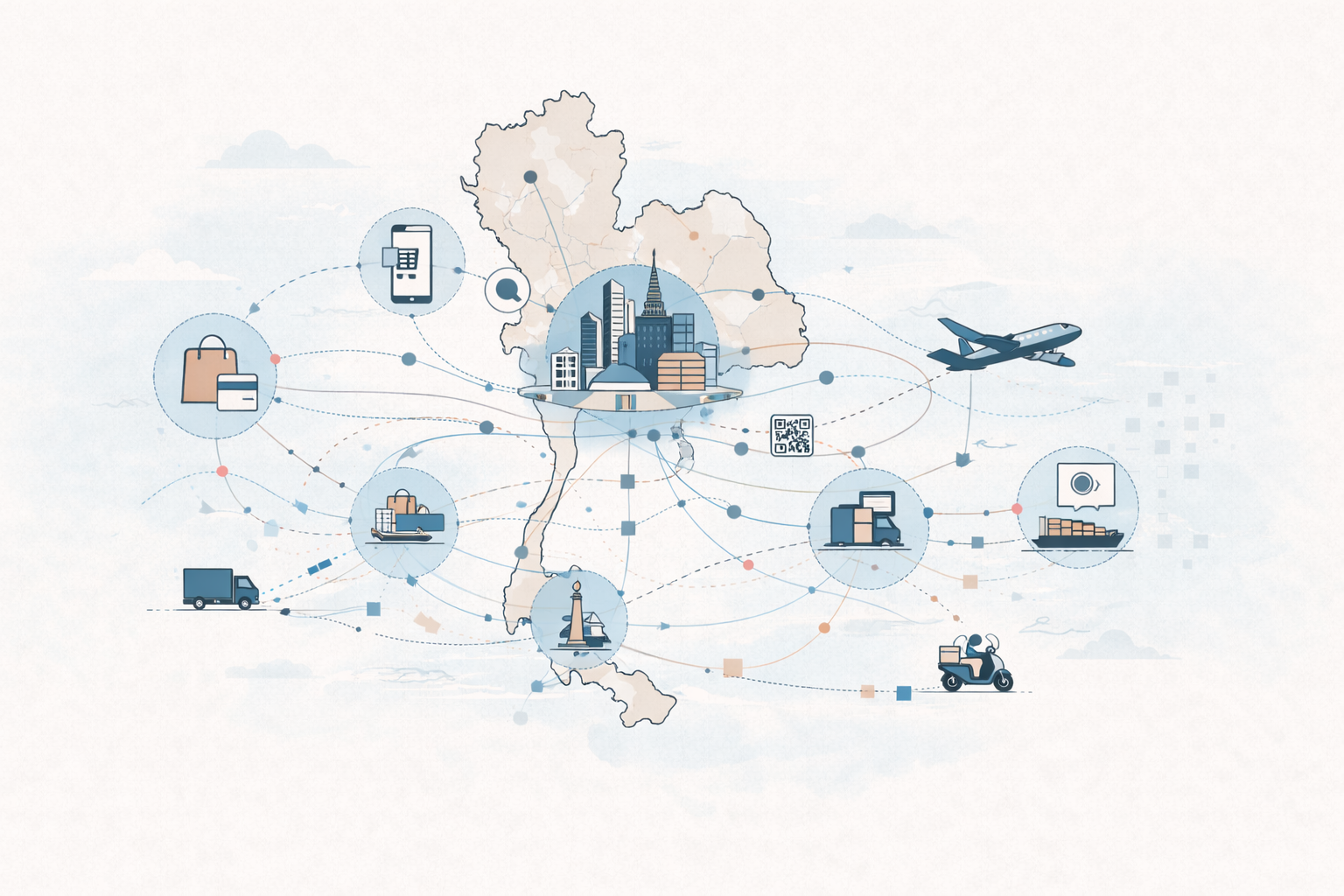
Thailand’s digital economy isn’t just growing—it’s become the second-largest in Southeast Asia, behind only Indonesia, and the velocity is accelerating. As of Q1 2026, the market reached 5.6 trillion baht, representing 4.2% year-on-year expansion. That’s 67.8 million internet users across a 94.7% penetration rate, built on 59 million smartphone devices where Android commands 67.67% of the market against Apple’s 32.05%. The digital transformation market itself is forecast to grow from USD 10.06 billion in 2025 to USD 16.64 billion by 2031, a compound annual growth rate of 8.75% (Mordor Intelligence). This isn’t a secondary market anymore. It’s where Thailand’s economic future is actually being written, and the pace of consolidation—both in platforms and in infrastructure—means the next two years will decide which players dominate the next decade.
What’s Driving Thailand’s Digital Economy?
Thailand’s digital market hit 5.6 trillion baht in 2026 because the structural conditions finally aligned. You’ve got population density, smartphone saturation, and critically, payment infrastructure that actually works. The Thai internet users themselves aren’t the constraint anymore—it’s what they’re doing with that connection that matters.
The smartphone adoption story is straightforward. 59 million active devices in a market of 72 million people isn’t quite saturation, but it’s close enough that growth is now about upgrade cycles and increasing time-on-device rather than market expansion. Android’s dominance at 67.67% reflects purchasing power—not preference—while iOS’s 32.05% share represents the premium segment concentrated in Bangkok and tier-one cities. The distinction matters because it splits the monetisation story in two: Android dominates volume, iOS dominates margin.
Internet penetration at 94.7% is remarkably high for a country with significant rural populations. The True Corporation and AIS duopoly (which we’ll come back to) has forced competitive pricing that makes mobile data affordable even in provincial areas. That’s not accident—it’s the consequence of Thailand’s telecom infrastructure investments over the past five years finally compounding. 67.8 million internet users means Thailand is past the inflection point where digital services are optional. They’re now infrastructure.
The digital transformation market—USD 10.06 billion in 2025, growing to USD 16.64 billion by 2031—tells you something important: enterprise investment in cloud, AI, and automation is climbing faster than consumer-facing applications. That’s unusual for emerging markets. Normally Southeast Asia runs ahead on consumer adoption while enterprises lag. Thailand’s flipping that. Which means the next generation of opportunity isn’t just in consumer platforms—it’s in the technology that powers them behind the line.
Which platforms are winning Southeast Asia’s social commerce wars?
Is AI Integration Actually Happening, or Just Announced?
Thailand’s AI market is hitting 48 billion baht in 2024 and is forecast to reach 130 billion baht by 2030, a compound annual growth rate of 18% (according to local tech ministry projections). The gap between those two numbers tells you something crucial: the market believes in the trajectory, but adoption is still in early phases.
Here’s what’s real: 76% of Thai citizens interact with AI tools on a daily basis. That’s genuine penetration—not awareness, but use. The tools are embedded in apps they already use (search, translation, image generation, chat). They’re not downloading separate AI applications. The technology is invisible infrastructure, which is exactly what you want to see in a mature market.
What’s not real yet is business adoption. Only 18% of Thai companies have integrated AI into their operations (Bank of Thailand analysis, 2025). That’s a massive gap between consumer exposure and organisational readiness. A tech-forward city like Bangkok has plenty of startups running on AI—customer service bots, recommendation systems, content moderation. But mid-market manufacturing, retail, and logistics companies? They’re still figuring out what the technology actually does.
The Thai government put 1.5 billion baht behind an AI workforce development program targeting 30,000 trained workers by 2027. The ambition is explicit: Thailand wants 100,000 AI professionals across the economy by 2030, but only 21,000 currently exist. That’s a five-year shortage. FPT (the Vietnamese conglomerate) is training locally. Microsoft partnered with THAI Academy to push AI education to over 10 million citizens. Those aren’t charity moves—they’re infrastructure plays from companies betting on Thailand as a regional training hub.
The money follows the strategy. Private AI funding in Thailand hit USD 73 million in 2025, but that’s only 3% of ASEAN’s total AI funding. Vietnam gets more. Singapore gets more. But the rate of growth is outpacing the baseline, which means investor conviction is rising faster than the current share.
The real constraint is talent. You can build the market opportunity all day, but if you don’t have the people who can architect, train, and deploy these systems, the opportunity gets distributed elsewhere. That 100,000-person shortfall isn’t idle—it’s a strategic vacuum, and right now it’s getting filled by immigration (mostly from Vietnam and India) and by companies building offshore. Neither of those is a long-term solution for a country with Thailand’s ambitions.
The 5G Duopoly: True-DTAC vs AIS
Thailand’s mobile market just experienced a fundamental restructuring. True Corporation’s acquisition of DTAC closed in 2024, creating a functional duopoly—True-DTAC on one side with approximately 48.5 million subscribers (51-52% market share), and AIS on the other with roughly 46 million subscribers (47-48% market share). This concentration is rare in Southeast Asia.
The competitive outcome: 5G coverage hit 93% by February 2025 (according to Thai telecommunications regulator reports). That’s extraordinary. For comparison, many Western countries hit that mark years later. AIS is operating 5G speeds of 105.3 Mbps—the fastest in the region—which means the infrastructure exists to support bandwidth-heavy services like video streaming, cloud gaming, and real-time AR applications.
But duopoly economics always tighten pricing eventually. Budget plans in Thailand now cost between 199 and 299 baht per month—roughly USD 5.50 to 8.00. That’s not expensive by developed-market standards, but it’s a meaningful cost in Thailand’s tier-two and tier-three cities. The competition between True-DTAC and AIS is real, but you’re no longer seeing the aggressive price wars that characterised the pre-merger period. The market has stabilised at a higher price floor.
The bigger shift is the 2G and 3G shutdown scheduled for Q3 2026. Both carriers are sunsetting older networks. That forces handset replacement in markets that otherwise wouldn’t upgrade—feature phone users in provincial areas, enterprise IoT devices running on legacy protocols. It’s infrastructure churn dressed as spectrum reclamation, but it’s driving device sales nonetheless.
The 5G build-out is also strategic. It’s not just for consumers. Thailand is pushing 5G as the foundation for smart cities and industrial automation, particularly in the Eastern Economic Corridor (EEC). That infrastructure becomes the backbone for healthtech, logistics tracking, and autonomous systems. You don’t build 93% 5G coverage for consumer TikTok streaming alone. You build it because what comes next is a different economy.
E-Commerce Velocity: 1.1 Trillion Baht and Accelerating
Thailand’s e-commerce market hit 1.1 trillion baht in 2024, growing at 14% year-on-year. But the headline number understates the story. The growth rate is accelerating fastest in a particular subcategory: social commerce.
Total e-commerce includes everything—direct purchases from websites, marketplace transactions, in-app shopping, and social commerce. Shopee is dominating in pure transaction volume (75% usage among online shoppers), followed by Lazada (67%), and increasingly TikTok Shop (51% awareness, climbing toward 40%+ active usage). These aren’t separate channels anymore. Consumer behaviour is converging around platforms.
The fastest-growing segment within e-commerce is social commerce specifically, which hit USD 5.20 billion in 2025 and grew 18.6% year-on-year. That’s double the rate of traditional e-commerce. Why? Because 69% of Thai consumers shop on social platforms. The behaviour isn’t exceptional or niche—it’s mainstream.
The mechanics are worth understanding. Live shopping—a streamer showcasing products in real-time, viewers purchasing directly in the stream—converts at 7.4%, which is remarkably high. For comparison, Instagram Stories convert at around 2-3%. YouTube Shopping is lower still. TikTok Shop has found a format that genuinely works for impulse purchases, which in Thailand is increasingly category-defining.
LINE remains the dominant chat commerce platform. Thais are already deep in LINE for messaging (56 million users on a 72-million-person population is nearly saturation). Buying through LINE Shop, LINE Pay, or LINE’s shopping integrations feels like a natural extension. Brands that understand this—that the purchase journey starts with LINE, not Google—are the ones winning repeat customers.
The implication is structural. Thailand’s e-commerce isn’t siloing into “online” and “offline.” It’s collapsing into platforms. Shopee and Lazada own transaction volume. TikTok is capturing the attention of first-time shoppers (younger, mobile-first audiences). LINE owns the trust-based repeat purchase mechanic. That’s not three separate markets—that’s one market with three distribution channels competing for share.
The margin side is tighter. Commission rates on Shopee and Lazada have stabilised around 5-8% depending on category. Fulfillment costs are real (logistics in Thailand isn’t as optimised as Vietnam or China). But transaction volume is high enough that brands can afford to sell on thin margins because the velocity makes up for it.
Social commerce: Why TikTok Shop is winning in Southeast Asia
Digital Advertising: USD 5.95 Billion and Shifting Format
Thailand’s digital advertising spend hit USD 5.95 billion in 2025 and is growing 11% annually (according to GroupM forecasts through 2029). But the composition of that spend is changing radically. Programmatic advertising is forecast to represent 79% of all digital ad revenue by 2029, up from roughly 65% today. That means human-negotiated, direct-sold ads are declining as a percentage of spend, even though absolute volumes stay high.
What’s fascinating is what’s actually driving revenue within programmatic. It’s not traditional display. It’s video—YouTube, TikTok, Instagram Reels—and increasingly, it’s performance marketing (search, social conversion, affiliate). Brand campaigns are still significant, but they’re smaller slices of a growing pie.
The creator economy itself—the ecosystem of influencers, micro-influencers, and content creators who earn money from platforms—hit 45 billion baht in value in 2024. Thailand has 3 million influencers by 2025 (Influential data, 2025), which is extraordinary density for a 72-million-person market. That’s one influencer per 24 people. In reality, distribution is uneven—Bangkok and tier-one cities are oversaturated—but the point stands: creator-driven content is now how brands actually move volume.
Key Opinion Sellers (KOL equivalents who drive direct sales rather than pure brand awareness) dominate TikTok. They’re morphing into a hybrid role: part entertainer, part salesperson. They’re not advertising in the traditional sense. They’re just living in a format that collapses entertainment and transaction.
Digital media itself—the publishing and content platforms that host these creators—hit 38 billion baht in market value (2024) with 15% year-on-year growth. That includes everything from traditional news publishers (Bangkok Post, Nation Thailand) that have digital subscriptions, to long-form YouTube channels, to TikTok creators. It’s a fragmented space, but it’s consolidating around platforms rather than around publishers.
The implication for advertisers: efficiency is improving. Programmatic automation means less waste on untargeted placements. But it also means margin compression for ad networks that can’t differentiate on data or targeting capability. The winners are either large platforms with first-party data (Google, Meta, TikTok) or AI-driven banking and fintech companies or very good at converting attention into revenue (performance marketers). Everyone else is getting squeezed.
Gaming: USD 2.37 Billion and Thailand’s Per-Capita Lead
Thailand’s gaming market hit USD 2.37 billion in 2025 and is growing at 6.81% annually, forecast to reach USD 3.30 billion by 2030 (Newzoo/Niko Partners analysis). The headline number is good, but the composition is more interesting.
Mobile games represent 58.3% of total gaming revenue. That’s not unusual for Asia—it’s the same ratio across the region. But what is unusual is Thai in-app purchase spending, which grew 16% year-on-year, compared to a global average of 4%. Thais are paying more per person to unlock content within games.
Per capita spending on games in Thailand is USD 393 per player (2025 Niko Partners), which is the highest in Southeast Asia. Vietnam’s at USD 284. Philippines is USD 156. Indonesia is USD 198. Thailand’s premium position exists because:
- Mobile adoption is high, smartphone quality is high, and 4G/5G connectivity is reliable enough for seamless gameplay.
- Thai consumers treat in-app purchases as normalized transactions. There’s less cultural friction around spending on digital goods than in some neighbouring markets.
- Game titles themselves are tailored for Thai audiences. MOBA games and RPGs with real-money progression models have captured the majority of engaged players.
49% of Thai gamers are paying users (meaning they’ve spent money on in-app transactions at least once). That’s a healthier monetisation ratio than North American markets, where it’s typically 5-10%. The Thai market is smaller, but it’s denser in terms of engagement and spending willingness.
41 million players in a 72-million-person population means gaming penetration is roughly 57%. But “players” includes people who play occasionally (casual mobile games, browser games). Core gamers—people spending 5+ hours per week—are probably 12-15 million. That’s the segment driving the per-capita spending numbers.
Esports is a separate conversation. There’s an esports audience (competitive MOBAs like Mobile Legends, traditional esports like CS2), but it’s smaller than the casual gaming base. The real money in esports in Thailand is in sponsorship and media rights, not in prize pools. The Thai esports scene is vocal, but it’s not revenue-driving yet.
PromptPay: 77 Million Registrations and the Death of Cash
PromptPay—Thailand’s national instant payment system launched in 2017—hit 77 million registrations by 2025. On a population of 72 million, that’s impossible. It means accounts are duplicated, inactive, or registered across multiple devices. But the operational metric is more revealing: 75.9 million daily transactions at an average of 538 per person annually (Bank of Thailand, 2024). That’s 27.7 billion transactions per year. Every Thai is transacting 7-8 times per week through the system.
For comparison: cash represented 68% of point-of-sale transactions in Thailand in 2019. By 2024, it fell to 31%. That’s a structural shift. A five-year transition from cash-dominant to digital-dominant in a country where physical currency was culturally embedded.
The mechanics of this shift matter. PromptPay is free to use, government-backed, and integrated into every major bank and mobile wallet. Users scan QR codes or enter phone numbers to send money. It’s simple, reliable, and most importantly, it’s ubiquitous. That ubiquity creates network effects. Once everyone you transact with accepts PromptPay, you stop carrying cash.
TrueMoney (the mobile wallet from True Corporation) holds 52.6% of the e-wallet market by transaction volume. That’s dominant, but not monopolistic. Competitors exist—Alipay has Thailand coverage, Google Pay is expanding, mobile banking apps are integrated with major banks. But TrueMoney’s position is structural because it’s integrated into every True wireless account.
Buy Now, Pay Later (BNPL) reached USD 3.94 billion in transaction value in 2024. Companies like Akulaku, Siam Commercial Bank’s Kakaopay, and others are fragmenting the market. BNPL is attractive to consumers because it lowers the friction of larger purchases. A THB 5,000 smartphone can now be split into four THB 1,250 payments. That’s payment innovation disguised as consumer credit.
The fintech ecosystem itself—177 active fintech companies as of 2025 (Thai fintech association)—is consolidating. The pure play fintechs that tried to compete on payment convenience lost to banks and existing platforms. The ones winning are either specialised (lending, investments, remittance) or operating within existing platforms (embedded finance).
Virtual bank licenses are pending. Five applicants are awaiting formal approval from the Bank of Thailand, with decisions expected mid-2025. This could be significant—virtual banks operate with lower overhead than traditional branches and can offer digital-first experiences. But they’re also entering an already-saturated payments market. The consumer benefit is unclear.
Mobile payments reached USD 29.73 billion in transaction value (2024), and it’s the fastest-growing segment within fintech. But it’s almost entirely captured by existing players. New entrants need either regulatory advantage (virtual banks) or a unique mechanism (BNPL, remittance).
Social Media at 51 Million Users: The Attention Concentration
51 million social media users in Thailand represent 71.1% of the population. That’s not penetration—that’s saturation plus duplication plus inactive accounts. Real active users are probably 35-40 million. But the volume tells you something: social media isn’t where Thais go to connect anymore. It’s where they live.
LINE: 56 million registered users (78.2% of population). Most accounts are active. LINE is built into Thai mobile from day one—it’s the default messaging platform, the default social network for sharing moments, and increasingly, the default payment method. It’s not a global social platform. It’s the Thai social platform, and it’s owned by Japan’s Z Holdings (which also owns Yahoo Japan). That concentration matters because LINE controls not just attention, but the infrastructure of daily life—payments, shopping, customer service, business communication.
TikTok: 44.4 million users. YouTube: 47.6 million users. These are massive, but they’re still second and third to LINE. That tells you that global platforms matter for specific use cases (video discovery, entertainment), but they haven’t replaced the local default.
Average daily social media consumption is 2 hours and 35 minutes per person (DataReportal, 2025). That’s slightly below the global average of 2 hours 20 minutes, which is surprising given how much time Thais spend on LINE and TikTok. The data likely treats messaging (LINE) differently than social media, which depresses the total.
YouTube consumption is 42 hours and 14 minutes per month per active user. TikTok is 37 hours and 40 minutes. Those are huge numbers. They’re not consumption—they’re basically second jobs of attention.
Video sellers—people creating and selling products via TikTok, YouTube, and Facebook Live—surged 175% year-on-year to 850,000 individuals by 2025. These aren’t companies. These are individual creators treating video creation as a business model. They’re competing for attention against each other and against traditional e-commerce. Some are making six figures (USD equivalent) per month. Most are making pocket money. But the aggregate represents a new form of distributed commerce.
Creator economy in Southeast Asia: Which countries are attracting talent?
Cloud and Data Centre: USD 1.85 Billion Growing to USD 4.31 Billion
Thailand’s data centre market hit USD 1.85 billion in 2025 and is forecast to reach USD 4.31 billion by 2030, a compound annual growth rate of 18.39% (according to Frost & Sullivan estimates). That’s faster than most other ASEAN markets, driven by government cloud-first policy and enterprise adoption of infrastructure-as-a-service.
A single project captures the ambition: Galaxy (a Vietnamese company), announced a USD 2 billion investment in green-AI data centres in Rayong, Thailand’s industrial corridor. That’s not a regional facility. That’s continental-scale infrastructure. The facility will support AI training and inference workloads for the broader region. When it opens (estimated 2026-2027), Thailand stops being a consumer of cloud services and starts being a provider.
Government policy explicitly favours cloud adoption. Thai ministries are moving to cloud-first procurement. That creates internal demand and signals a direction to the private sector. Hyperscalers—AWS, Google Cloud, Microsoft Azure—are expanding capacity. Local data centre operators (Digital Realty, AIS, other Thai carriers) are building redundant capacity.
The Eastern Economic Corridor is becoming the infrastructure hub for this. THAI government is co-investing in smart city infrastructure, which requires data centre capacity, connectivity, and cloud services. That’s not investor hype—it’s structural investment.
The margin is attractive. Thailand’s cost of electricity is lower than Singapore or Hong Kong. Land is cheaper. Labour is cheaper. That economics draw infrastructure spending. But the real attraction is positioning: a data centre in Thailand can serve ASEAN (Thailand, Vietnam, Myanmar, Laos, Cambodia) and increasingly, India and South Asia. That’s a 1.5 billion person market.
Healthtech and Edtech: Solving for Infrastructure, Not Just Application
Thailand’s digital health market hit 50 billion baht in 2025 and is forecast to reach 61.7 billion baht by 2029 (Thai Ministry of Digital Economy, 2024). That’s 5.2% year-on-year growth in a market that already has foundation. The growth is incremental, not explosive, which makes sense for a country with universal healthcare (Thai citizens have basic coverage).
Telehealth is the growth driver. USD 1.60 billion in 2025, forecast to reach USD 9.51 billion by 2030, a compound annual growth rate of 29.1% (according to Precedence Research). Why the acceleration? Three things: smartphones making remote consultation accessible, 5G making video calls reliable, and post-pandemic habit formation (Thais got used to remote consultation during COVID-19 lockdowns and didn’t stop).
EdTech is larger than healthtech in absolute value. The market hit USD 1.76 billion in 2025 and is forecast to reach USD 4.89 billion by 2034, a growth rate of 11.6% annually (Mordor Intelligence, 2025). But there’s a structural constraint: 20% of Thai schools still lack reliable internet access. You can’t have a functioning digital education system when a fifth of schools can’t reliably access the network. That gap is being addressed (Thai government’s 20-year digital infrastructure plan), but it’s not solved yet.
THAI Academy partnered with Microsoft on an AI education initiative targeting 10 million citizens. That’s not a company training program. That’s a country-scale reskilling initiative. The goal is explicit: prepare a generation for AI-enabled work. Participation is free. The curriculum is standardised. Success means Thailand moves from knowledge importer to knowledge exporter in AI training.
These aren’t Silicon Valley startups disrupting education. They’re foundational infrastructure plays. The question isn’t whether edtech succeeds—it’s whether the underlying connectivity, digital literacy, and institutional will can keep pace with the market demand.
Regulation: PDPA, AI Governance, and the E-Commerce Framework
Thailand’s Personal Data Protection Act (PDPA) entered full enforcement in June 2022. By August 2025, the Thai National Personal Data Committee had issued 21.5 million baht in cumulative fines for violations. That’s real teeth. Companies are paying attention. The most common violations: inadequate consent mechanisms, retention of data beyond permitted periods, and insufficient security controls.
The PDPA’s impact on business is visible. Companies are now running privacy audits. Third-party vendors are being evaluated for PDPA compliance. Consent flows are being redesigned. It’s slowing down some business processes—no complaints there—but it’s also raising the baseline cost of doing business in Thailand.
An AI governance framework is in draft form (circulated by the Thai government to stakeholders in late 2025, formal adoption expected in 2026). The current text is surprisingly restrained. It’s not the sweeping restrictions you see in EU AI Act proposals. It’s more about transparency, accountability for automated decision-making, and sector-specific rules for high-risk applications (hiring, credit decisions, law enforcement). For a developing-market regulator, that’s thoughtful. It signals that Thailand wants to enable AI adoption without outright banning use cases.
The Trade Competition Commission issued platform guidelines in September 2025, specifically targeting e-commerce marketplaces (Shopee, Lazada, TikTok Shop). The guidelines address commission rate transparency, prohibited seller practices, and dispute resolution. The effect is to legitimise platforms while constraining unfair behaviour. It’s not regulation-light, but it’s not draconian either.
PromptPay infrastructure has been linked to Singapore’s PayNow system, enabling cross-border instant payments. That’s significant for remittances and regional commerce. It means a Thai seller can transact with a Singaporean buyer using their respective domestic payment systems. It’s infrastructure interoperability, and it’s the kind of work that doesn’t make headlines but matters enormously for regional commerce.
What Comes Next: Three Dynamics to Watch Through 2027
Three things are going to shape Thailand’s digital market over the next 18 months.
First: AI deployment will outrun talent. The 100,000-person shortfall in AI professionals won’t close by 2027, but the market’s going to demand these roles anyway. That means either inflated salaries (pricing Thais out of their own economy), immigration (non-Thai engineers filling roles), or outsourcing (work going elsewhere). Thai government’s betting on THAI Academy education to close the gap. It won’t be enough. Companies that can’t get AI talent locally are already outsourcing to Vietnam, India, and the Philippines. That brain drain isn’t lethal, but it costs Thailand a share of the value created by these systems.
Second: TikTok Shop’s maturation. TikTok Shop isn’t dominant yet, but the user base is converging on it. 51% awareness climbing toward 40%+ monthly active users is a trajectory. If TikTok Shop can improve seller onboarding and reduce the fees charged to merchants (currently lower than Shopee or Lazada, but still meaningful), it becomes a three-player market (Shopee, Lazada, TikTok) instead of a two-player market with a challenger. That fragmentation of commerce across three major platforms is good for consumers (more choice, more competition on fees) but harder for sellers (more platforms to manage inventory across).
Third: Cloud and AI infrastructure investment. USD 2.7 billion in approved investments (government capital plus private) is flowing into data centre capacity, cloud-first systems, and AI training infrastructure through 2027. That’s infrastructure getting built right now. Within two years, Thailand will have continental-scale cloud capacity. That changes what’s possible—you can now train frontier AI models in Thailand, not just consume cloud services. That’s a shift from consumer to producer of digital goods.
All three of these dynamics are already in motion. The question is speed and distribution. Which companies capture the upside? How much talent drain happens before THAI Academy output kicks in? When TikTok Shop reaches maturity, which sellers win and which lose market share?
Those questions will define 2026 and 2027 for Thailand’s digital economy. The underlying market—67.8 million internet users, 5.6 trillion baht in economic value, and structural infrastructure investment—isn’t going anywhere. What changes is velocity, consolidation, and the distribution of profit among players. That’s where the strategy happens. That’s where the money actually follows.
This article is part of Digital in Asia’s market overview series. See also: Indonesia | Vietnam | Thailand | Singapore | Malaysia | Philippines | China | India | Japan | South Korea
