
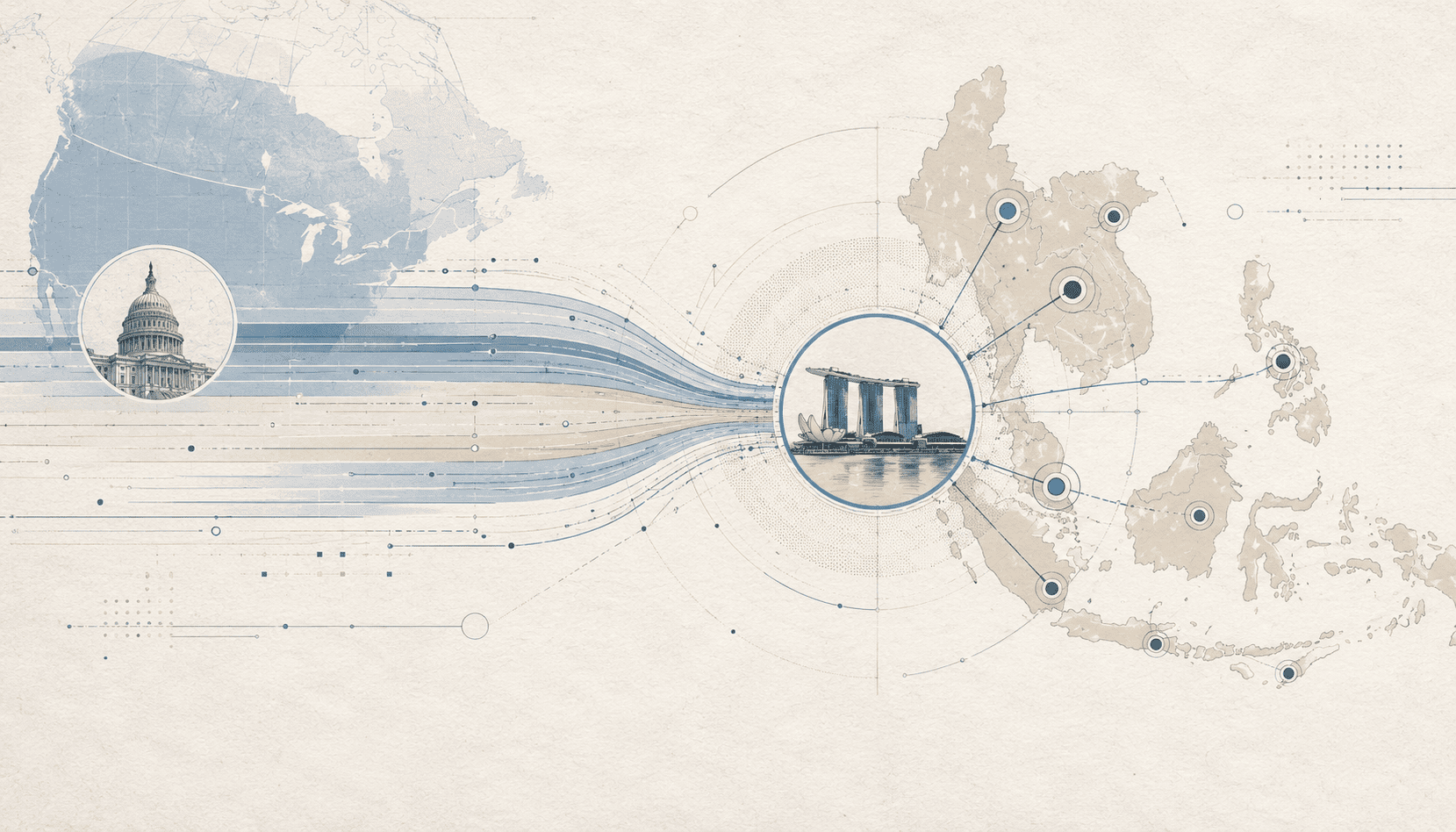
Singapore remains the operating layer for US technology, capital and regulation across Southeast Asia.
US–Singapore bilateral trade hit S$145.7 billion (around US$112.6 billion) in 2024, with the US running a surplus of US$27.1 billion — and that surplus tells you most of what you need to know about the relationship.
Singapore’s digital economy reached S$128.1 billion (about US$99 billion) in 2024, contributing 18.6% of GDP, up from 18.0% in 2023, according to the Infocomm Media Development Authority’s Singapore Digital Economy Report 2025. The country grew its digital economy at a 12.0% CAGR from 2019 to 2024, nearly double the 7.3% nominal GDP growth rate. Singapore’s tech workforce expanded to 214,000 in 2024, with median monthly wages at S$7,950 — well above the overall resident median of S$4,860.
These are not the metrics of a manufacturing economy. They’re the metrics of a digital headquarters.
For US technology companies, Singapore is where the region gets organised. Google, Meta, Apple, Microsoft, Amazon, Salesforce, Stripe, Visa and Mastercard all run their Asia-Pacific or Southeast Asia operations from Singapore. Sea Group (parent of Shopee), Grab, ByteDance’s regional operations, Razer and Ninja Van are all headquartered or substantively run from there. The US–Singapore relationship is the operating layer for a $300 billion-plus digital economy spanning Indonesia, Vietnam, Thailand, Malaysia and the Philippines.
Why the digital economy concentrates in Singapore
Three structural advantages make this work.
First, regulation. Singapore’s Personal Data Protection Act, payment services framework, and the Monetary Authority of Singapore’s licensing regime are credible to US legal teams in a way that no other Southeast Asian regulator is. When a US fintech wants to operate across the region, it gets its MAS licence first and uses that as the credibility layer.
Second, capital. Temasek and GIC together manage over US$900 billion. The Singapore venture ecosystem channels US, Chinese, and Gulf capital into regional startups. A US company doesn’t just sell into Singapore — it raises follow-on capital from Singapore.
Third, talent and language. Singapore offers a workforce that operates in English at native level, holds work permits for talent imported from the region, and can be relocated to manage Vietnam, Indonesia or Thailand operations.
The result is concentration. According to IMDA’s 2025 report, two-thirds of Singapore’s digital economy growth came from non-Information & Communications sectors — meaning digitalisation is now embedded across finance, wholesale trade, manufacturing and logistics, not just tech firms. Among SMEs, AI adoption tripled from 4.2% in 2023 to 14.5% in 2024. Among non-SMEs, it rose to 62.5% from 44%.
Where US capital lands
Several specific channels matter.
Cloud and data centre infrastructure. AWS, Google Cloud, Microsoft Azure and Oracle have all made multi-billion-dollar regional investments anchored in or near Singapore. Singapore’s 2019–2022 data centre moratorium pushed some hyperscale capacity into Johor (see US–Malaysia: Semiconductors and Data Centres), but Singapore continues to attract premium AI and financial-services workloads under its Sustainable Data Centre framework.
Quantum and frontier R&D. Singapore’s National Quantum Strategy was allocated US$224 million from the Research, Innovation and Enterprise 2025 plan, on top of US$298.5 million in prior quantum investment. US firms in Singapore’s quantum ecosystem include Quantinuum, Keysight, IBM, AWS, Google and JP Morgan.
Fintech and payments. The US–Singapore relationship is the most important channel for cross-border digital payments innovation in Asia ex-China. The integration of UPI with Singapore’s PayNow is one of the few cross-border digital payment systems that actually works at scale.
Enterprise software. Salesforce, ServiceNow, Workday, Atlassian and Adobe all run their regional sales and customer success functions from Singapore. The Asia-Pacific revenue lines on those companies’ earnings calls largely originate in or are routed through Singapore.
The tariff dynamic
The 2025 US tariff escalation hit Singapore differently than most of the region. A baseline 10% tariff applied to most Singaporean imports despite the US–Singapore Free Trade Agreement, with semiconductor tariffs escalating to 100% by August 2025. Singapore’s GDP grew 4.1% in Q1 2025 and 4.4% in Q2, partly buffered by digital exports and AI-driven productivity gains.
The reason this matters: Singapore is the only Southeast Asian economy that runs a meaningful US trade deficit. The country imports advanced US chips and software at scale, particularly for AI manufacturing and financial services infrastructure. That makes Singapore both more strategically aligned with US export controls and more exposed to US technology supply disruption than its neighbours.
For US firms, this is generally an asset. Singapore is the only ASEAN economy where US export controls on advanced chips can be implemented with reasonable confidence.
The headquarters function isn’t going anywhere
Singapore’s domestic market is small. Five and a half million people, even at premium ARPUs, doesn’t move the needle for a US platform’s global revenue. What Singapore offers is coordination — and that’s getting more, not less, valuable as Southeast Asia’s digital economy fragments under different national regulations.
Indonesia’s data localisation rules, Vietnam’s evolving digital licensing, Thailand’s PDPA, Malaysia’s data centre framework, the Philippines’ BPO regulatory updates — every market has a different operating environment. Singapore is the place where US firms structure regional compliance, regional capital flows, regional partnerships and regional product strategy.
Where this goes next
The next phase of US–Singapore ties will be shaped by three things.
AI infrastructure investment scaling further. The Enterprise Compute Initiative announced in February 2025 committed S$150 million (US$115.9 million) to expand AI computational resources for enterprise use. Expect US hyperscalers to match.
The Johor–Singapore Special Economic Zone. JS-SEZ will let Singapore concentrate on premium digital services and capital functions while Johor absorbs the lower-margin data centre and back-office capacity. This is good for US firms that want both.
Continued export-control alignment. As US controls on advanced chips and AI tighten, Singapore’s role as the trusted operating jurisdiction for US tech in Southeast Asia becomes more important.
US–Singapore is a small relationship by population. By strategic weight, it’s one of the most important digital partnerships in Asia.
The reason is simple: when you want to do business across Southeast Asia, Singapore is still where you start.
This is part of a Digital in Asia series mapping the digital relationships shaping Asia’s next decade.
Related DIA coverage: Singapore digital economy, the Asian fintech ecosystem.
Sources & Further Reading
- Office of the US Trade Representative — bilateral trade and tariff data
- IMF — World Economic Outlook — macro and trade indicators
- NASSCOM — Strategic Review — IT and GCC sector data
- Bain & Company — e-Conomy SEA Report — Southeast Asia digital economy
- World Economic Forum — global digital trade analysis
Discover more from Digital in Asia
Subscribe to get the latest posts sent to your email.
