
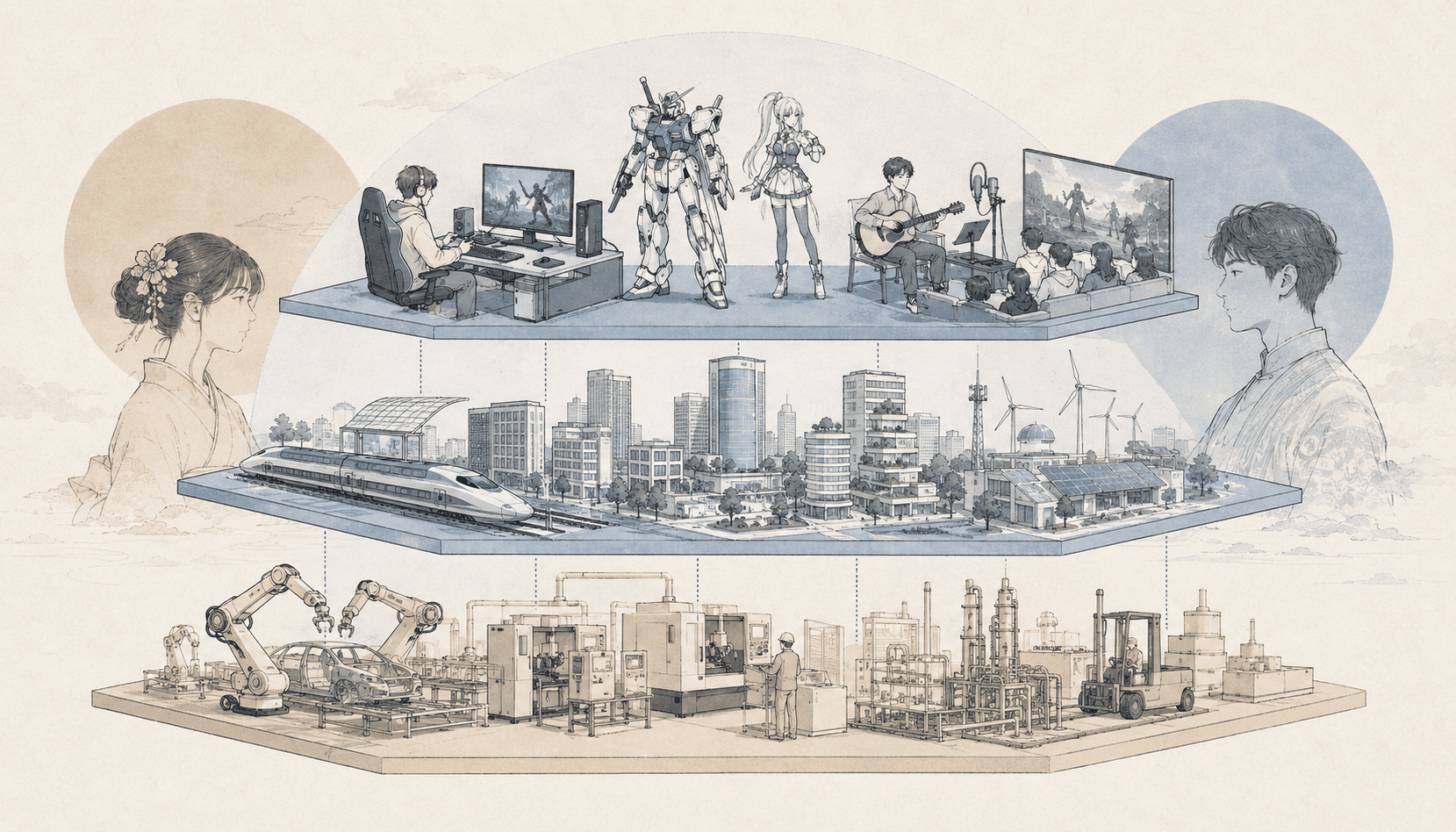
Japan’s long relationship with Thailand is expanding into smart cities, digital infrastructure, gaming, entertainment and platform partnerships.
Japan has been Thailand’s largest cumulative foreign investor for decades, and the digital layer of that relationship is now growing faster than the industrial base.
Japanese companies have invested approximately US$96 billion cumulatively in Thailand, with Toyota, Honda, Nissan, Mitsubishi Motors, and Isuzu accounting for the majority of automotive sector exposure, according to the Japan External Trade Organization (JETRO). Around 6,000 Japanese companies operate in Thailand, including roughly 4,000 manufacturing firms — the largest concentration of Japanese corporate presence in any Southeast Asian country. Thailand’s digital economy is projected to reach US$49 billion in GMV by 2025 per Bain & Company, the second largest in Southeast Asia after Indonesia.
The interesting story isn’t the manufacturing base. It’s how Japanese soft power, gaming, entertainment IP and digital infrastructure are now layering on top of an industrial relationship built over fifty years.
The two faces of Japan in Thailand
The industrial face is the legacy story. Thailand became “Detroit of the East” because Japanese automakers built it that way. Toyota’s Thailand operations are among its largest globally outside Japan. The transition to electric vehicles is now testing this dominance — Chinese EV makers BYD, Great Wall Motor, and Hozon have rapidly scaled Thai operations — but the Japanese industrial footprint remains the deepest of any foreign economy.
The investment numbers underline how integrated the relationship has become. Japan led foreign direct investment into Thailand in 2025, contributing 20% of total FDI ahead of the US (15%), China (12%), Singapore (12%) and Hong Kong (10%), with Japanese investments exceeding 41 billion baht largely in auto and electronics (Nation Thailand). Thailand’s Board of Investment received 1.37 trillion baht (~US$42 billion) in promotion applications between January and September 2025, up 94% year-on-year — the largest pipeline on record. Thailand’s digital economy is forecast to grow 4.2% in 2026, twice the pace of headline GDP, with software (+7.8%), digital content (+6.9%) and smart devices (+5.5%) the fastest-growing segments. Toyota committed US$700 million to smart manufacturing in the Eastern Economic Corridor in 2025 alone, and Thailand is targeting at least 15 designated smart cities by 2027 — most of them on Japanese reference architectures.
The cultural and digital face is the newer story. Japan’s anime, gaming, manga, J-pop and entertainment IP have shaped Thai consumer culture in ways that translate directly into commercial outcomes.
Three specific channels matter most.
Gaming. Japanese gaming companies — Sony, Nintendo, Bandai Namco, Capcom, Square Enix, Konami — operate substantial Thailand businesses. The Thai gaming market reached approximately US$1.2 billion in 2024 and continues growing, with Japanese console and PC titles holding significant mind share alongside mobile-first games. Thailand is also a major hub for Japanese gaming localisation, esports tournaments, and regional gaming media.
Anime and entertainment. Thailand is one of the largest anime consumption markets in Southeast Asia. Japanese streaming partnerships — Crunchyroll, Bilibili Thailand, regional Netflix anime distribution — have made Thai consumers core to the global anime economy. This isn’t just consumption; Thai animation studios increasingly co-produce with Japanese partners.
Smart city and infrastructure technology. Hitachi, Toshiba, NEC, Fujitsu, and Mitsubishi Electric have all built substantial smart city, transport, and industrial digital infrastructure businesses in Thailand. Bangkok’s mass transit systems, Thai industrial estate digital infrastructure, and increasingly the country’s 5G rollout all carry Japanese technology embedded in the layer.
Why the digital relationship is accelerating now
Three forces are pushing Japan and Thailand closer on digital specifically.
Japan’s industrial transition pressure. As Japanese automakers face the EV transition and demographic decline at home, their Thai operations need to evolve faster than ever. This means heavier investment in robotics, factory automation, AI-driven manufacturing systems, and predictive maintenance technology — all areas where Japan is genuinely strong.
Thai government strategy. The Thailand 4.0 framework explicitly targets advanced manufacturing, digital economy and bioeconomy as growth pillars. Japanese partnership is central to delivering on these targets, particularly in smart manufacturing and digital health. The Eastern Economic Corridor (EEC) hosts most of the new Japanese industrial digital investment.
Cultural compounding. Decades of consumption of Japanese entertainment have created a generation of Thai consumers, creators and entrepreneurs who think of Japan as a primary cultural reference. This shapes everything from product design to startup branding to gaming preferences. Japanese platforms, IP holders, and brands benefit from this in ways US firms can’t replicate.
The competitive context
Thailand sits at the centre of Asia’s most competitive consumer technology market. Chinese platforms (TikTok Shop, Shopee through Sea Group, Lazada through Alibaba) hold the e-commerce layer. US platforms (Google, Meta, Apple, Amazon Prime Video) hold the broader consumer internet layer. Japanese influence runs through gaming, entertainment IP, automotive infrastructure, and now industrial digital systems.
This means Japanese companies in Thailand operate alongside, not against, the dominant US and Chinese platforms. The strategic logic is complementary rather than competitive: Japanese firms own deep verticals where they have genuine IP advantage, and use those positions to build broader digital relationships.
For example, Sony’s PlayStation business in Thailand operates on top of consumer internet infrastructure provided by US platforms, but Sony owns the gaming IP, the studios, and the relationship with Thai gamers. That stack-level positioning is how most Japanese digital business in Thailand actually works.
What this looks like in 2026
Several specific developments illustrate the current trajectory.
TikTok Shop Thailand reached US$2.5–3 billion in GMV in Q1 2025, with 217% quarterly growth surpassing the US and Indonesia per Momentum Works. Thailand is the fastest-growing e-commerce market in Southeast Asia. Japanese brands and SKUs sit on top of this Chinese-built distribution layer.
Toyota and Honda have committed multi-billion-dollar Thai EV and hybrid investments to compete with Chinese entrants. The associated digital infrastructure — connected car platforms, in-vehicle AI, charging network management — represents a new layer of Japanese-Thai digital integration.
Japanese fintech partnerships are scaling. SBI Group, Mitsubishi UFJ and Sumitomo have expanded Thai operations, often through partnerships with Thai banks and SCB X (Siam Commercial Bank’s tech arm).
Japanese game studios continue to license content to Thai esports operators and mobile game publishers. The Pokémon Go revival in 2025 had one of its highest engagement levels globally in Thailand.
Where this goes next
Three structural shifts to watch.
Japanese EV and smart manufacturing recovery. If Japanese automakers successfully execute their Thai EV transition, the digital infrastructure layer they bring will be substantial. If they don’t, much of this is at risk to Chinese substitution.
Smart city and digital infrastructure expansion. Bangkok’s transit systems, port digitisation, and industrial estate connectivity are likely to remain Japanese-dominated through the 2020s.
Cultural IP monetisation. Japanese gaming, anime and entertainment IP will continue to compound in Thailand. Expect deeper licensing deals, more co-productions, and growing Thai studio capacity feeding back into Japanese global content pipelines.
Japan–Thailand is one of the longest-running, most stable digital and industrial relationships in Asia. It’s also one of the most under-analysed in English-language coverage, partly because the dynamics are slow-moving and partly because the cultural layer doesn’t show up in trade statistics.
For DIA readers, this is the relationship that proves industrial partnerships and digital partnerships aren’t separate categories. They’re the same partnership, viewed at different time horizons.
Part of a Digital in Asia series on the digital relationships shaping Asia’s next decade.
Related DIA coverage: Thailand digital economy, Japan in Southeast Asia, Asia gaming markets.
Sources & Further Reading
- Office of the US Trade Representative — bilateral trade and tariff data
- IMF — World Economic Outlook — macro and trade indicators
- NASSCOM — Strategic Review — IT and GCC sector data
- Bain & Company — e-Conomy SEA Report — Southeast Asia digital economy
- World Economic Forum — global digital trade analysis
Discover more from Digital in Asia
Subscribe to get the latest posts sent to your email.
