
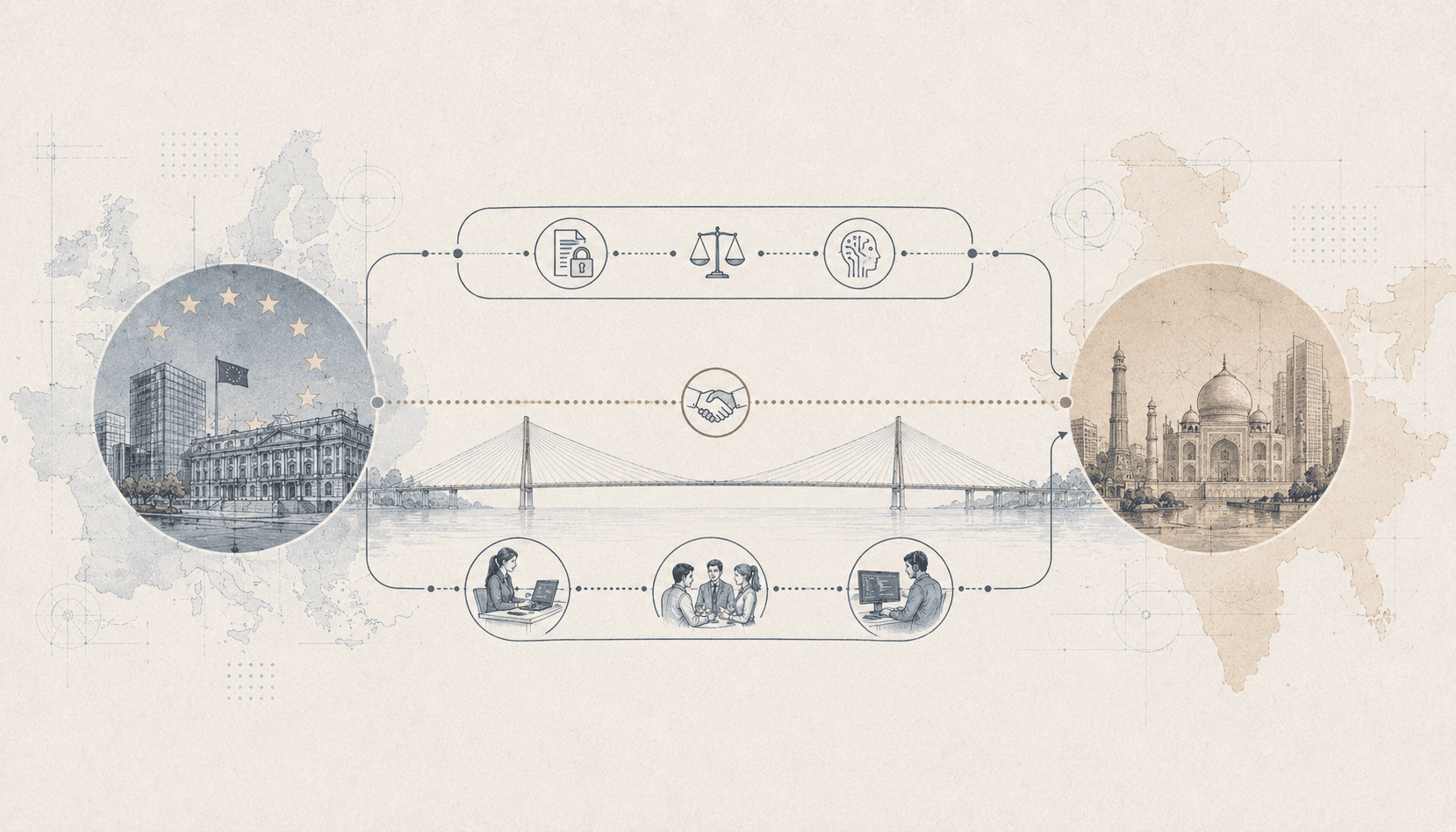
Europe and India have different digital strengths, but their relationship matters across AI, data, software, privacy, enterprise technology and digital trade.
EU–India bilateral trade reached €124 billion in 2023 (around US$135 billion), and the EU is now India’s third-largest trading partner — but the digital relationship has been growing faster than the goods trade for years.
India’s IT industry generated US$224 billion in exports in FY25, with Europe accounting for US$58.8 billion (30.8%) of that total, according to NASSCOM’s 2025 Strategic Review. The UK alone accounted for US$26.8 billion, or 14.1% of Indian IT exports — a number that puts India’s relationship with the UK on roughly equal footing with the rest of continental Europe combined. The EU and India launched their Trade and Technology Council in 2022 and have been negotiating a Free Trade Agreement (FTA) and a Digital Trade Agreement that, if completed, would be among the largest such deals globally.
The EU–India relationship doesn’t fit the simple narratives that get applied to US–India or China–India. It’s slower, more complicated, and ultimately may be one of the most consequential digital partnerships of the 2030s.
Why the EU–India relationship is structurally different
Three things distinguish EU–India from US–India.
The agreement itself is now the headline. The EU and India concluded a Free Trade Agreement on 27 January 2026, covering around 2 billion people and roughly 25% of global GDP between them — what India’s Commerce Ministry has described as the “mother of all deals” (European Commission). India will eliminate or reduce tariffs on 96.6% of EU exports by value; the EU will reciprocate on 99.5% of Indian goods. The European Commission projects US$4.7 billion in annual duty savings, with bilateral exports potentially doubling by 2032.
The digital layer is where the agreement breaks new ground. Trade in services between the EU and India reached €59.7 billion in 2023, nearly doubling from €30.4 billion in 2020 (European Commission Trade Policy). India’s IT, telecom, digital and business services exports to the EU hit roughly US$50 billion in FY2024–25, and the FTA’s dedicated Digital Trade chapter locks in commitments India has not made elsewhere — most importantly because India is not a member of the WTO’s E-Commerce Joint Initiative. The EU made deeper services commitments across 144 sub-sectors, including IT, professional services, business services and education.
The unresolved question is data adequacy. India’s Digital Personal Data Protection Act (DPDPA), 2023, is not yet recognised as adequate under GDPR — and the technical differences are real: DPDPA covers digital personal data only, while GDPR covers all personal data regardless of format (DPDPA.com — India-EU Data Adequacy). Without adequacy, every Indian processor handling EU personal data needs Standard Contractual Clauses or Binding Corporate Rules. Convergence is happening — but as of February 2026 the formal recognition has not arrived. That single decision will determine how quickly the FTA’s digital chapter actually compounds.
Different digital strengths. The US offers India platforms, capital, and frontier AI. Europe offers India regulation, industrial depth, privacy frameworks, enterprise markets and standards. These are complementary, but they don’t generate the same kind of fast capital deployment that US–India does.
Slower deal-making. The EU operates by 27-member consensus. India operates by complex federal politics. Both sides take longer to land trade agreements than the US or UAE do. The result is a relationship with high theoretical potential and slower realisation.
Different commercial incentives. US firms going to India want talent and engineering capacity for their global operations. European firms going to India want talent and engineering capacity, but they also want enterprise software customers, manufacturing partners, and increasingly green technology partners. The deal structures are messier.
These differences make the EU–India relationship harder to summarise but ultimately more durable. It’s not built on a single dependency.
What’s actually flowing between Europe and India
Here is where the relationship actually flows.
IT services and GCCs. European firms operate major Indian Global Capability Centres. According to Zinnov’s UK GCC Impact Report 2025, more than 130 UK firms operate 250-plus GCCs across India, employing over 200,000 professionals across digital, design and AI. German firms — particularly automotive and industrial — have built engineering-focused centres reflecting their precision and product ethos. French, Dutch, Swedish and Italian firms have followed. Together, European companies operate hundreds of Indian GCCs employing several hundred thousand people.
Industrial digital partnerships. Siemens, ABB, Bosch and Schneider Electric all run major Indian operations focused on industrial digitalisation. India’s manufacturing push (Make in India, PLI schemes) creates demand for European industrial software and automation that maps directly onto European strengths.
Pharma and healthtech. The EU–India relationship in pharmaceuticals is one of the deepest globally. European pharma giants run major Indian R&D, manufacturing and clinical trials operations. The digital health and clinical informatics layer on top of this base is now growing fast.
Regulation and data. The EU’s General Data Protection Regulation (GDPR) and India’s Digital Personal Data Protection Act 2023 are the two most important data privacy frameworks outside the US. They’re broadly compatible in spirit but different in implementation. Cross-border data flows between Europe and India are heavily shaped by both regimes.
Education and talent. European universities are significant destinations for Indian students, particularly in Germany, France, the Netherlands, Ireland and the Nordic countries. The talent pipeline that feeds European tech firms includes major Indian flow.
Why the EU sees India as strategic
The EU’s strategic logic on India has clarified over five years.
China dependency. EU firms over-exposed to China are looking for alternatives. India is the most credible large alternative for both manufacturing and engineering talent.
US technology dependency. Europe has become uncomfortable with the degree to which its digital economy runs on US platforms. India represents an alternative source of software, talent and increasingly digital infrastructure that doesn’t deepen US dependency.
A third digital path. Europe sees an opportunity to partner with India on building digital frameworks (data flows, privacy, AI governance) that aren’t dictated by US platform interests or Chinese state interests. The EU–India Digital Partnership, formalised in 2022, is the institutional vehicle for this.
These motivations make EU–India unusually strategic from the European side, even when the deal flow looks slower than US–India.
The FTA question
The EU–India Free Trade Agreement has been in negotiation since 2007, paused, restarted in 2022, and is currently in active negotiation rounds. Indian negotiators have committed to closing it during the current European Commission term ending in 2029. The associated Investment Protection Agreement and the Geographical Indications Agreement are being negotiated in parallel.
If these complete, they will likely include digital trade provisions covering data flows, e-commerce, payments and intellectual property. They won’t be as ambitious as the EU–Korea Digital Trade Agreement or what an EU–Japan equivalent might look like, but they’ll be more substantive than what exists today.
The bigger question is whether EU–India can move beyond agreements to actual deal velocity. The structural barriers — regulatory complexity on both sides, multiple national interests within the EU, complex Indian federal politics — won’t disappear. But the strategic logic for both sides is increasingly clear.
What this looks like commercially
Three developments illustrate where the relationship is heading.
European AI firms are establishing Indian operations. Mistral has been exploring Indian partnerships. SAP, Software AG, and OutSystems all run major Indian engineering operations. Adyen, Wise and Klarna run Indian product and engineering teams.
European industrial firms are deepening Indian commitments. Bosch has continued expanding its Bangalore R&D presence. Siemens runs major Indian manufacturing and engineering operations. Schneider Electric has expanded Indian smart grid and industrial automation businesses.
European VCs are increasing Indian exposure. EQT, Index, Atomico and others have built more active Indian investment programmes. While European VC in India still trails US and Asian capital, it’s growing as a share.
Where this goes next
Three structural shifts to watch.
The FTA finally landing. If the EU–India FTA closes by 2027–2028, it changes the deal velocity significantly. Even a modest agreement would unlock several hundred billion dollars in additional bilateral trade over a decade.
Industrial AI partnerships scaling. European industrial software (Siemens, SAP, Bosch) plus Indian engineering talent and increasingly Indian manufacturing capacity is a credible alternative to US-Chinese industrial AI competition.
Data and AI governance alignment. As the EU’s AI Act and India’s emerging AI governance frameworks both mature, alignment between them creates significant operating advantages for firms working across both jurisdictions.
The EU–India relationship is the slow-moving but compounding story in Asia. It doesn’t generate the headlines that US–India does, and it doesn’t have the consumer drama of China–India. What it does have is a real shared interest in building digital frameworks that aren’t dictated by either of the two superpowers.
For DIA readers tracking how Asia’s digital architecture evolves, EU–India is the relationship most likely to surprise on the upside over the next decade.
Part of a Digital in Asia series on the digital relationships shaping Asia’s next decade.
Related DIA coverage: India GCC market, Europe in Asia, AI governance in Asia.
Sources & Further Reading
- Office of the US Trade Representative — bilateral trade and tariff data
- IMF — World Economic Outlook — macro and trade indicators
- NASSCOM — Strategic Review — IT and GCC sector data
- Bain & Company — e-Conomy SEA Report — Southeast Asia digital economy
- World Economic Forum — global digital trade analysis
Discover more from Digital in Asia
Subscribe to get the latest posts sent to your email.
