
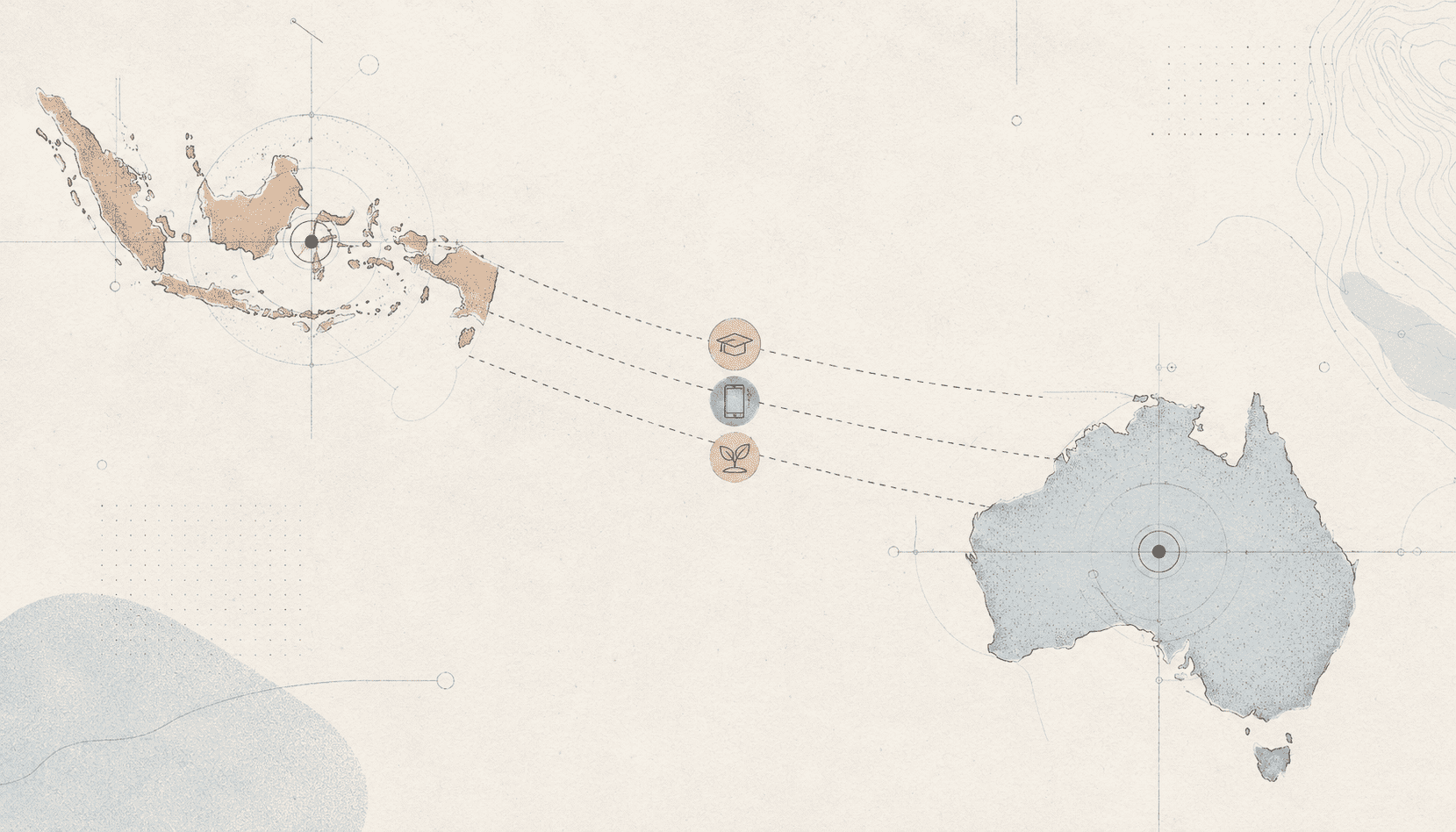
Education, fintech, skills, climate technology and consumer platforms give Australia and Indonesia more digital overlap than the relationship usually suggests.
Australia and Indonesia are direct neighbours with a combined population of more than 290 million, an Indonesia–Australia Comprehensive Economic Partnership Agreement (IA-CEPA) in force since 2020, and a digital economy story that’s significantly underbuilt relative to its potential.
Indonesia’s digital economy was projected to reach US$109 billion in GMV in 2025, the largest in Southeast Asia, per Bain & Company analysis. Australian foreign direct investment in Indonesia stood at AU$13.5 billion in 2024 — substantial but a fraction of Australian FDI in the US, UK, or Japan. Two-way trade between Australia and Indonesia exceeded AU$25 billion in 2024. Indonesian students account for one of the top international cohorts at Australian universities, with around 21,000 Indonesian students enrolled in 2024 according to Australian Department of Education data.
The numbers are decent. The strategic logic is strong. The execution has been weaker than it should be.
Why this is the most undervalued relationship in Asia
The geography is obvious. The economic complementarity is also clear: Australia has capital, education depth, enterprise technology, climate expertise and financial services maturity. Indonesia has population scale, mobile-first consumers, fast-growing fintech, e-commerce, digital banking, and a young workforce.
Three structural reasons the relationship has stayed smaller than its potential.
Australian capital has historically gravitated to OECD destinations. US, UK, Japanese and EU markets feel familiar to Australian institutional investors. Indonesia, despite being next door, requires a different operating model that Australian funds have been slow to build.
Indonesian regulatory complexity. Foreign ownership rules, data localisation requirements, and licensing regimes have made Indonesia harder to enter than its size justifies. Many Australian firms try once, encounter friction, and pull back.
Cultural and language distance. Despite proximity, Australian businesses operate predominantly in English with Anglosphere networks. Indonesia operates in Bahasa, with networks that often run through Singapore, Hong Kong, China and the Gulf rather than Australia.
These frictions are real. They are also overcomeable, and several Australian firms are now actively overcoming them.
Where the digital relationship is actually working
Here is where the relationship actually flows.
Education and edtech. Australia is a top-three destination for Indonesian higher education. Universities including Monash, Melbourne, UNSW and Sydney have major Indonesian alumni networks and growing edtech partnerships. Monash has even opened a campus in Indonesia. The pipeline of Indonesian graduates trained in Australian institutions is one of the most concrete digital relationships either country has.
Climate and renewable technology. Australia’s expertise in solar, grid management, mining technology and carbon accounting maps directly onto Indonesia’s energy transition. Australian firms including Squadron Energy, Macquarie Group’s green energy arm, and Fortescue’s clean energy business are scaling Indonesian operations.
Fintech and capital flows. The Australian fintech ecosystem — Atlassian, Canva, Afterpay, SafetyCulture, Airwallex (Australian-founded though now Asian-headquartered) — has built credible Asia-Pacific operations that include Indonesia. Australian VCs including AirTree, Blackbird and Square Peg now write Indonesian cheques.
Mining and industrial digitalisation. Australia’s mining technology stack — autonomous haulage, predictive maintenance, drilling automation — is being deployed in Indonesian operations, particularly in nickel, copper and coal where Australian operators have direct exposure.
What Indonesia offers Australian companies
The case for Australian companies thinking seriously about Indonesia comes down to three things.
A consumer market larger than ASEAN’s combined non-Indonesian population. Indonesia’s middle class is projected to reach 145 million people by 2030. The number of mobile internet users already exceeds 200 million.
A young workforce that English-language Australian companies can credibly hire from. Indonesia produces hundreds of thousands of STEM graduates annually, with a growing share fluent in English at professional level.
Strategic counterweight to over-concentration in China. Australian businesses with significant China exposure have been actively seeking diversification, and Indonesia is the most plausible regional alternative for consumer market access at scale.
The IA-CEPA framework, the Australia–Indonesia Investment Promotion Forum, and bilateral agreements on green economy and digital trade all create the institutional scaffolding. The commercial activity has been catching up but slowly.
The under-told story: Indonesian capital in Australian tech
The flow runs both ways. GoTo’s pre-IPO and post-IPO capital structure included Australian institutional investors. Indonesian family-office capital has been increasingly active in Australian tech and commercial property. Indonesian state-linked entities have invested in Australian critical minerals and battery supply chain assets.
This is the part of the relationship that’s least visible but most important. As Indonesia’s economy keeps growing — projected to be the world’s fourth-largest by 2050 — the capital flow into Australian assets is likely to scale significantly.
Where this goes next
Three structural shifts to watch.
A more concrete digital trade framework. The IA-CEPA hasn’t yet been substantially upgraded for the AI era. Both governments have signalled openness to a digital chapter that addresses data flows, e-commerce rules and fintech licensing more directly.
Indonesia’s role in Australian critical minerals strategy. Australia exports nickel, lithium and rare earths that increasingly route through Indonesian processing. The integration of Australian raw materials with Indonesian downstream capacity is a significant industrial story with major digital infrastructure requirements.
Edtech and skills export. Australian universities and training providers are well-positioned to support Indonesia’s large workforce upskilling needs. AI and digital skills training, in particular, is a category where Australian capacity could find significant Indonesian demand.
Australia–Indonesia is the relationship most likely to surprise on the upside over the next decade. The fundamentals are right, the geography is unbeatable, and both governments have signalled commitment to scaling it.
What’s been missing is execution. That’s now starting to change.
Part of a Digital in Asia series on the digital relationships shaping Asia’s next decade.
Related DIA coverage: Indonesia digital economy, Australia in Asia, ASEAN edtech.
Sources & Further Reading
- Office of the US Trade Representative — bilateral trade and tariff data
- IMF — World Economic Outlook — macro and trade indicators
- NASSCOM — Strategic Review — IT and GCC sector data
- Bain & Company — e-Conomy SEA Report — Southeast Asia digital economy
- World Economic Forum — global digital trade analysis
Discover more from Digital in Asia
Subscribe to get the latest posts sent to your email.
