
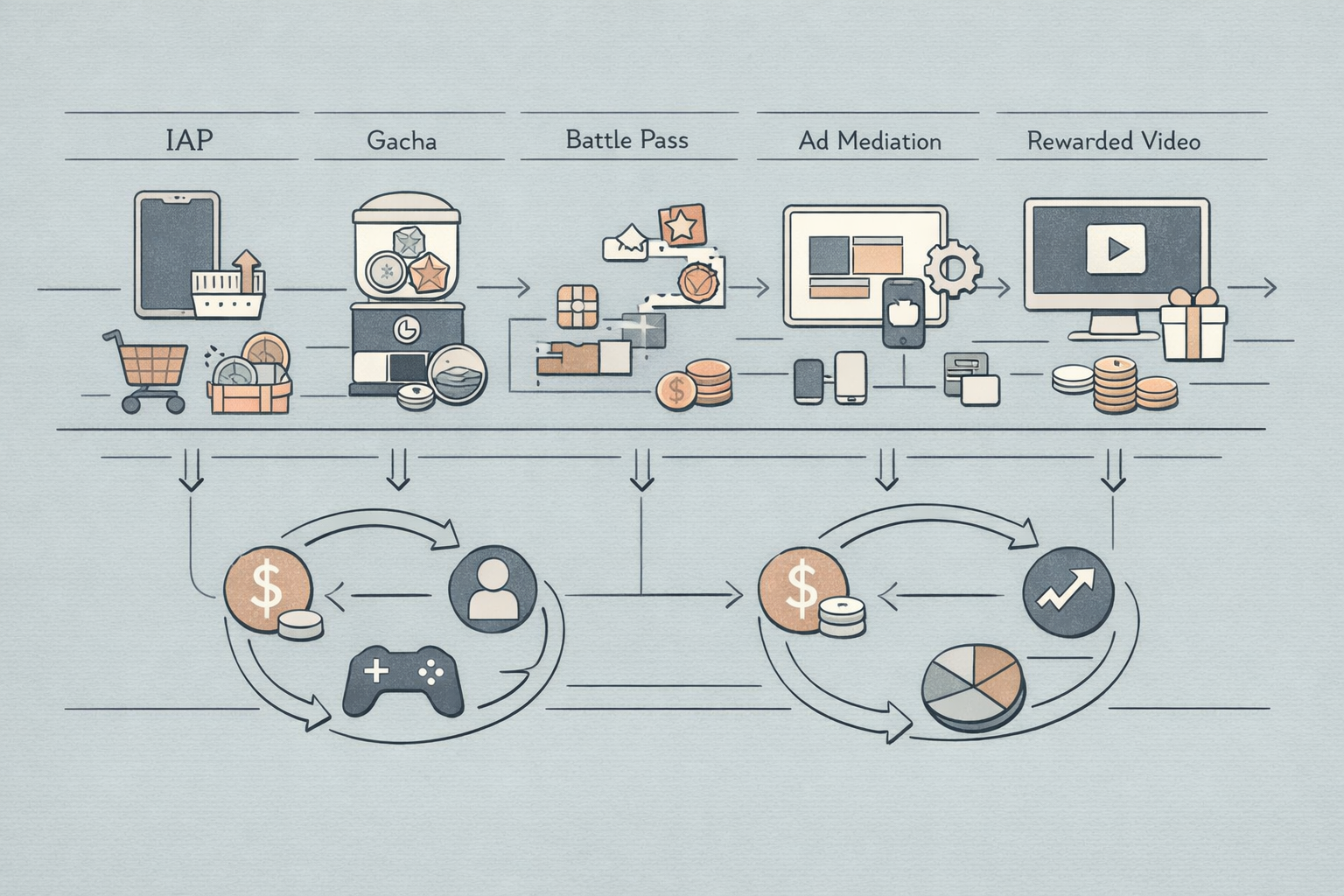
Asia-Pacific gaming generated $87.6 billion in 2025, accounting for 46% of global gaming spend (Newzoo). That’s not a projection or an aspiration — it’s the single largest entertainment revenue pool on the planet, and it’s growing. China’s market alone hit RMB 350.79 billion ($49.7 billion), up 7.68% year-on-year, with 683 million players setting a new all-time high (CGIGC). Mobile takes the lion’s share: roughly 73% of China’s domestic gaming revenue and over 70% of Southeast Asia’s $6.6 billion market. The companies driving this — Tencent, miHoYo, Krafton, Garena — aren’t just making games. They’re operating monetisation machines that blend free-to-play mechanics, live-ops cadences, ad mediation stacks, and increasingly, hybrid models that would’ve been heresy five years ago. Krafton posted record annual revenue of KRW 3.3 trillion in 2025, up 22.8% year-on-year. Garena’s Free Fire pulled $358 million. miHoYo’s Genshin Impact continues to print money across every market it touches.
Understanding how these companies actually monetise — the mechanics beneath the surface — matters because Asia’s gaming playbook is now the global playbook. The models that work here export everywhere.
What are the main monetisation models?
There are four, and most successful games in Asia now use at least two.
In-app purchases (IAP) remain the dominant revenue driver. Japan and China are the two largest IAP markets globally, with Japanese players spending $11 billion and Chinese players $11.5 billion on mobile IAP between August 2024 and July 2025 (Sensor Tower). IAP covers everything from character pulls and battle passes to cosmetic skins and progression boosts. In mid-core and RPG titles — which account for 79% of Asia’s game revenue — IAP is the primary engine.
Ad monetisation is the second pillar, particularly in casual and hyper-casual genres. In-game advertising revenue worldwide hit $124.45 billion in 2025 and is forecast to reach $181 billion by 2030 at 7.82% CAGR (Statista). In South Korea, 83% of mobile games utilise in-app advertising, compared to 74% globally. The mechanics here — waterfalls, bidding, mediation — are where operational complexity lives, and I’ll break those down below.
Subscriptions are still a minor contributor but growing. Battle passes — essentially time-limited subscriptions with progression rewards — have become ubiquitous since Fortnite popularised the model. In Asia, titles like PUBG Mobile and Free Fire run seasonal passes that convert free players into low-spend recurring users. It’s not subscription in the Netflix sense; it’s subscription as a gateway drug to higher IAP spend.
Hybrid monetisation — combining IAP and ads in the same title — is the fastest-growing model, driven largely by the hybrid-casual wave. More on that shortly.
How does the free-to-play model actually work in Asia?
Free-to-play (F2P) isn’t a pricing strategy. It’s a design philosophy, and Asia invented the modern version of it.
The core loop is straightforward: give the game away, acquire users at scale, then monetise a small percentage of them through IAP or ads. In most F2P mobile games, roughly 2-5% of players ever spend money. The entire economic model rests on making the experience good enough that millions play for free — generating ad impressions, social proof, and matchmaking liquidity — while a small cohort of high-spenders drives the revenue.
In Asia, this model runs deeper than anywhere else because the dominant mechanic is gacha. Gacha systems — randomised reward draws modelled on Japanese capsule-toy machines — are featured in 93% of Japan’s top-grossing titles (Sensor Tower). Players spend premium currency (bought with real money) for a chance to pull rare characters, weapons, or items. The psychology is potent: variable-ratio reinforcement, collection completionism, and social comparison all firing simultaneously. miHoYo’s Genshin Impact built a $4 billion franchise on this mechanic, refined with pity systems (guaranteed rare drops after a set number of pulls) and limited-time banners that create urgency.
Japan has the highest ARPU in the world for mobile gaming, exceeding $100 per paying user. That’s not because Japanese players are careless with money — it’s because the live-ops rhythm is meticulously designed. Banners rotate, events layer, meta shifts demand new characters, and the sunk-cost psychology of an established collection keeps players spending over years, not weeks. The combination of RPG/gacha affinity, character attachment, and live-ops mastery creates lifetime value profiles that few markets can match.
How does ad monetisation work in mobile games?
This is where the operational complexity sits, and where most non-specialists’ eyes glaze over. But the ad stack is where billions of dollars in value get created or destroyed, so it’s worth understanding properly.
The ad formats. Three formats dominate mobile game ad monetisation. Rewarded video — where players opt in to watch a 15-30 second ad in exchange for in-game currency or extra lives — delivers the highest eCPMs, typically $10-50 in premium markets. In Asia-Pacific, iOS rewarded video eCPMs rebounded 18% year-on-year in 2025, with Japan hitting $17.35 on Android (TopOn). Interstitials — full-screen ads shown at natural break points — sit slightly lower but drive volume. Banners still exist but they’re margin filler at best, generating a fraction of the revenue per impression.
The waterfall. Historically, publishers monetised ads through a waterfall: a ranked list of ad networks, called sequentially from highest to lowest expected eCPM. If Network A didn’t fill the impression at $15 eCPM, the request cascaded to Network B at $12, then Network C at $10, and so on. The problem is obvious — waterfalls are static, they leave money on the table when a lower-ranked network would’ve paid more for that specific impression, and they require constant manual optimisation. Any ad ops person who’s spent time tuning waterfall floors at 2am knows this pain intimately.
The shift to bidding. The industry has been migrating from waterfalls to real-time bidding, and 2025 marked a tipping point. AppLovin’s MAX — the dominant independent mediation platform — announced that from July 2025, it would no longer support traditional non-bidding network instances. That’s not a nudge; it’s an ultimatum. The shift matters because bidding lets every network compete on every impression simultaneously, which generally lifts publisher revenue 20-40% compared to a well-optimised waterfall. Unity LevelPlay (the merged ironSource and Unity Ads stack) competes for the same publishers, though MAX has pulled ahead dramatically in market share.
The mediation layer. Mediation platforms sit between the publisher and the ad networks, running the auction or waterfall and optimising for yield. The duopoly is AppLovin MAX and Unity LevelPlay. Both platforms perform significantly better when their own demand is running natively — AppLovin and Unity each generate roughly 4x more revenue on their own mediation versus as a guest network on the competitor’s platform. That structural advantage is why the mediation wars matter so much. For publishers in Asia, choosing the right mediation stack can be the difference between a viable business and a marginal one.
What’s different about monetisation in China vs Southeast Asia vs Japan/Korea?
The regional variation is enormous, and treating “Asia“ as a single market is a recipe for burning cash.
China is the world’s largest gaming market by revenue, but it operates behind regulatory walls that shape every monetisation decision. The government caps monthly game licence approvals, imposes youth gaming curfews, and restricts loot box mechanics — monthly licence caps alone trim market growth by roughly 1.6 percentage points (Niko Partners). Tencent and NetEase hold 61% of the mobile and PC market. IAP dominates, with cosmetics and progression items driving the bulk of spend. Ad monetisation is less developed in mid-core titles but growing in casual. The biggest strategic shift is outbound: China’s studios are aggressively exporting globally, with titles like Genshin Impact, Black Myth: Wukong, and Delta Force generating substantial revenue outside China.
Japan and South Korea are high-ARPU, IAP-heavy markets with distinct spending cultures. Japan skews toward gacha and character collection — 93% of top-grossing titles use gacha mechanics — while South Korea’s spending centres on cosmetics and status items, particularly in competitive titles. South Korea’s ARPU is tracking toward roughly $369 by 2029 (Statista). Both markets have mature, sophisticated players who expect deep progression systems and regular content updates. Ad monetisation is a secondary revenue stream in these markets, though Japanese publishers are increasingly experimenting with rewarded video in RPG titles — genres that would’ve been IAP-only three years ago.
Southeast Asia is structurally different. Lower ARPU, younger demographics, Android-dominant (80%+ market share), and far more price-sensitive. Mobile gaming generates about $4.6 billion across the region, with Free Fire and PUBG Mobile as anchor titles. Ad monetisation plays a much larger role here because IAP conversion rates are lower — players are willing to watch ads for premium content rather than pay for it. eCPMs are lower than Japan or Korea, but the user volumes are enormous. Indonesia alone has 200 million mobile internet users. The hybrid-casual model — mixing ads and light IAP — finds its natural home in SEA.
What’s the hybrid-casual shift?
Hybrid-casual was the standout monetisation gainer in 2025, and it’s reshaping how studios think about game economics.
The concept is simple: take the accessibility and broad appeal of casual or hyper-casual games, add deeper progression mechanics that increase retention, and monetise through both ads and IAP simultaneously. Pure hyper-casual titles — those five-second-to-learn games that monetise almost entirely through interstitial ads — have been declining because user acquisition costs outpace the ad revenue per user. Hybrid-casual fixes this by adding an IAP layer that increases LTV enough to sustain higher UA spend.
The monetisation split varies by sub-genre. Lifestyle and puzzle hybrid-casual titles lean heavily on ads (41% of revenue from advertising), while action and strategy variants derive more from IAP (ads accounting for only 18%). That bifurcation matters for studio economics — an ad-heavy title needs volume and eCPM optimisation, while an IAP-heavy title needs retention and conversion funnel design. They’re fundamentally different operational challenges.
What’s driving adoption in Asia specifically is the market structure. Southeast Asia’s lower ARPU makes pure IAP models harder to sustain, but pure ad models don’t generate enough per user either. Hybrid-casual threads the needle: ads monetise the 95% who’ll never pay, IAP captures incremental revenue from the 5% who will, and the combined LTV justifies the acquisition spend. It’s not elegant, but it works. Vietnam is the poster child for this, dominating the global market with 9.6 billion downloads but a low ARPU — and now switching from hyper to hybrid casual to close the monetisation gap.
What’s changing?
Three forces are reshaping gaming monetisation in Asia, and all of them are accelerating.
AI-driven personalisation is moving from targeting ads to designing the monetisation experience itself. Dynamic difficulty adjustment, personalised offer timing, and predictive churn models are letting studios optimise revenue per user in ways that static systems never could. The studios with the deepest data — Tencent, miHoYo, Krafton — have the structural advantage here, because AI monetisation models are only as good as the behavioural data they’re trained on. China holds the advantage on AI models, with deep penetration via Qwen and Deepseek.
Alternative distribution is challenging the app store duopoly. Big players in Asia are already testing direct-to-consumer IAP outside the App Store and Google Play, bypassing the 30% platform commission. Epic’s legal victories, the EU’s Digital Markets Act, and regulatory pressure in South Korea and Japan are opening doors. A studio that can move even 10% of IAP revenue off-platform reclaims 3% of gross revenue overnight — that’s transformational at scale.
User-generated content and creator economies are blurring the line between player and developer. Roblox-style models, where players build and monetise content within the platform, are gaining traction in Asia. This shifts the monetisation model from studio-to-player to platform-as-marketplace, with the game company taking a cut of every creator transaction. It’s the mini-program model applied to gaming, and given how well that model works for WeChat, it’s got a clear precedent in the region.
The through-line across all of these shifts is the same: the games that win in Asia aren’t just the ones with the best gameplay. They’re the ones with the best monetisation infrastructure — the mediation stacks, the live-ops cadences, the data pipelines, the pricing algorithms. In a market this large and this competitive, the business model is the product.
Sources & Further Reading
Discover more from Digital in Asia
Subscribe to get the latest posts sent to your email.
