
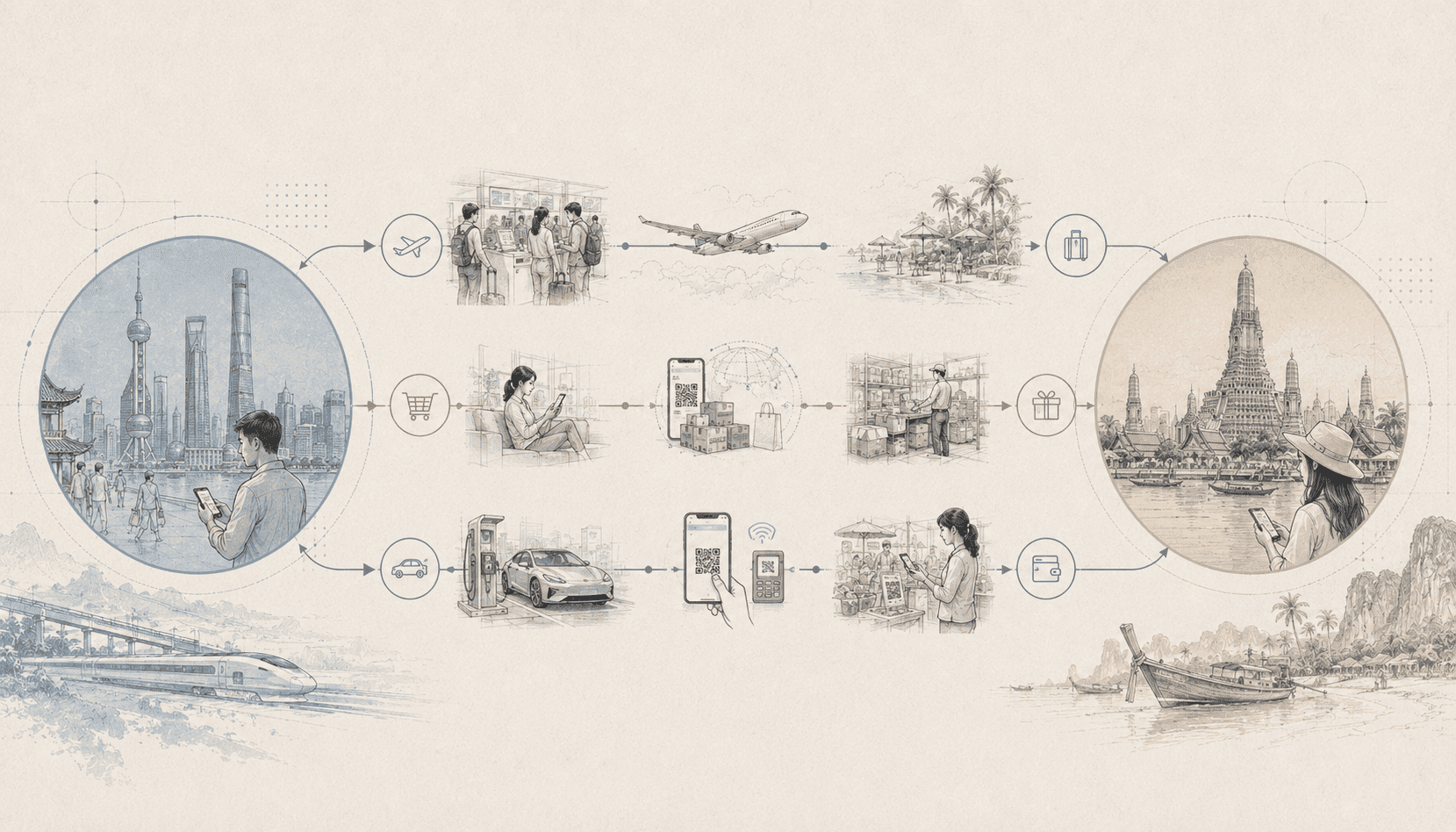
Chinese platforms, payments, ecommerce, EVs and travel flows are reshaping Thailand’s consumer and digital economy.
Thailand’s e-commerce market grew faster than any other Southeast Asian country in 2025, and Chinese platforms are the dominant force behind that growth.
TikTok Shop Thailand reached US$5.9 billion in 2024 sales with more than 3 million Thai sellers, and Q1 2025 GMV grew 217% year-on-year — surpassing both the US and Indonesia by quarterly growth rate, per Momentum Works. Thailand’s overall digital economy was projected to reach US$49 billion in GMV in 2025, the second largest in Southeast Asia. Chinese tourists were forecast to account for around 7 million arrivals in Thailand in 2025, recovering toward pre-pandemic levels of 11 million. Chinese EV makers BYD, Great Wall Motor, MG (SAIC) and Hozon Auto have collectively committed billions of dollars to Thai EV manufacturing operations. TikTok Shop has announced an US$8.8 billion investment over five years in Thailand alone.
This is one of the most consequential consumer-facing digital relationships in Asia, and it operates at the intersection of platforms, payments, EVs, tourism and content.
Why Thailand is the Chinese platform stronghold
Several structural reasons.
Smaller, less protected market than Indonesia. Thailand’s regulatory regime for digital platforms has been relatively permissive compared to Indonesia’s, allowing Chinese platforms to operate without the same level of acquisition or restructuring overhead. TikTok Shop never faced the kind of forced merger that ByteDance had to execute with Tokopedia in Indonesia.
Tourism integration. Chinese tourist flows into Thailand create constant on-the-ground demand for Chinese payment systems, Chinese-language content, and Chinese consumer brand recognition. Alipay and WeChat Pay are widely accepted in tourist areas. Thai retailers have systematically integrated Chinese payment infrastructure to serve Chinese visitors.
Cultural and geographic proximity. Thailand sits on China’s southern doorstep. Chinese influence has been cumulative across decades — through tourism, business, immigration, and cultural exchange. This base makes platform adoption more frictionless than in markets without that history.
Thai government strategy. Thailand has positioned itself as a friendly destination for Chinese investment, particularly in EVs, electronics and digital infrastructure. The Eastern Economic Corridor (EEC) has been a major channel for Chinese industrial and digital investment.
What Chinese platforms have built in Thailand
The footprint is broad.
E-commerce. Shopee (Tencent-backed) and Lazada (Alibaba-owned) compete intensely with TikTok Shop for the Thai e-commerce market. The combined Chinese platform share of Thai e-commerce is well over 80%.
Live commerce and content. Thailand has become one of the most successful markets globally for TikTok-style live shopping. Thai sellers have adopted Chinese live commerce playbooks — sometimes more successfully than Chinese sellers do in their own market.
Payments. Alipay+ and WeChat Pay extend Chinese payment infrastructure across Thai retail. Local Thai e-wallets (TrueMoney, Rabbit LINE Pay) interoperate with Chinese systems. The Thai-Chinese payments corridor is one of the most fluid in Southeast Asia.
EVs. BYD’s Thai factory, Great Wall Motor’s Rayong plant, MG’s Thai operations, and Hozon’s expansion are reshaping the Thai automotive industry. Chinese EVs accounted for the majority of new EV sales in Thailand in 2025. The associated digital infrastructure — connected car platforms, charging networks, in-vehicle Chinese-developed AI — represents a new layer of integration.
Tourism technology. Chinese platforms shape how Chinese tourists discover, plan and pay for Thai experiences. Trip.com, Meituan, Dianping, and Xiaohongshu all run substantial Thai tourism businesses. This isn’t just demand routing — it’s algorithmic shaping of which Thai destinations and businesses get visitor flows.
What this means for Thai businesses
The opportunity is real. Thai sellers who learn to operate on Chinese platform economics can scale fast. The 3 million Thai TikTok Shop sellers represent one of the most effective small-business digitisation programmes in Southeast Asia.
The risk is also real. As Chinese platforms accumulate share, Thai-owned digital businesses face structural disadvantages. Thai e-commerce platforms (Lookbook, Shopat24, others) have largely been displaced or absorbed. Thai content and entertainment platforms compete against Chinese platforms with superior algorithmic infrastructure and better cross-platform monetisation tools.
Thailand’s response has been pragmatic rather than restrictive. The government has not imposed Indonesia-style licensing requirements or forced acquisitions. Instead, the country has tried to extract maximum economic value through investment commitments (TikTok’s US$8.8 billion over five years), tax structures, and local hiring requirements.
Whether this approach holds through 2030 is one of the central questions for Thailand’s digital sovereignty.
The competitive context
Chinese platforms in Thailand operate against US platforms (Google, Meta, Apple, Amazon Prime Video) and Japanese cultural and gaming influence (see Japan–Thailand: Industry Meets Digital Soft Power). The Chinese position is strongest in commerce, payments and short-form content; the US position is strongest in search, social media (Facebook, Instagram), and premium content; the Japanese position is strongest in gaming, anime and industrial digital systems.
This three-way structure makes Thailand one of the most competitive digital consumer markets in Asia. No single foreign technology bloc dominates the whole stack — though Chinese platforms have come closest to building a full integrated experience from content through commerce through payment.
Where this goes next
Three things to watch.
Continued Chinese EV scaling and the digital layer it brings. As Chinese EVs reach majority market share in Thai new-vehicle sales, the connected car infrastructure, in-vehicle AI, and charging network management built by Chinese firms becomes a major piece of Thai digital infrastructure.
The TikTok Shop investment ramp. The US$8.8 billion commitment over five years implies major data centre and content hub investment. This creates Thai jobs and capacity but also embeds Chinese platform infrastructure deeper into Thai digital ground.
Regulatory evolution. Thailand has been more permissive than Indonesia, but pressure is building to extract more domestic value from Chinese platform operations. Expect tax structure changes, data localisation rules, and possibly licensing requirements similar to Indonesia’s.
For DIA readers tracking how Chinese digital influence operates outside China, Thailand is the cleanest case study. The relationship works because it’s broad — content, commerce, payments, EVs, tourism — rather than narrow.
That breadth makes it durable. It also makes it strategically important to anyone building or competing across Southeast Asia.
Part of a Digital in Asia series on the digital relationships shaping Asia’s next decade.
Related DIA coverage: Thailand digital economy, TikTok Shop in Southeast Asia, Chinese EVs in Asia.
Sources & Further Reading
- Office of the US Trade Representative — bilateral trade and tariff data
- IMF — World Economic Outlook — macro and trade indicators
- NASSCOM — Strategic Review — IT and GCC sector data
- Bain & Company — e-Conomy SEA Report — Southeast Asia digital economy
- World Economic Forum — global digital trade analysis
Discover more from Digital in Asia
Subscribe to get the latest posts sent to your email.
