
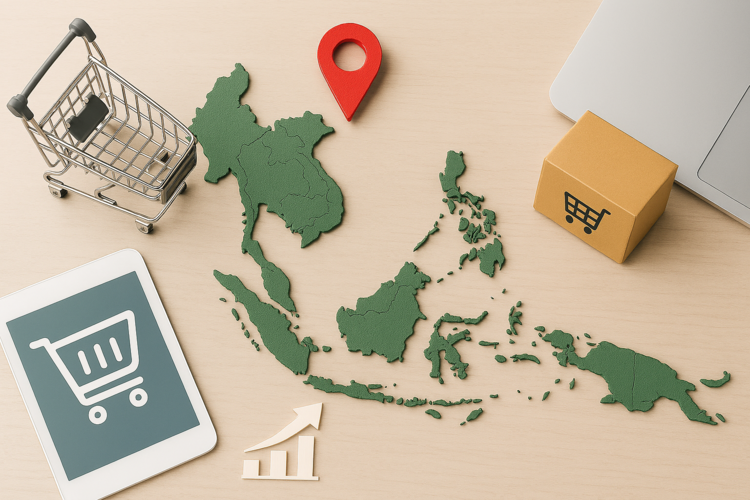
The Southeast Asian e-commerce market reached $159 billion in gross merchandise value (GMV) during 2024, representing a 15% year-over-year increase, according to the e-Conomy SEA 2024 report. As of Q1 2026, the market is on track to hit $215–230 billion by end of 2026, with a path to $350–370 billion by 2030. These aren’t vanity metrics—they represent real structural shifts in how 612 million people in the region shop online.
But here’s what most analysts get wrong: size alone doesn’t tell you where the money actually flows. Indonesia dominates with $65 billion in GMV (41% of the region’s total), but Thailand punches above its weight with $26–30 billion (+21.7% growth), Vietnam sits at $22–25 billion (+18–25%), the Philippines claims $20–21 billion (+23%), Malaysia holds $16 billion (+19.5%), and Singapore—the wealthiest nation—represents just $9 billion (+12%). The fact that a city-state with 5.9 million people generates less GMV than the Philippines’ 115 million tells you this market runs on volume, not affluence.
E-commerce still only penetrates 12.8% of total retail in Southeast Asia. Compare that to China’s 47%, and you’re looking at a market that’s still in the gold-rush phase. The physical infrastructure alone reveals why: 43.6 million parcels ship daily across the region. That’s not a logistical achievement—it’s a logistical nightmare that somehow works.
Why 68% of Southeast Asian E-Commerce Buyers Have Never Used Desktop
Seventy-three to 83% of Southeast Asia is internet-connected, and 90% of that connection happens on mobile. Here’s the uncomfortable truth: 68% of Southeast Asian shoppers have never made a desktop e-commerce purchase. Ever. Not once. The industry isn’t “becoming mobile-first”—it already is. Desktop is already dead.
This single fact drives decisions about design, checkout flow, payment methods, and content strategy that Western companies consistently misunderstand. When you’re building for mobile-only audiences, app-exclusive features aren’t a luxury—they’re mandatory.
The demographic composition amplifies this. Generation Z represents 25% of the region’s population. Indonesia alone has 74.93 million Gen Z consumers. These are digital natives who’ve never known physical retail as their primary shopping destination. They don’t need to be educated about online shopping; they need to be convinced your specific platform is worth their attention.
How Video Commerce Created a Structural Demand Shift Worth Billions
The 2024 re-acceleration in the SEA e-commerce market wasn’t just growth—it was a structural demand shift created by video commerce. Shoppable video, live shopping events, and social commerce integration fundamentally changed consumer behavior. Products that couldn’t move on traditional e-commerce platforms suddenly found demand through livestream channels.
The broader digital economy context matters here: Southeast Asia’s entire digital economy crossed $300 billion by the end of 2025. E-commerce is the visible part, but payments, digital advertising, and SaaS are all growing at different velocities. Understanding which segment you’re entering is critical to realistic projections.
The $159 billion figure for 2024 represents a market that’s still structurally young. The penetration rate gap versus China means there’s demand ceiling headroom that hasn’t been breached yet. But the growth rate slowdown from prior years (15% YoY is solid, but lower than the 19–22% rates seen in 2021–2022) suggests the easy growth is behind us.
What remains is the hard work: building logistics networks that actually work at scale, acquiring customers who don’t default to your competitors (as Lazada’s strategic pivot to Confidence Commerce shows), and creating retention mechanics for markets where price is the primary differentiator.
Gen Z is accelerating this shift. Gen Z accounts for approximately 25% of Southeast Asia’s total population — the largest single generational cohort. Indonesia alone has 74.93 million Gen Z individuals (e-Conomy SEA 2024). These consumers rely on social media as their primary product research channel at a rate of 70%, shop online multiple times weekly, and are 21% more likely than Millennials to discuss products on social platforms. Their purchasing behaviour is fundamentally content-driven rather than search-driven, which reshapes the entire acquisition funnel for brands operating in the region.
The logistics infrastructure underpinning this growth is equally significant. Southeast Asia’s express delivery market handled 14.94 billion parcels in 2023 and is projected to reach 37.99 billion by 2029 at a 16.82% CAGR (Mordor Intelligence, 2025). Shopee Express (SPX) now delivers 50% of Shopee’s SEA parcels in under two days, while J&T Express commands a 28.6% market share across the region. Same-day delivery is standard in Singapore, Malaysia, and Thailand’s major cities, and extending rapidly into secondary markets.
The $215–230 billion projection for 2026 reflects compound growth across all six markets simultaneously. The question for operators and investors is which segments — social commerce, cross-border, quick commerce — will capture the largest share of incremental GMV over the next four years.
Read more: how digital payments are replacing cash-on-delivery across the region
