
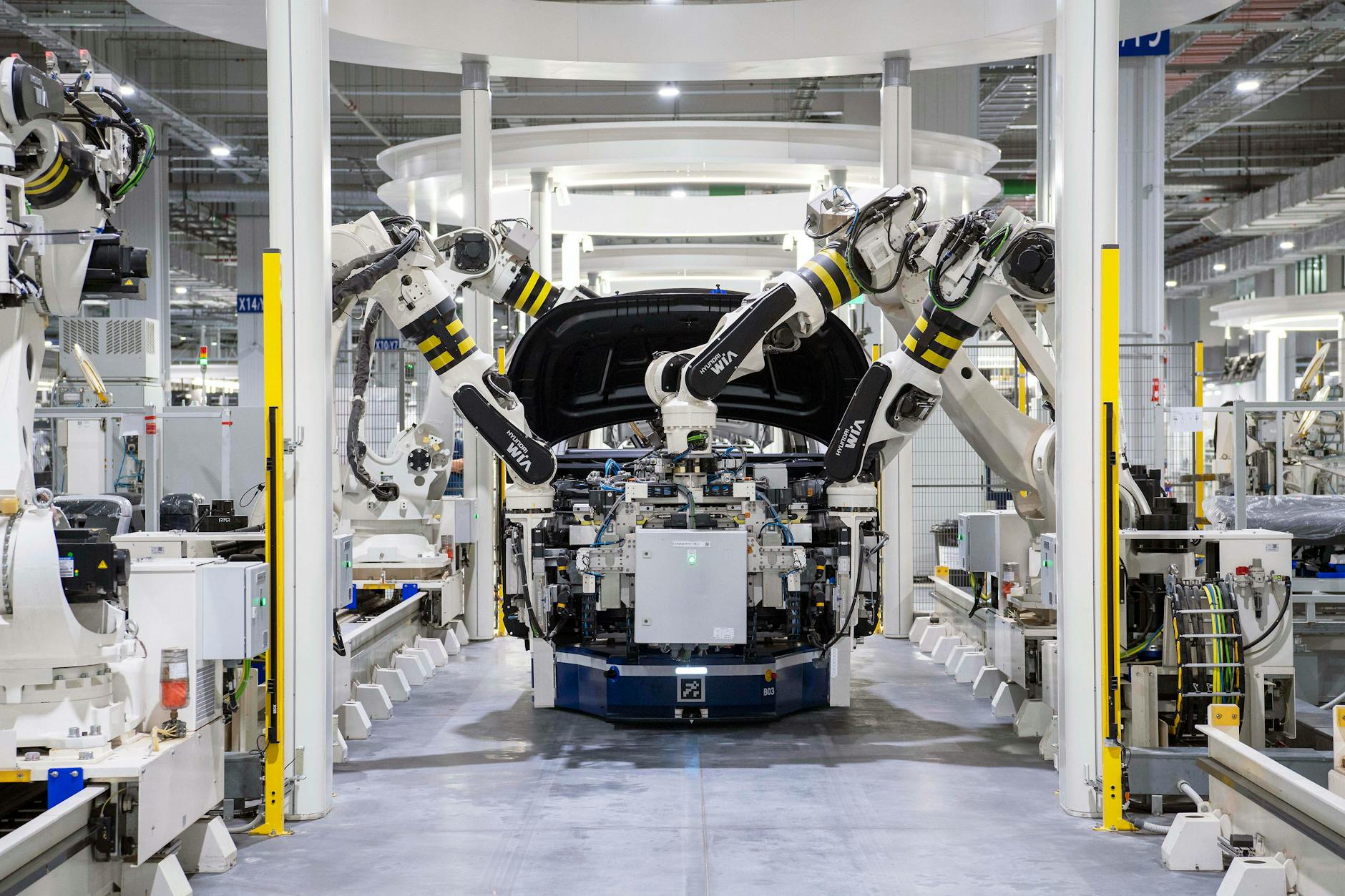
China dominates industrial AI the way no country dominates any other part of the AI race. It operates more than 30,000 smart factories, installs over half the world’s industrial robots, and runs a manufacturing AI build-out so large that Nvidia’s Jensen Huang calls China “formidable” in physical AI and says the US robotics industry “relies deeply” on Chinese supply chains. While the West argues about chatbots, China has pointed AI at the factory floor — and the gap in deployment is the real story of Asian AI. This is the China industrial AI market: the largest applied-AI economy on earth.
How many smart factories does China operate?
More than 30,000, according to China’s Ministry of Industry and Information Technology (MIIT), with the tally broken into tiers: over 30,000 basic-level smart factories, plus around 1,200 advanced-level and 230 excellence-level facilities, spanning all 31 provincial regions and more than 80% of manufacturing sectors (MIIT, February 2025). The excellence-level plants are not marginal upgrades — MIIT reports them averaging 28.4% shorter development cycles, 22.3% higher productivity, 50.2% lower defect rates and 20.4% lower carbon emissions.
China also leads the World Economic Forum’s Global Lighthouse Network — the benchmark for advanced manufacturing — with 101 lighthouse factories after 16 new Chinese sites were added in January 2026, roughly 70% of the global cohort. No other country is close. The 30,000 figure is MIIT’s February 2025 headline count and remains the reference number into 2026.
How big is China’s industrial AI market?
Here the numbers need care, because definitions vary wildly. China’s core AI industry topped 1.2 trillion yuan (about $174 billion) in 2025, with more than 6,200 AI companies, and by the end of 2025 over 30% of China’s above-scale manufacturing enterprises had adopted AI (MIIT minister Li Lecheng, March 2026). That core-AI figure is broader than industrial AI specifically — but it’s the official measure, and the 30%-of-manufacturing adoption rate is the cleanest signal of how deep industrial AI now runs.
Narrower “industrial AI” market estimates from Western research firms land far lower and disagree sharply with each other — these are useful as directional signals, not precise figures, because each firm defines the category differently. The honest summary: by the official Chinese measure, AI is now embedded across a third of China’s large manufacturers, and the deployment is accelerating under explicit state policy.
Why is China the world leader in industrial AI?
Three structural forces drive it. First, policy. China’s August 2025 “AI+” initiative — the framework succeeding Made in China 2025 — names “AI+ Manufacturing” a national priority and targets AI penetration above 70% by 2027 and 90% by 2030. Provincial governments compete to subsidise AI-intensive manufacturing, creating a policy environment that actively funds deployment.
Second, scale and demographics. China is the world’s largest manufacturer by output, giving AI an enormous deployment surface, and its working-age population peaked in 2015 and is now declining — the same automation pressure Japan faces, at roughly ten times the scale. Automating production isn’t optional; it’s a demographic necessity.
Third, robots and compute. China installed 295,000 industrial robots in 2024 — 54% of global demand — and now operates a world-record stock of over 2 million factory robots, about 4.5 times more than second-place Japan, with domestic suppliers outselling foreign ones at home for the first time (International Federation of Robotics, 2025). Combined with a large domestic AI-compute base running on Huawei Ascend silicon, China can run the inference-heavy workloads that factory AI requires without depending on foreign cloud providers.
What is “physical AI,” and why does it favour China?
This is the framing that captures China’s edge. Nvidia’s Jensen Huang distinguishes physical and industrial AI — robotics, automation, embodied systems — from the consumer-facing chatbots that dominate Western AI discourse. In March 2026 he called China “formidable” in robotics, noting that its microelectronics, motors, rare earths and magnets are “the world’s best,” and that the US robotics industry “relies deeply” on China’s supply chain. Nvidia has since partnered with China’s Unitree on a humanoid-robot reference design.
The embodied-AI push is real and large: Chinese companies had released over 300 humanoid robot products by the end of 2025, and Unitree became the world’s top humanoid seller before filing for a Shanghai IPO. It’s worth noting even China’s own planners see froth here — the National Development and Reform Commission has warned of “bubble” risk with 150-plus firms chasing few proven at-scale uses. But the underlying strength is genuine: if the next phase of AI is physical, China starts from the front. We map the model and chip side of this in our analysis of China’s AI models, chips and national strategy.
Which sectors lead China’s industrial AI?
Manufacturing leads by a wide margin. China’s smart factories integrate AI across the production chain — computer vision for quality inspection, predictive maintenance to cut downtime, digital twins to simulate and optimise production lines, and autonomous mobile robots for warehouse logistics. By IFR’s data, electronics is China’s single largest robot-using sector (around 83,000 installs, 64% of global electronics-robot demand), followed by automotive (57,200 installs, 45% of the global total) — the EV boom led by BYD is a major driver — with metals and machinery surging over 30%.
Beyond the factory, AI deployment runs deep in healthcare (medical imaging, hospital screening systems) and, less visibly, in agriculture — drone crop monitoring, precision irrigation and automated harvesting addressing rural labour shortages. The common thread is applied, physical AI at scale: China’s strength isn’t the frontier model, it’s putting AI to work in the real economy faster than anyone else.
What does China’s industrial AI leadership mean for Asia?
It creates pressure across the region. South Korea is responding with Samsung’s AI megafactory push and government investment in over 1,000 “K-Smart” lighthouse factories; Japan, technologically sophisticated but slower to deploy AI at scale, risks eroding its traditional manufacturing edge.
For Southeast Asia it’s both opportunity and threat. The opportunity is technology transfer — Chinese industrial-AI firms are expanding into Vietnamese, Thai and Indonesian manufacturing, bringing capabilities those markets can’t build alone. The threat is displacement: as Chinese factories automate, the labour-cost advantage that drew manufacturing to Southeast Asia narrows. The deeper constraint is geopolitical — US export controls have pushed China to build a parallel AI hardware stack, and the resulting split between Chinese and Western industrial-AI systems may limit interoperability for years. Either way, the centre of gravity in applied AI now sits in China. For the regional market picture, see our Asia AI market breakdown.
Frequently asked questions
How many smart factories does China have?
More than 30,000, per China’s Ministry of Industry and Information Technology (February 2025), including around 1,200 advanced-level and 230 excellence-level facilities across all 31 provincial regions and over 80% of manufacturing sectors. China also leads the WEF Global Lighthouse Network with 101 sites.
How big is China’s industrial AI market?
China’s core AI industry topped 1.2 trillion yuan (about $174 billion) in 2025, and over 30% of its above-scale manufacturers had adopted AI by end-2025 (MIIT). Narrower “industrial AI” estimates from Western firms vary widely by definition and should be treated as directional.
How many industrial robots does China install?
China installed 295,000 industrial robots in 2024 — 54% of global demand — and operates a world-record stock of over 2 million factory robots, about 4.5 times more than Japan (International Federation of Robotics, 2025).
What is physical AI?
Physical or industrial AI refers to robotics, automation and embodied systems applied to the real economy — manufacturing, logistics, robots — as distinct from consumer chatbots. Nvidia’s Jensen Huang uses the term to describe China’s AI strength, which is concentrated in deployment rather than frontier models.
Why does China lead in industrial AI?
A combination of state policy (the “AI+” initiative targeting 90% AI penetration by 2030), the world’s largest manufacturing base, an ageing workforce forcing automation, and dominance in industrial robots and domestic AI compute.
—
Sources & Further Reading
Discover more from Digital in Asia
Subscribe to get the latest posts sent to your email.
