
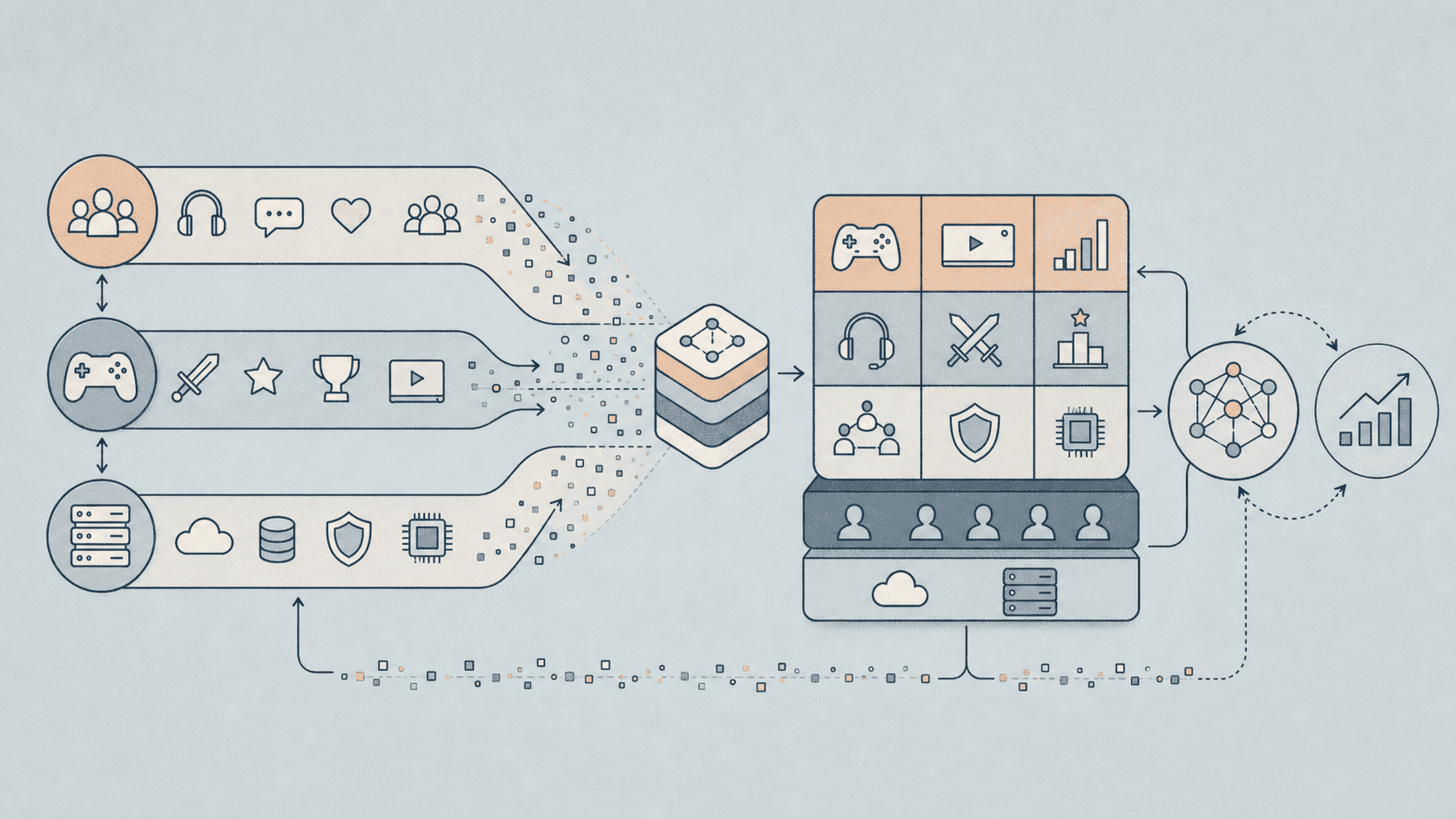
Asia-Pacific is the centre of gravity in global gaming — and it works in both directions. The Asia gaming market generated $87.6 billion in player spending in 2025, roughly 46% of the world’s $189 billion games market, with 1.9 billion of the planet’s 3.58 billion players (Newzoo). As a producer, it’s even more dominant: Asian studios make a large share of the games the rest of the world actually plays. Vietnam alone shipped 6.7 billion mobile game downloads in 2024 — more than any other country on earth, China included. China earns over $20 billion a year exporting games. The money flows in; the games flow out. If you only read Asia as a place where games get bought, you’re reading half the map. This is the whole one.
How big is the Asia gaming market really?
At $87.6 billion in 2025, Asia-Pacific is the single largest regional games market on earth, accounting for close to half of all money spent on games worldwide (Newzoo). The player base is the headline that matters more: 1.9 billion people in the region play games, more than five times the population of the United States. Spread that revenue across that many players and you get the defining feature of Asian gaming — enormous reach, lower average spend, and a market that lives or dies on scale rather than premium pricing.
The growth story has cooled from its pandemic-era highs. Regulatory tightening, app-store changes and privacy rules have slowed the explosive years, and Newzoo now puts more of mobile’s incremental growth in Western markets. But “slower” here means a market the size of a national economy adding a few percent a year. The base is so large that even modest growth moves billions.
Asia doesn’t just play games — it makes them
Here’s the part most market reports miss. Asia is not only the world’s biggest gaming audience; it is its biggest gaming factory. The most interesting story isn’t how much the region spends — it’s how much it ships. On the supply side, Asian studios produce a disproportionate share of the world’s most-played mobile games, and our reading of the download data is that the majority of mobile games installed globally now originate from Asian developers.
The evidence is in the export figures. China earned $20.45 billion from self-developed games sold overseas in 2025, and the flow is accelerating as Tencent, NetEase and miHoYo go international. Vietnam shipped 6.7 billion mobile game downloads worldwide in 2024 — the most of any country on earth (more on that below). Japan and South Korea export franchises the whole world knows, from Nintendo and Capcom to Krafton’s PUBG. When you add it up, the games on phones in São Paulo, Cairo and Chicago are increasingly built in Ho Chi Minh City, Shenzhen, Seoul and Tokyo.
And the production story runs deeper than exported titles. Chinese companies own much of Western gaming outright — Tencent holds 100% of Riot, around 28% of Epic and 81.4% of Supercell — so games that look American are often Chinese-controlled. At the other end, a wave of Asian studios now builds inside Western platforms: a growing share of Roblox and Fortnite Creative experiences are made in India and Southeast Asia, where Roblox alone paid out over $1 billion to creators in a single year (we cover this in Asia builds the metaverse). Counted properly — exports, ownership and platform builds together — Asia’s hand in global gaming is bigger than any revenue chart shows.
This is the lens that reframes everything below. A country can be a small market and an enormous exporter at the same time — and the country that proves it is Vietnam.
Why mobile rules Asian gaming
Asia plays on phones. The Asia-Pacific region accounts for roughly half of all global mobile gaming revenue, and within most Asian markets mobile is not one channel among several — it is the market. In Southeast Asia mobile makes up about 71% of gaming revenue; in India it is 79%. The reasons are structural: cheap Android handsets under $300, widespread 5G, and a generation that came online through a phone and never owned a console or a gaming PC.
This shapes everything downstream — the dominant genres (battle royale, MOBA, casual), the business model (free-to-play with in-app purchases), and the companies that win. A title like Garena’s Free Fire or Moonton’s Mobile Legends: Bang Bang isn’t a mobile version of a “real” game. In Asia, it is the real game. That’s the inversion Western analysts still get wrong. For how the money actually flows once a player is inside a free game, see our breakdown of how gaming monetisation works in Asia.
China: the $50 billion anchor
China is the largest gaming market in Asia and the second-largest in the world. Domestic player spending hit a record RMB 350.79 billion (about $49.8 billion) in 2025, up 7.7% year on year, with the player base reaching an all-time high of 683 million (China Game Industry Group Committee). For scale: China’s domestic games revenue is larger than the entire Japanese and South Korean markets combined.
The more important number for 2026 is exports. Chinese self-developed games earned $20.45 billion overseas in 2025, and the flow is accelerating as Tencent, NetEase and miHoYo push international. miHoYo’s Genshin Impact and Tencent’s Honor of Kings and Delta Force are no longer Chinese hits that travel — they are global franchises that happen to be Chinese (the full picture is in our China gaming market deep-dive). Console gaming, long suppressed in China, is also growing fast off a small base. China’s regulatory overhang — game-licence approvals, playtime limits for minors — remains the single biggest swing factor, but the 2025 numbers show an industry that has adapted and returned to growth.
Japan and South Korea: the premium core
Japan and South Korea are Asia’s high-value markets, together generating an estimated $29.1 billion in 2025 — a slight decline year on year, but at an average revenue per player that dwarfs the rest of the region. These are mature markets where players spend like Western console buyers and then some.
The two differ in character. Japan is a console-and-mobile market with deep franchise loyalty and the world’s most lucrative gacha spending — see our Japan gaming market deep-dive. South Korea is built on PC online gaming and mobile, and punches far above its population as an exporter — Krafton (PUBG), Nexon and Netmarble are global businesses (we go deep on this in our South Korea gaming market deep-dive). Niko Partners projects South Korea, Japan and Chinese Taipei together reaching $30.8 billion by 2027, so the premium core is steady rather than spectacular. The growth in Asia is happening elsewhere.
Southeast Asia: the growth engine
Southeast Asia is where the new players are coming from. The region’s six largest markets generated about $5.5 billion in 2025, up 2.1% year on year, across 290 million gamers (Niko Partners). Revenue is modest next to China, but the trajectory and the demographics are what make it the most-watched region in gaming — young, mobile-first, and still adding players.
Indonesia is the giant. It holds roughly 29% of Southeast Asia’s gaming market and more than 175 million players, and led the region with 870 million mobile game downloads in the first quarter of 2025 alone (Sensor Tower) — the full picture is in our Indonesia gaming market deep-dive. The Philippines and Vietnam follow on downloads, while Thailand quietly leads the region on revenue, generating $162 million in in-app purchases in a single quarter. Malaysia, Thailand and Vietnam are the fastest-growing markets. Mobile is about 71% of regional revenue, and two titles — Free Fire and Mobile Legends — anchor the competitive scene.
The regulatory picture is shifting here too, with governments from Indonesia to Vietnam tightening rules on who can operate. For the genre-by-genre view of what’s actually being played across the region, see our Asia gaming tracker. And one Southeast Asian market deserves its own section — because it isn’t really a market story at all.
Vietnam: the world’s mobile game factory
Vietnam is the clearest proof that market size and export power are different things. Domestically it’s a mid-tier market. As an exporter, it is number one on the planet. Vietnamese studios shipped 6.7 billion mobile game downloads globally in 2024 — the highest of any country, surpassing China by roughly 700 million downloads (our Vietnam mobile gaming deep-dive has the full breakdown) and pushing past long-time leaders the United States and Turkey. One country of 100 million people out-exports China on volume. That should stop people in their tracks, and mostly it hasn’t.
The concentration is staggering in specific genres. Vietnam accounts for 10.93% of all global downloads in Simulation, Puzzle and Arcade — about 3.3 billion installs — ahead of China (8.48%), Hong Kong (8.28%) and the United States (7.20%). This isn’t a fluke of one viral hit. It’s a production system: studios like Amanotes, ABI Game Studio, Falcon, iKame and OneSoft turning out hyper-casual and casual titles at industrial scale. Amanotes alone is the world’s number-one music game publisher, with more than 3 billion downloads and Magic Tiles 3 past a billion installs on its own.
The honest tension in the Vietnamese story is monetisation. For years Vietnam was a download factory — colossal install numbers, thin revenue per user, most of the value captured by ad networks rather than the studios. That’s changing. Game export revenue hit $315 million in 2024 and is projected to clear $430 million in 2025, a 36.4% jump, as studios move from ad-funded hyper-casual toward hybrid and in-app-purchase models. Vietnam is doing what Korea did a generation ago — turning a volume advantage into a value business.
Add the domestic picture — a young, mobile-first population, a fast-growing esports scene, and a government now licensing the sector under Decree 147 — and Vietnam is the most under-rated gaming nation in the world. We’ve made this case repeatedly: see why Vietnam is Asia’s most under-rated gaming powerhouse, the licensing detail in Decree 147 and Vietnam gaming, and the numbers in our Vietnam gaming market 2026 findings.
India: the wildcard
India has the players but not yet the spending. The market was worth about $3.8 billion in FY24 and is forecast to reach $9.2 billion by FY29 at a 20% compound annual growth rate (Lumikai / Google), against a base of roughly 517 million gamers in 2025. Mobile accounts for 79% of revenue. On player count, India rivals China; on revenue per player, it remains a fraction of it.
The story for 2026 is regulatory rupture. Real-money gaming was India’s largest revenue segment at around $2.4 billion — until the Promotion and Regulation of Online Gaming Act, passed in August 2025, imposed a blanket ban on real-money games while promoting skill-based esports and educational gaming. That single piece of legislation rewired the economics of Indian gaming overnight, pushing investment toward casual, mid-core and esports models. India remains the highest-upside market in Asia and the hardest to forecast — our India gaming market deep-dive has the detail. The ceiling is enormous; the path there just got redrawn.
Who are the biggest players in Asian gaming?
The companies that dominate Asian gaming increasingly dominate global gaming. Tencent is the world’s number-one mobile game publisher, with gaming revenue of 63.6 billion yuan ($8.9 billion) in the third quarter of 2025 alone, driven by Honor of Kings and the breakout success of Delta Force. NetEase is the clear number two in China, with $3.3 billion in quarterly gaming revenue. miHoYo turned Genshin Impact and Honkai: Star Rail into a global gacha empire from a standing start.
Beyond China, Krafton carries South Korea’s flag worldwide through PUBG, and Garena, the gaming arm of Singapore’s Sea Group, owns Southeast Asia’s competitive mobile scene with Free Fire — Singapore’s outsized role as the region’s HQ hub is covered in our Singapore gaming market deep-dive. In one widely cited 2026 ranking of the top 50 gaming companies by revenue, Tencent placed second globally, NetEase fifth, miHoYo tenth, Krafton twenty-third and Garena twenty-fifth — five Asian publishers in the global elite. A decade ago this list was American and Japanese. That’s how fast the centre moved.
Esports and what comes next
Asia is the heart of competitive gaming. The region leads global esports revenue at $2.3 billion, and the cultural footprint is larger than the money suggests. When Moonton’s Mobile Legends: Bang Bang held its M5 World Championship, more than 5 million people watched simultaneously — a concurrent audience most traditional sports broadcasts never reach. Mobile esports, not PC, is the format that scales in Asia, because mobile is how the audience already plays.
The direction of travel for 2026 is clear enough. Growth shifts from the mature North toward Southeast Asia and India. Mobile keeps its grip while console gaming creeps up in China. Asian publishers keep exporting, turning regional hits into global franchises. And regulation — licensing in Vietnam, real-money bans in India, approval cycles in China — becomes the single biggest variable separating the markets that compound from the ones that stall. The money in gaming has an address now, and it’s in Asia.
Frequently asked questions
How big is the Asian gaming market?
Asia-Pacific generated $87.6 billion in gaming revenue in 2025, about 46% of the global $189 billion games market, with 1.9 billion players (Newzoo).
Which is the largest gaming market in Asia?
China, with record domestic revenue of roughly $49.8 billion in 2025 and 683 million players — the largest in Asia and second-largest in the world after the United States.
Which Asian gaming market is growing fastest?
Southeast Asia and India lead on growth. India is forecast to grow at a 20% annual rate to $9.2 billion by FY29, while Malaysia, Thailand and Vietnam are Southeast Asia’s fastest-growing markets.
Which country exports the most mobile games?
Vietnam. Vietnamese studios shipped 6.7 billion mobile game downloads globally in 2024 — the most of any country, surpassing China by about 700 million downloads — making Vietnam the world’s largest mobile game exporter.
Why is Vietnam important in global gaming?
Vietnam is a mid-sized domestic market but the world’s number-one mobile game exporter, accounting for 10.93% of global downloads in Simulation, Puzzle and Arcade. Studios like Amanotes (the world’s top music game publisher) drive the volume, and export revenue is forecast to clear $430 million in 2025.
Is Asian gaming mostly mobile?
Yes. Mobile is the dominant platform across Asia — about 71% of revenue in Southeast Asia and 79% in India — driven by cheap Android handsets and widespread 5G.
Who are the biggest gaming companies in Asia?
Tencent and NetEase lead from China, miHoYo (Genshin Impact) has gone global, Krafton (PUBG) represents South Korea, and Garena (Free Fire) dominates Southeast Asia.
Discover more from Digital in Asia
Subscribe to get the latest posts sent to your email.
