
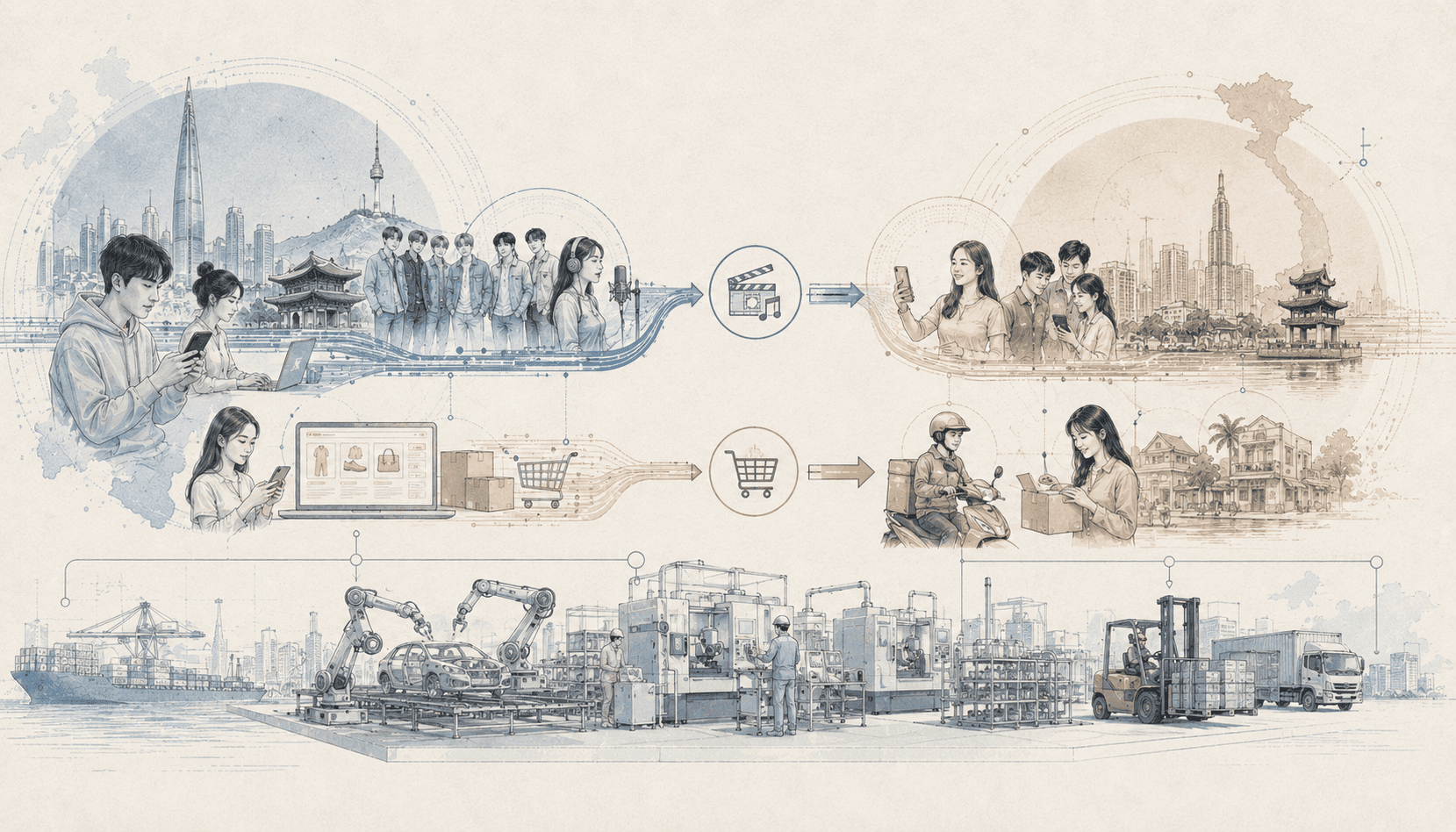
Korean brands, entertainment, ecommerce and manufacturing are helping shape Vietnam’s digital consumer market.
South Korean firms account for roughly 30% of Vietnam’s total exports through their manufacturing operations, and the cultural and digital layers built on top of that industrial base have made South Korea–Vietnam one of the clearest soft-power-to-commerce conversions in Asia.
Samsung alone produces around half of its global smartphone output in Vietnam, generating tens of billions of dollars in annual exports from facilities in Bac Ninh and Thai Nguyen, according to multiple industry reports. South Korean cumulative FDI in Vietnam exceeds US$80 billion, making South Korea Vietnam’s largest single foreign investor. Korean cultural exports — K-pop, K-drama, K-beauty, Korean food — drive consumer behaviour across the Vietnamese economy in ways that consistently translate into commercial outcomes for Korean brands.
This is what soft power looks like when it actually works.
Why Vietnam matters to South Korean strategy
Three structural reasons.
The scale is hard to overstate. Samsung’s revenue from its six Vietnamese plants reached US$62.5 billion in 2024 with US$54.4 billion in exports — equivalent to roughly 13% of Vietnam’s entire GDP (The Investor). Samsung’s cumulative investment in Vietnam now stands at US$22.4 billion, including a fresh US$1.8 billion OLED plant announced in Bac Ninh in late 2025, with the Hanoi R&D centre employing 2,400 engineers. Korean investors registered US$7.06 billion in fresh capital in Vietnam in 2024 — up 37.5% year-on-year — making Korea Vietnam’s second-largest FDI source after Singapore (Vietnam Briefing). Bilateral trade hit a record in 2025, with Korean exports of computers, electronics and components rising from US$14.8 billion in 2024 to US$17.5 billion — Vietnam is now Korea’s third-largest trading partner overall.
Manufacturing scale. Samsung Electronics’ Vietnam operations are not peripheral — they are core to Samsung’s global manufacturing strategy. LG, Hyundai and a long tail of Korean industrial firms have followed similar patterns. Vietnam offers what South Korea itself can no longer offer at scale: lower-cost, abundant manufacturing labour with rising technical skills.
Demographic complementarity. Korea is one of the fastest-ageing major economies. Vietnam has a median age around 33 and a workforce still expanding. For Korean firms thinking 20 to 30 years ahead, Vietnam is one of the few Asian markets that solves Korea’s demographic problem operationally.
Cultural runway. Korean entertainment, fashion and lifestyle products have penetrated Vietnamese consumer culture more deeply than perhaps any other Asian market outside Korea itself. K-drama on Vietnamese streaming services, K-pop concerts, K-beauty in pharmacies and online retail, Korean food chains in every Tier-1 city. This cultural footprint is the foundation that Korean brands monetise.
The result is a digital consumer relationship where Korean platforms, products, and content land into receptive Vietnamese demand without major adaptation overhead.
The digital consumer footprint
Here is where the relationship actually flows.
E-commerce. Korean brands account for a substantial share of Vietnamese online beauty, fashion and consumer electronics sales. Olive Young, Innisfree, The Face Shop, Etude House and Laneige run major Vietnamese operations. Coupang, Korea’s largest e-commerce platform, has been exploring Southeast Asian expansion with Vietnam as a likely target market.
Gaming. Korean game studios — Krafton (PUBG), Smilegate, NCSoft, Nexon — operate major Vietnamese player bases and sometimes Vietnamese development studios. PUBG Mobile and various Korean MMORPGs are major Vietnamese gaming categories. Krafton’s investment in Indian fintech Cashfree (US$53 million Series C in March 2025) shows how Korean gaming capital is increasingly active across Asia, with Vietnam often as the second market after Korea.
Entertainment platforms. CJ ENM, the Korean entertainment giant behind much of K-drama and K-pop production, runs Vietnamese distribution and increasingly local production. Big Hit (HYBE), Korea’s K-pop powerhouse behind BTS, has major Vietnamese fan economies and merchandise sales.
Fintech. Korean fintech firms including Toss have explored Vietnamese partnerships. Korean payments and banking technology — particularly Samsung Pay, KakaoPay-style super-app models — has influenced Vietnamese fintech design.
What Korean culture exports actually drive
The K-wave (Hallyu) in Vietnam is not just consumer entertainment. It systematically shapes purchasing decisions.
K-beauty drives Vietnamese cosmetics and skincare market preferences. Korean fashion shapes Vietnamese youth retail. Korean food (Korean BBQ chains, instant ramen, Korean fried chicken) has restructured Vietnamese fast-casual dining. Korean fashion influencers on TikTok and Instagram drive major Vietnamese e-commerce volumes.
This is the part of the relationship that’s hardest to quantify but easiest to observe. Walk through any major Vietnamese shopping district and the proportion of Korean signage, products, and cultural references is striking. Korean cosmetic brands collectively hold a significant share of the Vietnamese market — by some estimates over 30% — well above what bilateral trade statistics alone would predict.
What Vietnam offers South Korean firms
Three things that matter most strategically.
Manufacturing capacity at scale. Samsung produces hundreds of millions of devices annually in Vietnam. LG runs major Vietnamese display, appliance and component operations. The Vietnamese industrial base now functions as Korea’s primary low-cost manufacturing partner.
Consumer market depth. Vietnam’s middle class is expanding rapidly, with rising incomes and strong adoption of premium consumer goods. Korean brands have a head start that’s difficult for competitors to displace.
Talent for Korean expansion across Southeast Asia. Korean firms with Vietnamese operations often use Vietnam as a regional hub for Southeast Asia, leveraging Vietnamese-trained talent to manage Indonesian, Thai and Filipino operations.
The competitive context
China is the main competitor for influence in the Vietnamese consumer economy. Chinese platforms (TikTok Shop, Shopee through Sea, Temu) and Chinese brands (Xiaomi, BYD, Huawei) have all scaled Vietnamese operations aggressively. Japan competes on the industrial and entertainment IP layers (see Japan–Vietnam: Engineering Partnership Up the Stack).
South Korea’s competitive advantage is the cultural integration. Vietnamese consumers don’t just buy Korean products — many genuinely identify with Korean cultural references in a way they don’t with Chinese or even Japanese products. This is the moat that makes the Korean position in Vietnam structurally durable.
Where this goes next
Three things to watch.
The continued Hallyu monetisation. Korean entertainment will keep driving Vietnamese consumer behaviour through the 2020s. Korean platforms increasingly building Vietnamese-specific products on top of this cultural base.
Manufacturing automation. As Samsung and LG automate their Vietnamese facilities, the digital infrastructure layer (factory management software, predictive maintenance, supply chain digitisation) becomes more important. Korean industrial digital firms are positioned to supply this.
The next-tier Korean brands. The first wave was Samsung, LG, Hyundai. The second wave (Krafton, Coupang, Toss, HYBE, CJ ENM) is now scaling. The third wave — Korean SaaS, fintech, and creator economy platforms — is just beginning to enter Vietnam at scale.
Most coverage of Korean firms abroad focuses on the US and China. From a Vietnamese consumer’s perspective, Korea may be the most culturally and commercially influential foreign economy in the country.
That cultural lead is becoming a digital lead. And it’s worth taking seriously.
Part of a Digital in Asia series on the digital relationships shaping Asia’s next decade.
Related DIA coverage: Vietnam consumer economy, Korean platforms in Asia, K-wave commerce.
Sources & Further Reading
- Office of the US Trade Representative — bilateral trade and tariff data
- IMF — World Economic Outlook — macro and trade indicators
- NASSCOM — Strategic Review — IT and GCC sector data
- Bain & Company — e-Conomy SEA Report — Southeast Asia digital economy
- World Economic Forum — global digital trade analysis
Discover more from Digital in Asia
Subscribe to get the latest posts sent to your email.
