
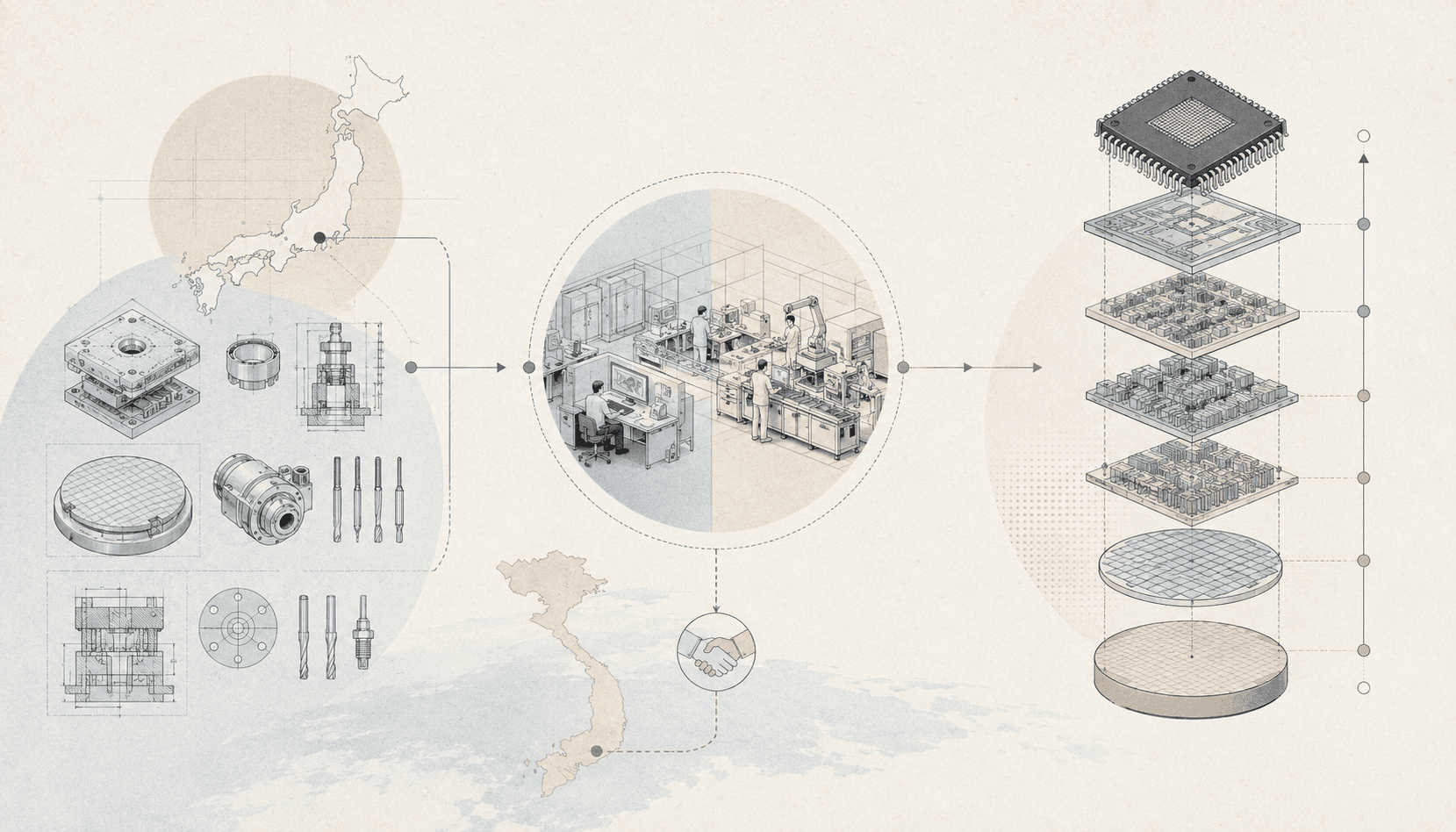
Japan’s industrial depth and Vietnam’s technical workforce are creating one of Asia’s most important digital production relationships.
Japan and Vietnam crossed US$50 billion in bilateral trade for the first time in 2025, and they’re targeting US$60 billion in trade and US$5 billion in annual Japanese investment by 2030.
As of March 2025, Japan held more than 5,500 active investment projects in Vietnam, with cumulative capital of nearly US$78.6 billion, concentrated in manufacturing, processing, energy and high-tech industries, according to Vietnam’s Ministry of Planning and Investment. Japanese FDI registered in Vietnam in 2023 reached US$6.57 billion, a 37% jump from 2022. In Q1 2025, investment capital from Japan grew over 20% year-on-year.
These numbers describe an industrial relationship. The interesting story is the layer being built on top of it: semiconductors, AI, digital health, green technology and engineering talent.
Why this is different from a typical FDI story
Most Japan–Asia investment stories are about manufacturing relocation — a Japanese auto company building a plant, a Japanese components supplier following its OEM. Japan–Vietnam is no longer mainly that.
The new layer is semiconductor cooperation. Japan’s Ministry of Economy, Trade and Industry committed an initial US$10 billion semiconductor development plan by 2025, with over US$30 billion allocated to more than 100 projects including TSMC’s Kyushu fab. Vietnam, in turn, aims to train 50,000 semiconductor engineers by 2030. The two countries set up a formal Vietnam–Japan Semiconductor Cooperation Programme through Vietnam’s National Innovation Centre, with Hiroshima University and other institutions providing specialist training.
For Japanese companies, the calculus is simple: Japan needs engineering talent that its own demographic profile can no longer supply at scale. Vietnam has it. The Vietnamese workforce profile — young, technically trained, lower-cost than Japan but increasingly capable — fits Japanese industrial requirements better than China currently does.
Nisso Corporation has begun bringing Vietnamese students to Japan for semiconductor training. FPT Semiconductor, Vietnam’s national champion, has set a target of producing 50,000 semiconductor engineers in collaboration with Japanese partners. Japanese firms including Renesas (in partnership with India’s CG Power and Thailand’s Stars Microelectronics) are building cross-border supply chain capacity that includes Vietnam.
The digital and AI layer
In November 2025, Japanese Prime Minister Sanae Takaichi described Vietnam as “a crucial link in global supply chains” and identified economic security — covering energy, critical minerals, AI, semiconductors and space — as a new priority area for the partnership.
This frame matters. Japan’s approach to Vietnam is shifting from low-cost manufacturing partner to strategic technology partner. The signed agreements in late 2025 explicitly target high-tech investments with technology transfer, support for Vietnamese firms investing in Japan, and expanded agricultural market access.
Specific digital projects include:
A new-generation Japanese ODA loan structure, announced in early 2026, that ties official development assistance to applications of Japanese AI, satellite-based monitoring and digital tools for Vietnam’s green transition and disaster risk management.
Continued expansion of Japanese platform investments. AEON’s e-commerce and retail digital infrastructure, Mitsubishi UFJ Financial Group’s fintech partnerships, and Sony’s gaming distribution are all growing Vietnamese exposures.
Vietnam–Japan ODA cooperation rose by over US$600 million in 2025, much of it tied to digital infrastructure and energy transition projects.
What Vietnam offers Japan that China doesn’t
Three things, mainly.
A workforce that’s still growing. Vietnam’s median age is around 33; Japan’s is closer to 50. Japanese companies that need engineers and operators for the next 20 years are looking at countries that will still have engineers and operators in 20 years.
Lower geopolitical exposure. Vietnam isn’t structurally aligned with Beijing in the way that some Southeast Asian peers are. For Japanese firms managing China exposure, Vietnam is the most natural China+1 destination in ASEAN.
Industrial culture compatibility. Japanese manufacturing standards, training systems and supplier relationships transfer to Vietnamese contexts more cleanly than to most other emerging markets. The Japanese keiretsu-style supplier model has analogues in Vietnamese industrial parks like those operated by Sumitomo and Mitsubishi.
These advantages are why Japanese firms increasingly treat Vietnam as a primary, not secondary, manufacturing and engineering base.
The friction is currency, not strategy
The structural friction in Japan–Vietnam is the yen. Japanese companies investing in Vietnam are funding those investments out of a weakened currency, which has compressed the value of Japanese FDI in dollar terms even as project counts rise. JICA, JBIC and the Japanese commercial banks have absorbed this for now, but if the yen weakens further, some Japanese investment plans get harder to finance.
The strategic case is unaffected. The relationship is built on industrial complementarity, not currency arbitrage.
Where this goes next
The Japan–Vietnam Comprehensive Strategic Partnership is one of the most concrete in Asia. The targets — US$60 billion in trade and US$5 billion in annual investment by 2030 — are achievable, and the digital and semiconductor layer of the relationship is likely to grow faster than the headline numbers suggest.
Three specific things to watch.
The semiconductor talent pipeline. If Vietnam hits its 50,000-engineer target by 2030, it becomes a credible regional design and packaging partner. Japan is one of the few countries with both the technology and the patience to help Vietnam get there.
The 2+2 dialogue. Vietnam and Japan agreed in late 2025 to implement a Deputy Minister-level 2+2 dialogue on foreign affairs and defence. Defence-tech and dual-use cooperation is the natural next layer.
Energy transition financing. Japan’s new-generation ODA model, designed around climate and digital infrastructure, will likely become a template for how Japan engages developing Asia more broadly. Vietnam is the test case.
Most US-centric coverage of Asia underweights this relationship. From a Vietnamese perspective, Japan is at least as important as the US for industrial upgrading and engineering capacity.
The next decade of Vietnam’s digital economy will be partly built on Japanese investment, training and technology — and that’s a relationship worth understanding on its own terms.
Part of a Digital in Asia series on the digital relationships shaping Asia’s next decade.
Related DIA coverage: Vietnam semiconductor strategy, Japan in Asia, Asia engineering talent.
Sources & Further Reading
- Office of the US Trade Representative — bilateral trade and tariff data
- IMF — World Economic Outlook — macro and trade indicators
- NASSCOM — Strategic Review — IT and GCC sector data
- Bain & Company — e-Conomy SEA Report — Southeast Asia digital economy
- World Economic Forum — global digital trade analysis
Discover more from Digital in Asia
Subscribe to get the latest posts sent to your email.
