
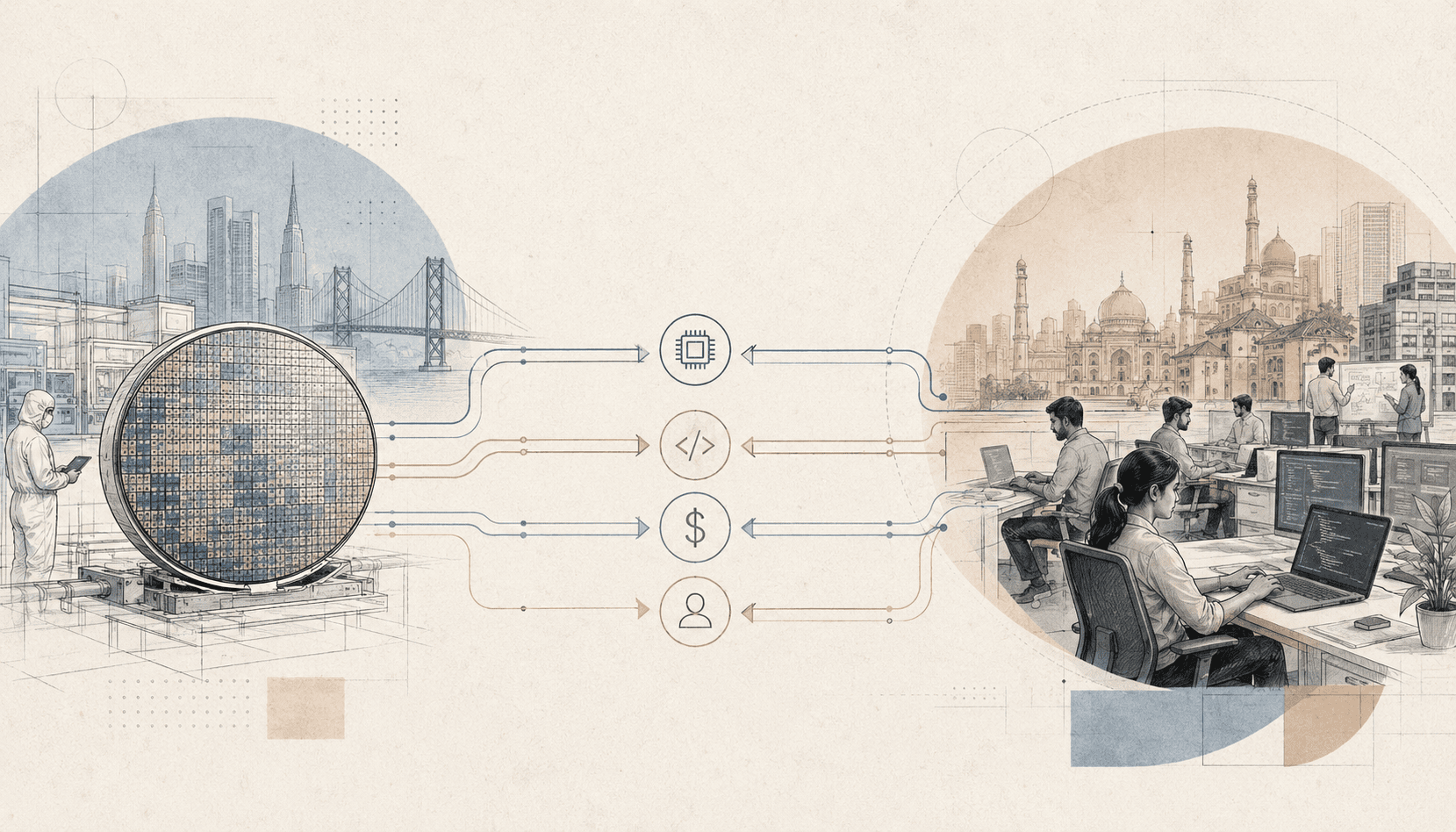
AI, chips, SaaS, defence technology and digital public infrastructure are turning US–India ties into one of the world’s most important digital relationships.
The US–India digital relationship is now worth more than $200 billion a year, and the digital layer is doing most of the lifting.
Total bilateral trade in goods and services reached $212.3 billion in 2024, up 8.3% on the year before, according to the Office of the US Trade Representative. India’s IT industry generated $283 billion in revenue in FY25, with $224 billion in exports — and the United States accounted for $103.2 billion of those exports, or 54.1% of the total, per NASSCOM’s 2025 Strategic Review. That single number — the US share of India’s IT exports — captures something most coverage misses. This isn’t a trade relationship with a tech component. It’s a tech relationship that happens to show up in trade data.
The companies anchoring it are the ones you’d expect: Google, Microsoft, Meta, Micron, Amazon, Apple, NVIDIA on the US side; Tata Consultancy Services, Infosys, Wipro, HCL, Reliance, and a long tail of GCC-hosted captives on the Indian side. The flows between them — capital, talent, code, chips, compute, IP — are now deep enough that decoupling either economy from the other would take years and cost both sides significantly.
This article looks at where that relationship sits in 2026, what’s actually changing, and where it goes next.
How big is the US–India digital trade relationship?
Big enough that India and the United States have set a target of doubling bilateral trade to $500 billion by 2030, per a February 2025 joint statement by Prime Minister Narendra Modi and President Donald Trump.
Services are the engine. US services exports to India hit $41.8 billion in 2024, up 15.9% year-on-year. Services imports from India reached $41.6 billion, up 15.4%. Total services trade between the two countries totalled an estimated $83.4 billion in 2024 — a near-perfect symmetry that’s unusual in global trade and tells you the relationship has matured beyond pure outsourcing.
Goods trade is more lopsided. US goods imports from India totalled $103.8 billion in 2025, against $45.6 billion in goods exports the other way, leaving a US goods deficit of $58.2 billion. That imbalance is now the centre of an active trade negotiation, with both governments trying to land a Bilateral Trade Agreement after the Trump administration raised the effective tariff on Indian imports to 50% in August 2025.
Tariffs matter for the headline number. They don’t change the underlying gravity of the relationship, which is software, services, talent, and increasingly compute.
Why India is now the world’s largest GCC market
The Global Capability Centre is the cleanest way to see the digital relationship in operation. India hosts more than 1,800 GCCs as of late 2025, employing roughly 1.9 million professionals, generating around $65 billion in annual revenue, according to Zinnov and NASSCOM. The number is projected to reach 2,100–2,400 centres by 2030, with revenue crossing $100 billion.
More than 65% of those centres are owned by US-headquartered companies.
That’s the clearest signal of how deep the partnership runs. When Goldman Sachs, JPMorgan, Microsoft, Google, Best Buy, Walmart, and dozens of other US firms decide where to build their largest non-US engineering, AI, and analytics operations, they’re choosing Bengaluru, Hyderabad, Pune, and Chennai. Best Buy describes its Bengaluru GCC as its largest global tech hub. Vanguard’s Hyderabad centre is being built out as the firm’s largest tech operation worldwide.
The shift from cost arbitrage to capability arbitrage is now the dominant story. According to EY’s GCC Pulse Report 2025, 92% of GCC leaders affirm their centres now contribute beyond cost savings. 58% of GCCs are investing in agentic AI. 83% are scaling generative AI deployments. Indian GCCs hold more than 6,500 global leadership roles, growing at roughly 40% CAGR over the past five years.
For US companies, India isn’t where you go to save 30%. It’s where you go to staff a global AI roadmap.
The semiconductor relationship is real, and it’s American
The most visible US chip investment in India is Micron Technology’s $2.75 billion assembly and test facility in Sanand, Gujarat — operational since early 2025, with about 5,000 direct jobs and an estimated 15,000 indirect ones. Micron’s investment was structured with up to 50% fiscal support from the Indian central government and an additional 20% from Gujarat state. In June 2025, India approved a further $1.5 billion Special Economic Zone proposal from Micron at the same Sanand site.
Micron is the anchor, but it’s not alone. Tata Electronics is partnering with Taiwan-based PSMC on a fab in Dholera, Gujarat, with announced investments of around ₹91,000 crore (roughly $11 billion at current rates). Tata Semiconductor Assembly and Test is investing ₹27,000 crore in Assam. CG Power, Renesas (Japan) and Stars Microelectronics (Thailand) have a ₹7,600 crore project in Sanand. India’s 2025 semiconductor budget rose 83% to ₹7,000 crore.
The strategic logic is straightforward. The US needs chip capacity outside China and Taiwan. India needs the demand, the IP transfer, and the supply chain integration. The Production Linked Incentive scheme makes the maths work. This is the kind of partnership that doesn’t move overnight — fab construction takes years — but once those facilities are running, the integration becomes structural.
What India brings to US AI infrastructure
The talent number is the one that changes the conversation: India produces more than 800,000 engineering graduates a year, nearly six times the US figure, according to the Information Technology and Innovation Foundation. India holds more than 20% of the global STEM workforce.
That’s why every major US AI company has either expanded existing operations in India or announced new ones in the past 18 months. OpenAI is opening an office in New Delhi. Google, Meta, Microsoft and Amazon have all expanded their Bengaluru and Hyderabad footprints. NVIDIA has deepened partnerships with Reliance and Tata for sovereign AI infrastructure.
The point isn’t that India is replacing US AI labs. It’s that frontier AI work — model training, applied research, product engineering — is now happening on both sides of the relationship simultaneously. India’s GCC ecosystem alone employs more than 1.9 million professionals, of which a fast-growing share work directly on AI mandates.
For US enterprise software companies, the same logic applies. Salesforce, ServiceNow, Adobe, Atlassian, Snowflake — every category leader runs a major India operation. The product teams are Indian-led, the engineering depth is Indian, and an increasing share of global revenue is now Indian-routed.
Defence and strategic technology: the new layer
The relationship is also accelerating in areas that didn’t exist a decade ago. India and the United States are set to sign a 10-year defence framework in 2026, building on the February 2025 Modi-Trump joint statement, with a focus on co-production, technology sharing, and joint exercises. Space cooperation expanded under a February 2025 partnership covering joint research, commercial collaboration, and startup engagement. Critical minerals and nuclear cooperation were the central topic of the January 2026 Jaishankar-Rubio talks.
For DIA readers tracking the digital economy, the defence and strategic tech layer matters because it brings dual-use technology into the bilateral flow — AI for defence, space-based connectivity, advanced sensors, secure compute. These are the areas where US export controls have historically tightened around China. India is the deliberate counterweight.
The frictions are real
None of this is frictionless. The 2025 tariff escalation cost goodwill on both sides. India remains on the USTR Priority Watch List for intellectual property concerns. Data localisation rules under the Digital Personal Data Protection Act create real costs for US platforms. India’s protectionist instincts on agriculture, e-commerce and certain manufacturing sectors aren’t going away.
The H-1B visa system is another structural pressure point. Roughly 70% of H-1B visas go to Indian nationals, and US policy oscillation on the programme creates persistent uncertainty for talent flows. Indian IT services firms have absorbed this by hiring more US locals and pushing more delivery onshore — but the basic dependence cuts both ways. Cut H-1B materially and a meaningful share of US enterprise IT runs slower.
These frictions are the kind partners argue about. They aren’t the kind that break the relationship.
Where this goes next
The honest read on US–India in 2026 is that the digital relationship has crossed a threshold where neither side can credibly walk away. India runs $103 billion in IT exports to the US, hosts the engineering operations for most of the Fortune 500, anchors the assembly and test step of US chip strategy, and produces the engineering talent that the US AI build-out needs. The US provides the capital, the platforms, the frontier compute, the enterprise demand, and the strategic cover for India’s tech ambitions in the Indo-Pacific.
What’s likely from here:
A Bilateral Trade Agreement, in some form, lands in 2026 or 2027 — probably more limited than originally scoped, but real enough to reset the tariff position.
Indian GCCs cross the $100 billion revenue mark sooner than the 2030 projection, on the back of agentic AI demand.
US chip investment in India scales beyond Micron, with at least one full fab operational by 2028.
The H-1B question remains unresolved, but workarounds (more onshore hiring, more remote-first delivery, more GCC-routed work) absorb the pressure.
For anyone tracking Asia’s digital economy, the US–India relationship is the one to watch most closely. It’s the only bilateral pairing in the world where two democracies are building this much technology infrastructure together at this scale.
It also happens to be one of the few that still has room to compound.
This is the first piece in a Digital in Asia series mapping the major digital relationships shaping Asia’s next decade. Future pieces cover US–Vietnam: From Manufacturing to Digital, US–Singapore: America’s SEA Digital Gateway, China–Indonesia: SEA’s Defining Platform Tie and others.
Related DIA coverage: India’s Digital Market Overview, How Mobile-First Economies in Asia Leapfrog Desktop, How AI Is Being Adopted Across Asia.
Sources & Further Reading
- Office of the US Trade Representative — bilateral trade and tariff data
- IMF — World Economic Outlook — macro and trade indicators
- NASSCOM — Strategic Review — IT and GCC sector data
- Bain & Company — e-Conomy SEA Report — Southeast Asia digital economy
- World Economic Forum — global digital trade analysis
Discover more from Digital in Asia
Subscribe to get the latest posts sent to your email.
