
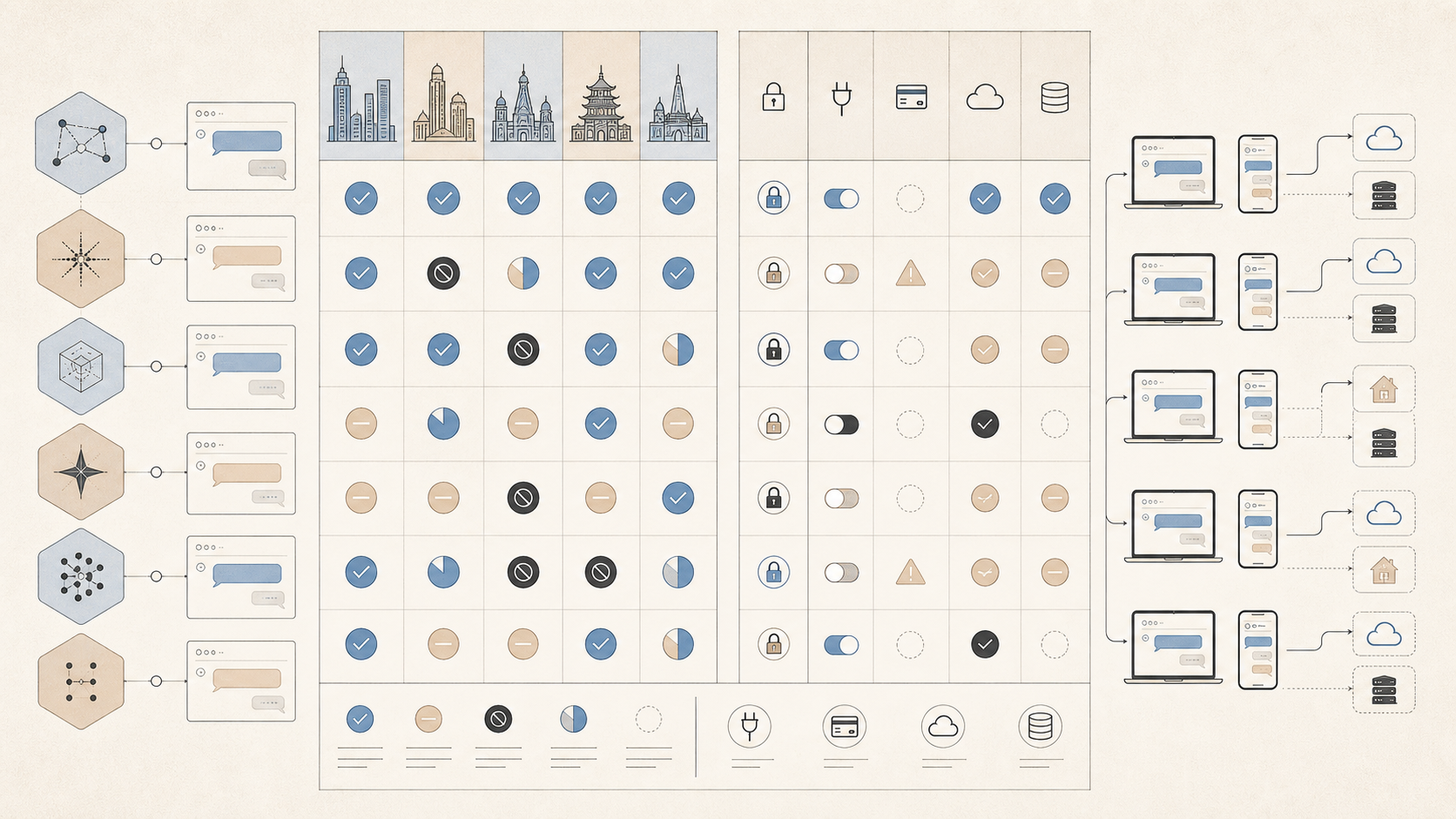
LLM access in Asia is more fragmented than the global rollout narratives suggest. The obvious divide is China versus the rest of the region. Western frontier models remain officially restricted in Mainland China. But that binary hides the more useful story.
OpenAI is pushing into emerging markets with low-cost ChatGPT Go. Anthropic supports Claude.ai and API access across most Asian markets, but with top-tier enterprise pricing. Google has just launched Gemini natively in Hong Kong.
And the real picture for businesses is even messier. Market by market, companies face different layers of friction: payment limitations, regulatory carve-outs, data residency rules, local hosting questions, enterprise availability, and platform-specific feature gaps. So what looks from the outside like a simple “available / not available” map becomes much harder to navigate in practice.
This is a working tracker of where the major LLMs stand across fifteen Asian markets as of April 2026, covering accessibility, pricing and market-by-market detail. It will be updated as the picture moves — and it moves often.
Country-by-country AI access guides
For a focused answer on whether you can use ChatGPT, Claude and Gemini in a specific market — plus how AI is actually used there and which models win — see our country guides: China, Hong Kong, Japan, South Korea, Taiwan, Vietnam, Indonesia, Thailand, Philippines, Singapore, Malaysia, India.
The Master Availability Table
The headline reference. Western frontier models on the left, Chinese frontier models on the right, fifteen markets running down.
Legend: – Native — consumer accounts work with local phone numbers, IPs, and (where applicable) local payment methods. Sign up like anyone else. – VPN — officially geo-blocked. Accessible only via VPN plus an overseas-issued phone number or card. Outside terms of service. – API only — no consumer-facing product targeted at this market (no local app store presence, no localised UI, no local payment), but the API is reachable by developers from this market and accepts USD payment.
| Market | ChatGPT | Claude | Gemini | Grok | DeepSeek | Qwen | Kimi | Doubao |
|---|---|---|---|---|---|---|---|---|
| Mainland China | VPN | VPN | VPN | VPN | Native | Native | Native | Native |
| Hong Kong | VPN | VPN | Native (Mar ’26) | Native | Native | Native | Native | API only |
| Japan | Native | Native | Native | Native | API only | API only | API only | API only |
| South Korea | Native | Native | Native | Native | API only | API only | API only | API only |
| Taiwan | Native | Native | Native | Native | API only | API only | API only | API only |
| Vietnam | Native | Native | Native | Native | API only | API only | API only | API only |
| Indonesia | Native | Native | Native | Native | API only | API only | API only | API only |
| Thailand | Native | Native | Native | Native | API only | API only | API only | API only |
| Philippines | Native | Native | Native | Native | API only | API only | API only | API only |
| Singapore | Native | Native | Native | Native | API only | API only | API only | API only |
| Malaysia | Native | Native | Native | Native | API only | API only | API only | API only |
| India | Native | Native | Native | Native | API only | API only | API only | API only |
| Cambodia | Native | Native | Native | Native | API only | API only | API only | API only |
| Bangladesh | Native | Native | Native | Native | API only | API only | API only | API only |
| Myanmar | Announced for ChatGPT Go | Not supported | Status unclear | Status unclear | API only | API only | API only | API only |
Three things jump out. First, mainland China and Hong Kong remain the two clear gaps in Western LLM availability across Asia — both commercial decisions by the Western labs rather than government bans. Myanmar is the messier case: OpenAI announced Myanmar in its October 2025 ChatGPT Go expansion, but Anthropic doesn’t list Myanmar in its supported regions, and Google’s Gemini consumer status in Myanmar is unclear. Everywhere else, the four major Western models are natively accessible.
Second, Anthropic supports more emerging Asia than older OpenAI documentation suggests — Claude.ai is available in Bangladesh, Cambodia, and Laos, three markets where Anthropic has explicitly cleared regulatory and sanctions constraints. That’s a genuine competitive differentiator for Asian markets at the lower end of GDP per capita.
Third, Chinese models are reachable everywhere outside their home market — through international APIs (Qwen, DeepSeek, and Kimi all accept USD payment from international developers) or via open-weight self-hosting — but they don’t run consumer-facing products targeted at non-mainland markets. A Tokyo developer can hit the DeepSeek API and pay in USD, but a Tokyo consumer can’t install a localised Doubao app the way a Beijing user does. That distinction matters for businesses making stack decisions.
Mainland China: A Closed Western Frontier, A Wide-Open Domestic One
ChatGPT, Claude, and the Gemini web app are all officially unavailable in mainland China. OpenAI tightened API enforcement in July 2024 to block Chinese developers from accessing its models through proxies, deepening what was already a hard line. Both Anthropic and Google maintain similar restrictions. The standard route for Chinese users wanting frontier Western models — VPN plus an overseas-issued credit card — still works, but it sits well outside official terms of service.
What the closure has produced is the most competitive domestic LLM market outside the US. ByteDance’s Doubao had 382 million monthly active users as of QuestMobile’s May 2026 data (published July 2026), ahead of Alibaba’s Qwen app at 167 million and DeepSeek at 130 million — making it one of the most-used AI applications in the world by user count. ByteDance launched Doubao 2.0 on February 14, 2026, positioning the upgrade for what it called the “agent era.” Alibaba’s Qwen line — the 3.5 series (February 2026), Qwen3.6 (April 2026), and the 2.4-trillion-parameter Qwen3.8-Max preview unveiled at WAIC Shanghai on 19–20 July 2026 — DeepSeek’s V4 (previewed April 24, 2026; officially released mid-July 2026 with a 1M-token context window), Moonshot’s Kimi K3 (released July 16, 2026, a 2.8-trillion-parameter open-weight MoE), and Zhipu’s GLM-5.2 (June 2026, successor to February’s GLM-5) all sit at or near frontier performance. DeepSeek V4-Flash undercuts every major Western model on price, costing $0.14 per million input tokens — roughly 35x cheaper than GPT-5.5 and Claude Opus 4.7 at $5 per million. One wrinkle from the mid-July official release: DeepSeek introduced peak/off-peak API pricing, with rates doubling during Chinese business hours (Beijing 9:00–12:00 and 14:00–18:00). For Chinese businesses, the question isn’t “how do I get ChatGPT” — it’s “which domestic model fits my use case.”
For non-Chinese businesses, the picture is different again. Qwen, DeepSeek, and Kimi all offer working international APIs that accept USD payment. The trade-off is jurisdictional: any data sent to a public Chinese API is processed on servers subject to Chinese law. Self-hosting open-weight versions (Qwen3.5 9B, DeepSeek V4 weights on Hugging Face) is the privacy-preserving alternative, and it’s a genuine one — these are models that can be downloaded, run on Western cloud or on-premise hardware, and used without data leaving the deployer’s infrastructure.
Hong Kong: The Recent Thaw
Hong Kong is excluded from OpenAI’s supported countries list. As of April 2026, ChatGPT remains officially unavailable to users with +852 phone numbers or Hong Kong IP addresses. The restrictions are set by OpenAI, not by Hong Kong authorities — local internet remains uncensored and there is no domestic law banning generative AI tools. The geofencing reflects internal company risk assessment, likely tied to mainland regulatory exposure.
Google moved differently. On March 16, 2026, Gemini began rolling out to all Hong Kong users via personal Google accounts, starting with the web app. Before this, individual users in Hong Kong were limited to Workspace-tier access or VPN workarounds. Anthropic’s Claude is also unavailable in Hong Kong, with no announced timeline for change.
The practical effect is that Hong Kong businesses face a split stack: Gemini natively available, Claude and ChatGPT requiring enterprise workarounds (Azure OpenAI through compliant regions, Bedrock, or VPN). One Hong Kong workplace technology survey reported that 88% of employees use AI tools daily while only 45% of firms have officially approved platforms — a governance gap that’s a direct consequence of fragmented availability.
Japan: The Hybrid Coexistence Strategy
Japan has all four major Western models available natively. Anthropic opened a Tokyo office in 2024 — its first in Asia-Pacific — and Japanese users rank among Claude’s heaviest globally. Google rolled out Gemini in Chrome to Japan in April 2026 (desktop only, with iOS following later). ChatGPT, Claude, Gemini, and Grok all accept Japanese accounts with local payment methods.
The domestic ecosystem is the most institutionally serious in Asia. Japanese companies have developed over 30 major LLM variants as of March 2026, and the December 2025 government commitment of 1 trillion yen (approximately $7 billion) over five years to AI and semiconductors gives the sovereign stack real backing. The pivotal data point: in March 2026, Japan’s Digital Agency selected seven domestic vendors — including NTT Data’s tsuzumi 2, KDDI/ELYZA’s Llama-3.1-ELYZA-JP-70B, PFN’s PLaMo 2.0 Prime, and NEC cotomi v3 — for deployment to roughly 180,000 government staff. That is a formal procurement decision to use domestic models for state functions, not an industry framing exercise.
NTT’s tsuzumi is the technically distinctive piece. Tsuzumi 2 (released October 2025) has 30 billion parameters and runs on a single H100 GPU, with hardware costs around $35,000 — versus the dozens or hundreds of GPUs required by frontier Western models. It’s built from scratch on Japanese data, performs near GPT-5 on Japanese MT-bench evaluations despite its size, and is positioned explicitly for on-premise deployment in regulated sectors (finance, healthcare, public administration). Tokyo Online University runs tsuzumi as an on-campus LLM platform to keep academic data inside its network. Mizuho Financial Group is co-developing a finance-specialised LLM with SB Intuitions based on Sarashina. MUFG has partnered with Sakana AI on a financial AI deployment leveraging evolutionary model merge technology.
What Japan has converged on is a dual-stack approach — GPT, Claude, and Gemini for general productivity tasks, domestic LLMs for confidential data, regulated industries, and Japanese-specific tasks. It’s the same pattern DIA has tracked across Singapore (OCBC running DeepSeek and Qwen alongside Western models) and Indonesia (Indosat partnering with DeepSeek for telco AI), now applied with state procurement weight behind it. On the Nejumi Leaderboard 4 (December 2025 run), GPT-5.2 — OpenAI’s flagship at the time — led at 0.8285, ahead of domestic models by roughly 0.13 points; OpenAI’s current flagship, GPT-5.6 (released July 8–9, 2026), is not yet reflected there. But on Japanese-specific benchmarks, PLaMo 2.2 Prime matches GPT-5.1 and Rakuten AI 3.0 outperforms GPT-4o. The frontier gap and the local-language gap are running in opposite directions.
South Korea: A Sovereign AI State, Fully Connected
South Korea has full access to ChatGPT, Claude, Gemini, and Grok. Anthropic announced in October 2025 that Seoul would become its third Asia-Pacific office, opening in early 2026. Korean users rank in Claude’s top five globally for both total and per-capita usage, and active weekly Claude Code users in Korea grew 6x in the four months prior to the announcement. A Korean software engineer reportedly ranks as the world’s top Claude Code user.
The sovereign AI push is the most formalised in Asia. South Korea’s Ministry of Science and ICT announced a $390M competition in 2025, selecting five consortia — LG AI Research, SK Telecom, Naver Cloud, NC AI, and startup Upstage — to compete for the country’s sovereign AI foundation model mandate. The government reviews progress every six months, cuts underperformers, and continues funding the frontrunners until two final teams remain. The aim is to reach at least 95% of frontier Western model performance with domestic alternatives.
Each of the five brings a distinct angle. LG AI Research’s Exaone 4.0, unveiled in July 2025, is a hybrid reasoning model with a 32-billion-parameter version that performs competitively on Artificial Analysis’s Intelligence Index. LG’s edge isn’t compute — it’s decades of proprietary industry data from biotech, materials, and manufacturing. Naver’s HyperCLOVA X is the Korean-language specialist, trained on 6,500 times more Korean data than GPT-4 according to the company, and outperforming GPT-4 on KMMLU benchmarks for Korean-specific questions. HyperCLOVA X SEED Think (32B), launched as an open-weights reasoning model, scored 44 on the Artificial Analysis Intelligence Index and achieved 87% on the τ²-Bench Telecom evaluation — the highest among Korean AI models. SK Telecom’s A.X K1 powers a custom AI customer service deployment that has become a blueprint for the entire Korean telco industry. Upstage’s Solar Pro 2 is the only Korean entry on the Frontier LM Intelligence leaderboard, demonstrating efficiency at smaller scale.
In the January 2026 Round 1 government evaluation, the field narrowed sharply. LG AI Research placed first across all three judging categories (benchmark testing, expert panel review, user feedback). SK Telecom and Upstage advanced. Naver Cloud and NC AI were eliminated — Naver in particular over originality concerns, after evaluators determined that the company’s vision encoder was ~99% weight-identical to Alibaba’s Qwen 2.5-VL 32B, which the Ministry of Science and ICT ruled inconsistent with the project’s “trained from scratch” requirement. The ministry plans to hold an additional selection round in mid-2026 to maintain a four-team competition structure. The Naver elimination is itself a sovereignty story: when Korea defines sovereign AI in its procurement framework, it means independence from Chinese pre-trained weights, not just from American ones.
The 2026 enforcement of Korea’s AI Basic Act — the country’s first comprehensive AI governance law, covering high-risk systems in finance, healthcare, and public administration — adds the regulatory dimension. Foreign LLMs remain available, but for high-trust industries, Korean enterprises increasingly prefer architectures where domestic models handle regulated workloads and Claude or GPT handle general productivity. Korea’s AI cloud market is projected to reach $12.46B by 2026.
Taiwan: Frontier Available, Politically Unique
Taiwan has full access to ChatGPT, Claude, Gemini, and Grok. There are no significant payment or signup restrictions. Taiwanese users can subscribe to Plus and Pro tiers using local cards.
The interesting asymmetry is that Taiwan is one of the few markets where Chinese LLMs are technically accessible (no Great Firewall blocking outbound traffic to Doubao or Qwen) but politically uncomfortable for many users. Taiwanese-language nuance, traditional character handling, and politically sensitive queries (cross-strait relations, ROC framing) produce visibly different outputs from Chinese versus Western models. This is the quiet case study for the broader thesis that LLM choice is increasingly a political act in Asia, not just a technical one.
Vietnam: The Pricing Test Case
Vietnam is now natively supported by all four major Western LLMs. Claude.ai launched in Vietnam as part of Anthropic’s expansion in 2024 and remains available. ChatGPT, Gemini, and Grok all accept Vietnamese accounts.
The pricing dimension is where Vietnam matters most. ChatGPT Plus costs the global $20/month rate, billed in USD — roughly 522,500 VND, before VAT. In October 2025, OpenAI launched ChatGPT Go, a budget tier specifically for Vietnam and 15 other Asian markets, at 132,000 VND per month (around $5). Google AI Plus, launched in Vietnam in September 2025, is priced at 122,000 VND per month with a 50% first-six-months discount. Gemini in Chrome rolled out to Vietnam in April 2026 across desktop and iOS.
For context, with average urban monthly income in Vietnam of 7-10 million VND, ChatGPT Plus represents 5-7% of earnings. ChatGPT Go and Google AI Plus, both around 1.5-2% of monthly income, are the realistic mass-market price points. The platforms that win Vietnam on accessibility won’t be the cheapest in absolute terms — they’ll be the ones that priced for purchasing power parity rather than running a flat global rate.
The domestic Vietnamese option is VinAI’s PhoGPT, a 4-billion-parameter open-source model trained on a 102-billion-token Vietnamese corpus. It doesn’t compete with GPT-5 on capability, but it’s the practical option for fine-tuning into Vietnamese-specific applications, and VinBigdata’s ViGPT is already deployed in legal virtual assistants for state agencies and the ViVi assistant in VinFast electric vehicles.
Consumer Pricing Across Asia
Pricing is the second binding constraint, after availability. The headline rates look like a single global figure, but the actual cost of consumer AI access varies meaningfully across Asian markets — and OpenAI’s October 2025 rollout of the ChatGPT Go budget tier across 16 Asian markets is the clearest signal that the major platforms have read the room.
All prices below are the published consumer rates as of April 2026, in local currency where the platform supports local-currency billing, with USD equivalent in brackets. Where a platform doesn’t run a localised price for that market, the dollar figure is the USD-billed rate.
| Market | ChatGPT Plus | ChatGPT Go | Google AI Plus | Claude Pro |
|---|---|---|---|---|
| Mainland China | N/A (blocked) | N/A | N/A | N/A |
| Hong Kong | N/A (blocked) | N/A | $19.99 (AI Pro tier) | N/A |
| Japan | $20 | Not yet | ~$20 (AI Pro) | $20 |
| South Korea | $20 | Not yet | ~$20 (AI Pro) | $20 |
| Taiwan | $20 | ~$5 (USD) | ~$20 (AI Pro) | $20 |
| Vietnam | ₫522,500 (~$20) | ₫132,000 (~$5) | ₫122,000 (~$5) | $20 |
| Indonesia | Rp310,000–350,000 (~$20) | Rp75,000 (~$4.50) | Rp75,000 (~$4.50) | $20 |
| Thailand | $20 | ฿259 (~$7.50) | ~$5 | $20 |
| Philippines | ₱1,100 (~$18.30) | ₱300 (~$5.20) | ~$5 | $20 |
| Singapore | $20 | Not in list | ~$20 (AI Pro only) | $20 |
| Malaysia | RM99.90 (~$21) | RM38.99 (~$8.50) | RM23.99 (~$5) | $20 |
| India | ~$18 | ₹399 list — free for 12 months from Nov 2025 | ~$5 | $20 |
| Cambodia | $20 | ~$5 (USD, web/Android only) | ~$5 | $20 |
| Bangladesh | $20 | ~$5 (USD-billed) | ~$5 | $20 |
| Myanmar | Officially restricted | Announced for ChatGPT Go (Oct 2025) | Restricted | Restricted |
Three things this table makes legible.
First, OpenAI and Google are running aggressive PPP-adjusted pricing across Asia — but at slightly different price points. ChatGPT Go is locally priced in five Asian markets (Vietnam, Indonesia, Thailand, Philippines, Malaysia, plus Pakistan), with the rest billed in USD at ~$5 plus local tax. Google AI Plus is priced around $4.50–5 across roughly the same markets, with a 50% first-six-months discount in several. The two products are now competing head-to-head on price across Southeast Asia.
Second, the local-currency rates aren’t uniform PPP. Vietnam’s ChatGPT Go at ₫132,000 is roughly $5, but Malaysia’s at RM38.99 is closer to $8.50 and Thailand’s at ฿259 is ~$7.50. OpenAI is reading individual markets, not running a single global discount. That matters: the assumption that “Asia gets a 75% discount” is wrong. The truth is more granular.
Third, Claude Pro is the conspicuous outlier. Anthropic runs a flat $20/month rate globally — no Go-equivalent tier, no PPP adjustment, no Asia-specific pricing. For Vietnamese, Indonesian, Filipino, Bangladeshi, Cambodian, and Indian consumers, that means Claude Pro costs four-to-five times what ChatGPT Go or Google AI Plus does. Anthropic’s positioning is enterprise-first; the consumer pricing reflects that. It’s a deliberate choice, but it’s one that puts Claude consumer adoption in mass-market Asia at a structural disadvantage to OpenAI and Google’s localised tiers.
Indonesia: Sahabat-AI as Local Anchor
Indonesia has full availability of ChatGPT, Claude, Gemini, and Grok. Gemini in Chrome rolled out to Indonesia in April 2026 across desktop and iOS, alongside the broader APAC expansion.
The structural distinction in Indonesia is that GoTo (the merger of Gojek and Tokopedia) launched Sahabat-AI, an LLM ecosystem built on AI Singapore’s SEA-LION foundation. Sahabat-AI is integrated into GoTo’s Dira AI voice assistant, allowing users to access Gojek and GoPay services with voice commands in native languages and dialects. This is what regional LLM deployment actually looks like in practice — not a domestic challenger to GPT, but a local-language layer built on regional open-source foundations and embedded into the apps consumers already use.
For Indonesian businesses choosing an AI stack, the meaningful split is between Western frontier models for general capability and regionally-tuned models (Sahabat-AI, SEA-LION variants) for Bahasa Indonesia handling and culturally-aware deployment. The two are complementary, not competitive.
Thailand: Typhoon and the Frontier
Thailand has full availability of ChatGPT, Claude, Gemini, and Grok. There are no payment or signup restrictions.
SCB 10X’s Typhoon, developed by the venture arm of Siam Commercial Bank, is Thailand’s most capable domestic model and has produced one of the more interesting collaborations in the region — joint research with AI Singapore on cross-lingual audio modelling, where SEA-LION-TH-Audio (derived from Typhoon) demonstrated that training on under 1,000 hours of Thai-English data could produce strong zero-shot performance on Indonesian-to-Thai and Thai-to-Tamil translation tasks. The pattern matters: Southeast Asian models are increasingly built collaboratively across the region rather than nationally, because the data scale required for any single Southeast Asian language is hard to assemble alone.
Gemini in Chrome has not yet rolled out to Thailand as of late April 2026 — it’s the conspicuous absence in Google’s APAC expansion announcement.
Philippines: The Pricing Floor
The Philippines has full availability of ChatGPT, Claude, Gemini, and Grok. ChatGPT Plus costs ₱1,100 per month in the Philippines, the only Asian market alongside Vietnam, Indonesia, Thailand, and Malaysia where OpenAI prices Plus in local currency. ChatGPT Go is ₱300 per month — one of the cheapest Go rates anywhere. Gemini in Chrome rolled out to the Philippines in April 2026 across desktop and iOS.
The Philippines doesn’t have a major domestic LLM challenger, but it’s a heavy beneficiary of regional models. Filipino is one of the eleven major Southeast Asian languages SEA-LION is trained on, and Project SEALD (the AI Singapore / Google Research collaboration on Southeast Asian language datasets) explicitly includes Filipino as a priority language alongside Indonesian, Thai, Tamil, and Burmese.
Singapore: The Frontier Plus the Region’s R&D Hub
Singapore has full availability of ChatGPT, Claude, Gemini, and Grok. Gemini in Chrome rolled out to Singapore in April 2026.
What distinguishes Singapore isn’t access — it’s that Singapore is the regional centre of gravity for Southeast Asian model development. AI Singapore’s SEA-LION is the foundational regional LLM family, with v4 (multimodal, reasoning-capable) released in Q3 2025 and built on Gemma 27B and Qwen 32B foundations. SEA-LION-Embedding launched in March 2026, and the SEA-Guard safety counterpart family launched on February 4, 2026 — content moderation models tuned to Southeast Asian cultural norms.
For businesses operating across Southeast Asia, the Singapore-anchored regional stack (SEA-LION for language coverage, SEA-Guard for content moderation tuned to regional norms, SEA-HELM for benchmarking) is increasingly a credible alternative to running everything through Western proprietary APIs. It’s not a replacement, but it’s a sovereignty option that didn’t exist eighteen months ago.
Malaysia: Full Access, Light Domestic Layer
Malaysia has full availability of ChatGPT, Claude, Gemini, and Grok. There are no signup or payment restrictions. Malaysia is included in the SEA-LION coverage (Bahasa Melayu is one of the eleven Southeast Asian languages in SEA-LION’s training data), but doesn’t have a flagship domestic LLM at the scale of Indonesia’s Sahabat-AI deployment or Thailand’s Typhoon.
The practical position for Malaysian businesses is that Western frontier models handle most use cases natively, with regional models (SEA-LION-based deployments) filling gaps where Bahasa Melayu cultural specificity matters.
India: A Sovereign AI Push With Frontier Access
India has full availability of ChatGPT, Claude, Gemini, and Grok. ChatGPT Plus costs around $18 per month — the second-cheapest globally after the Philippines. ChatGPT Go lists at ₹399 per month, but OpenAI made Go free for 12 months for users in India from November 2025 — and Go has since rolled out worldwide. ChatGPT Business is priced in INR at ₹2,099 per user per month when billed annually. Anthropic opened a Bengaluru office on February 16, 2026 — India is its second-largest market.
India’s domestic ecosystem is the most active in Asia outside China. Sarvam AI was selected by India’s IT Ministry in April 2025 to develop the country’s first indigenous foundational model under the IndiaAI Mission. Sarvam launched a 105-billion-parameter open-source flagship at the India AI Impact Summit 2026 in February. Krutrim, founded by Ola’s Bhavish Aggarwal, became India’s first AI unicorn at $1 billion valuation, though it’s faced organisational churn through 2025 with multiple rounds of layoffs in its linguistics team. Sarvam Vision OCR scored 84.3% on olmOCR-Bench, beating Gemini 3 Pro (80.2%) and ChatGPT (69.8%).
For Indian businesses, the choice isn’t between Western and Indian models — it’s about layering. Frontier Western models handle general productivity and English-dominant tasks. Sarvam, Krutrim, and BharatGen handle the 22 Indian language workloads, on-device deployments, and government-sector applications where data residency and sovereignty matter.
Cambodia: Frontier Available, Khmer Capability Emerging
Cambodia is fully supported on the Western consumer side: Claude.ai is available, and ChatGPT Go was rolled out in October 2025 (web and Android, not yet iOS). ChatGPT Go is billed in USD at ~$5/month — OpenAI hasn’t published a Cambodian Riel price point yet. Anthropic supports both Claude.ai and the API in Cambodia, putting the country in the “fully accessible” tier alongside Vietnam and Thailand.
The domestic capability story is more interesting than the population (17m) might suggest. Two parallel projects are building Khmer-language LLMs. Khmer LLM by Cambodia-based Angkor Intelligence is a 7-13B parameter open-source model under Apache 2.0, trained on 50M tokens of Khmer text and targeting a Q4 2025 release. Separately, AI Forum Cambodia signed an MoU with AI Singapore in January 2025 to build a Khmer variant of SEA-LION 7B as part of the SEA-LION ecosystem — the first official integration of Khmer into the regional foundation model family. Cambodia’s Ministry of Posts and Telecommunications has flagged the Khmer LLM launch as foundational infrastructure for further AI Readiness improvements; the country jumped from 145th to 118th globally in the 2025 Oxford Insights Government AI Readiness Index.
For Cambodian deployment, the current operator picture is: Western frontier models for general productivity (in English, French, or basic Khmer), regional generalists (SEA-LION, Qwen) for self-hostable Khmer-adjacent tasks, and the domestic Khmer LLM efforts arriving through 2026.
Bangladesh: A 170M-Person Market with a Real Domestic Stack
Bangladesh has full Western consumer availability: Claude.ai, ChatGPT (including Go), Gemini, and Grok all support Bangladeshi accounts. ChatGPT Go for Bangladesh is billed in USD at ~$5/month — OpenAI hasn’t published a Taka-denominated price. Local payment friction is real: most Bangladeshi consumers pay via bKash, Nagad, or Rocket mobile money rather than international credit cards, which has produced a small ecosystem of local resellers (SubscriptionBD, MARTsoon, Joss Creative) offering ChatGPT Plus and Go subscriptions for direct Taka payment.
The domestic ecosystem is more developed than any other low-resource Asian market. TituLLMs (1B and 3B parameters) are continual-pretraining adaptations of Llama-3.2 with the tokenizer extended to ~80,000-96,000 tokens via custom Bangla BPE vocabularies — reducing tokens-per-word from 7.84 to 1.90, a 75% efficiency improvement that materially affects deployment economics for Bangla applications. TigerLLM is a separate Bangla-focused family released in 2025. Earlier models include BanglaBERT and BanglaGPT.
The benchmark suite is the most developed of any low-resource Asian language. BnMMLU (138,949 question-option pairs across 23 academic and professional domains, sourced from Bangladeshi educational materials) launched in May 2025. BanglaSocialBench (March 2026) tests sociopragmatic and cultural alignment — particularly Bangla’s three-tier honorific pronoun system (apni / tumi / tui), which models routinely misuse despite producing grammatically correct output. BanglaMATH evaluates mathematical reasoning at grades 6-8.
For Bangladeshi deployment, the dual-stack pattern of Western frontier plus domestic specialist now applies as it does in India and Korea — but the specialist tier is younger and the population (170M+) is large enough that even a small fraction of mass-market AI uptake represents a serious commercial opportunity.
Myanmar: The Most Constrained Asian Market for AI Access
Myanmar sits in the messiest position in this tracker. OpenAI’s October 2025 ChatGPT Go expansion announcement explicitly listed Myanmar among 16 Asian markets receiving the budget tier. But OpenAI’s longstanding country-restriction documentation continues to flag Burma/Myanmar as restricted, an inheritance from US trade sanctions on the Tatmadaw regime. The contradiction hasn’t been formally resolved at the time of writing. Anthropic does not list Myanmar in its supported regions for either Claude.ai or the API. Google’s Gemini consumer status in Myanmar is unclear — neither explicitly listed nor explicitly excluded in publicly available documentation.
For practical Myanmar deployment in 2026, the operator answer is: no Western model is reliably available at consumer tier. Chinese models are reachable through international APIs (with the standard data-sovereignty trade-off), and self-hosting open-weight models is the privacy-preserving alternative — but no specialist Burmese LLM exists at flagship scale. Myanmar’s 54m population represents a meaningful underserved AI market, but the regulatory friction (US sanctions exposure, Tatmadaw governance) makes commercial entry by major Western labs unlikely in the near term. SEA-LION has Burmese on its expansion roadmap but a flagship Burmese-specialist model has not yet emerged.
For any organisation deploying AI for Myanmar (NGOs, journalism, diaspora services, regional businesses with Myanmar operations), the architectural answer is heavier on self-hosted open weights and human-in-the-loop than for any other Asian market covered here.
The Domestic Models, At a Glance
The headline domestic models across the major Asian markets, with size, positioning, and the killer fact that captures their distinctive angle:
| Market | Flagship Model | Scale | Key Differentiator |
|---|---|---|---|
| China | DeepSeek V4 family | 1.6T (Pro) / 284B (Flash) | V4-Flash at $0.14/M input tokens, MIT-licensed open weights |
| China | Doubao 2.0 (ByteDance) | Seed 2.0 family | 382M monthly active users (QuestMobile, May 2026) |
| China | Qwen3.6 (Alibaba) | 397B (3.5) / 2.4T (Qwen3.8-Max preview) | Apache 2.0 open weights; Qwen3.8-Max previewed at WAIC, July 2026 |
| China | Kimi K3 (Moonshot) | 2.8T MoE | Open-weight MoE released July 17, 2026; agent orchestration |
| Japan | tsuzumi 2 (NTT) | 30B | Single-GPU deployment, on-prem, purely domestic |
| Japan | PLaMo 2.0 Prime (PFN) | Undisclosed | Selected for Digital Agency 180,000-staff deployment |
| Japan | Rakuten AI 3.0 | Undisclosed | Outperforms GPT-4o on Japanese tasks |
| South Korea | Exaone 4.0 (LG) | 32B | Hybrid reasoning, biotech/materials/manufacturing data depth |
| South Korea | HyperCLOVA X SEED Think (Naver) | ~32B | 44 on Artificial Analysis Index, 87% on τ²-Bench Telecom |
| South Korea | Solar Pro 2 (Upstage) | Undisclosed | Only Korean entry on Frontier LM Intelligence leaderboard |
| India | Sarvam (105B flagship) | 105B | 84.3% on olmOCR-Bench, beats Gemini 3 Pro and ChatGPT |
| India | Krutrim-2 | 12B | 22 Indian languages, agentic |
| Indonesia | Sahabat-AI (GoTo) | SEA-LION based | Embedded in Gojek, GoPay voice flows |
| Singapore | SEA-LION v4 | Gemma 27B / Qwen 32B base | 11 SEA languages, regional foundation |
| Thailand | Typhoon (SCB 10X) | Undisclosed | Cross-lingual SEA audio (collab with AI Singapore) |
| Vietnam | PhoGPT (VinAI) | 4B | 102B-token Vietnamese corpus, open |
| Bangladesh | TituLLMs (1B/3B) | 1B / 3B | Llama-3.2 base with Bangla tokenizer extension (75% efficiency gain) |
| Bangladesh | TigerLLM | Undisclosed | Bangla-focused 2025 release |
| Cambodia | Khmer LLM (Angkor Intelligence) | 7-13B | Apache 2.0, 50M Khmer tokens, Q4 2025 |
| Cambodia | SEA-LION Khmer (in development) | 7B base | AI Forum Cambodia + AI Singapore MoU, Jan 2025 |
What this table makes legible is that the domestic model strategy in Asia isn’t uniform. China is competing on frontier capability and open-source distribution. Japan is competing on efficiency, on-premise deployment, and regulated-industry fit. Korea is competing on Korean-language depth and sovereign procurement. India is competing on linguistic breadth (22 languages) and frugal infrastructure. Southeast Asia is converging on collaborative regional development through SEA-LION rather than nation-by-nation competition. Each is a different bet, and each is rational given the underlying market structure.
What This Map Tells You
Three patterns are worth pulling out across the fifteen markets.
First, the China divide is structural and widening. Mainland China and Hong Kong are the only meaningful gaps in Western LLM availability across Asia, and there is no commercial pathway closing those gaps in the foreseeable future. The reciprocal — Chinese models becoming available in Asian markets outside China — is happening through international APIs and through open-weight self-hosting. The competitive pressure on Western model pricing is already visible in DeepSeek V4-Flash’s $0.14 per million input token rate, and DeepSeek slashed V4-Pro pricing by 75% on April 26, 2026 in a further move to undercut frontier Western lab pricing.
Second, the regional and sovereign model layer is becoming a real category, not a curiosity. Japan’s Digital Agency selecting seven domestic vendors for 180,000 government staff, Korea’s $390M five-consortium competition (now narrowed to LG, SK Telecom, and Upstage after Round 1 in January 2026), India’s Sarvam selection under the IndiaAI Mission, Indonesia’s Sahabat-AI deployment inside the Gojek stack, Bangladesh’s TituLLMs and TigerLLM with their dedicated benchmark suites, and Cambodia’s twin Khmer LLM efforts (Angkor Intelligence + AI Forum Cambodia / AI Singapore) are all the same story in different national accents. These aren’t competing with GPT or Claude on raw frontier capability. They’re competing on local-language quality, regulatory fit, and the specific deployments where those things matter more than benchmark scores.
Third, pricing is becoming the binding constraint in mass-market Asia, not availability. The fact that ChatGPT Go launched at 132,000 VND in Vietnam — roughly a quarter of the Plus price — signals that OpenAI has read the room. The Philippines’ $18.30/month Plus rate, Vietnam’s $5 Go tier, Bangladesh and Cambodia’s USD-billed Go access, and Google’s PPP-adjusted AI Plus pricing are all responses to a market reality: at $20/month, the addressable consumer market in emerging Asia is professional-class only. At $4-5/month, it’s something closer to mass market.
Fourth, a quieter pattern: Anthropic supports more emerging Asia than older OpenAI documentation suggests. Claude.ai is officially available in Bangladesh, Cambodia, and Laos — three markets where ChatGPT’s regulatory status is messier. Whether that’s a deliberate go-to-market choice or simply reflects different sanctions-compliance interpretation, it’s a real differentiator for low-GDP-per-capita markets where Claude is the only Western frontier model available without ambiguity.
This is a working document. Markets shift. Hong Kong got Gemini in March, Vietnam got Gemini in Chrome in April, DeepSeek took V4 from April preview to official release in mid-July, Japan’s Digital Agency picked its seven sovereign vendors in March, Korea’s sovereign AI competition cut Naver and NC AI in January. The next update will land when the picture changes meaningfully. If you’re tracking a specific market or model and the data here is wrong or stale, hit me up.
Related DIA coverage: – How Well Do LLMs Actually Speak Asian Languages? A Benchmark Tour – Inside China’s AI Machine: Models, Chips, Strategy, and What Comes Next – How Chinese AI Models Are Spreading Across Southeast Asia – Every National AI Strategy in Asia: A Policy Tracker – Southeast Asia’s AI Data Centre Boom: Who’s Building What, and Where
{“@context”: “https://schema.org”, “@type”: “Dataset”, “name”: “LLM Access in Asia Tracker”, “alternateName”: “Where ChatGPT, Claude, Gemini, and the Chinese Models Work Across Asian Markets”, “description”: “A working tracker of where ChatGPT, Claude, Gemini, Grok, and the major Chinese LLMs (DeepSeek, Qwen, ERNIE) are accessible across fifteen Asian markets. Documents official availability, common access methods, and regulatory restrictions by country.”, “url”: “https://digitalinasia.com/which-llms-work-asia-accessibility-tracker/”, “keywords”: [“LLM access Asia”, “ChatGPT availability Asia”, “Claude availability Asia”, “Gemini Asia”, “DeepSeek Qwen ERNIE”, “Chinese AI models”, “AI accessibility by country”, “LLM restrictions”], “creator”: {“@id”: “https://digitalinasia.com/#organization”}, “publisher”: {“@id”: “https://digitalinasia.com/#organization”}, “license”: “https://digitalinasia.com/credits/”, “isAccessibleForFree”: true, “spatialCoverage”: [{“@type”: “Country”, “name”: “China”}, {“@type”: “Country”, “name”: “Japan”}, {“@type”: “Country”, “name”: “South Korea”}, {“@type”: “Country”, “name”: “India”}, {“@type”: “Country”, “name”: “Vietnam”}, {“@type”: “Country”, “name”: “Singapore”}, {“@type”: “Country”, “name”: “Malaysia”}, {“@type”: “Country”, “name”: “Thailand”}, {“@type”: “Country”, “name”: “Indonesia”}, {“@type”: “Country”, “name”: “Philippines”}, {“@type”: “Country”, “name”: “Taiwan”}, {“@type”: “Country”, “name”: “Hong Kong”}, {“@type”: “Country”, “name”: “Bangladesh”}, {“@type”: “Country”, “name”: “Pakistan”}, {“@type”: “Country”, “name”: “Sri Lanka”}], “temporalCoverage”: “2024-01-01/..”, “variableMeasured”: [“Official LLM availability by country”, “Access method”, “Regulatory status”, “Local equivalents available”], “citation”: “Digital in Asia, LLM Access in Asia Tracker (2026)”}Frequently asked questions
Can you use ChatGPT in China?
No. ChatGPT, Claude and Gemini are all officially blocked in mainland China, accessible only via VPN with an overseas account, which falls outside the providers’ terms. Chinese users rely on domestic models like Doubao, DeepSeek and Qwen instead.
Can you use ChatGPT in Hong Kong?
Not officially — Hong Kong is excluded from OpenAI’s supported countries, and Claude is also unavailable. Gemini went natively available in March 2026. The block is set by the providers, not Hong Kong, and the Chinese models run natively.
Which AI models work across Asia?
Western frontier models (ChatGPT, Claude, Gemini, Grok) are natively available across most of Asia except mainland China and Hong Kong. Chinese models are native in China and Hong Kong and increasingly used across Southeast Asia. See our country-by-country guides for each market.
Where is AI cheapest in Asia?
The Philippines and Vietnam have the lowest frontier-AI pricing in Asia — ChatGPT Go launched at around ₱300 in the Philippines and roughly $5 in Vietnam, well below the standard $20 Plus tier.
Sources & Further Reading
- OpenAI — Supported Countries — Official list of countries where ChatGPT is available
- Anthropic — Claude Availability — Official Claude.ai country support
- Google AI — Gemini Availability — Gemini app country availability
- Cyberspace Administration of China — Generative AI Filings — China domestic LLM regulatory filings
- SEA-LION — Southeast Asian Open Models — AISG-developed multilingual SEA models
- Sahabat-AI — Indonesian Sovereign LLM — Indonesia's domestic LLM initiative
Discover more from Digital in Asia
Subscribe to get the latest posts sent to your email.
