
The US spent 23 times more than China on private AI investment in 2025 — $285.9 billion versus $12.4 billion — and yet the performance gap between the best American and Chinese AI models had narrowed to under three percentage points by early 2026, according to Stanford HAI’s 2026 AI Index — and Moonshot’s July 2026 Kimi K3 release narrowed it further. In May 2023, that gap sat between 17.5 and 31.6 points. Three years and hundreds of billions of dollars later, it’s almost gone. The question isn’t whether China’s catching up. It’s whether the scoreboard we’ve been reading even measures the right things. OpenAI, Anthropic, and Google DeepMind still hold the frontier in raw model capability, but DeepSeek, Alibaba’s Qwen, and Baidu’s ERNIE have rewritten what’s possible on a fraction of the budget — and they’ve done it while cut off from the world’s best chips.
The China vs US AI Race Scorecard: Who’s Ahead Where?
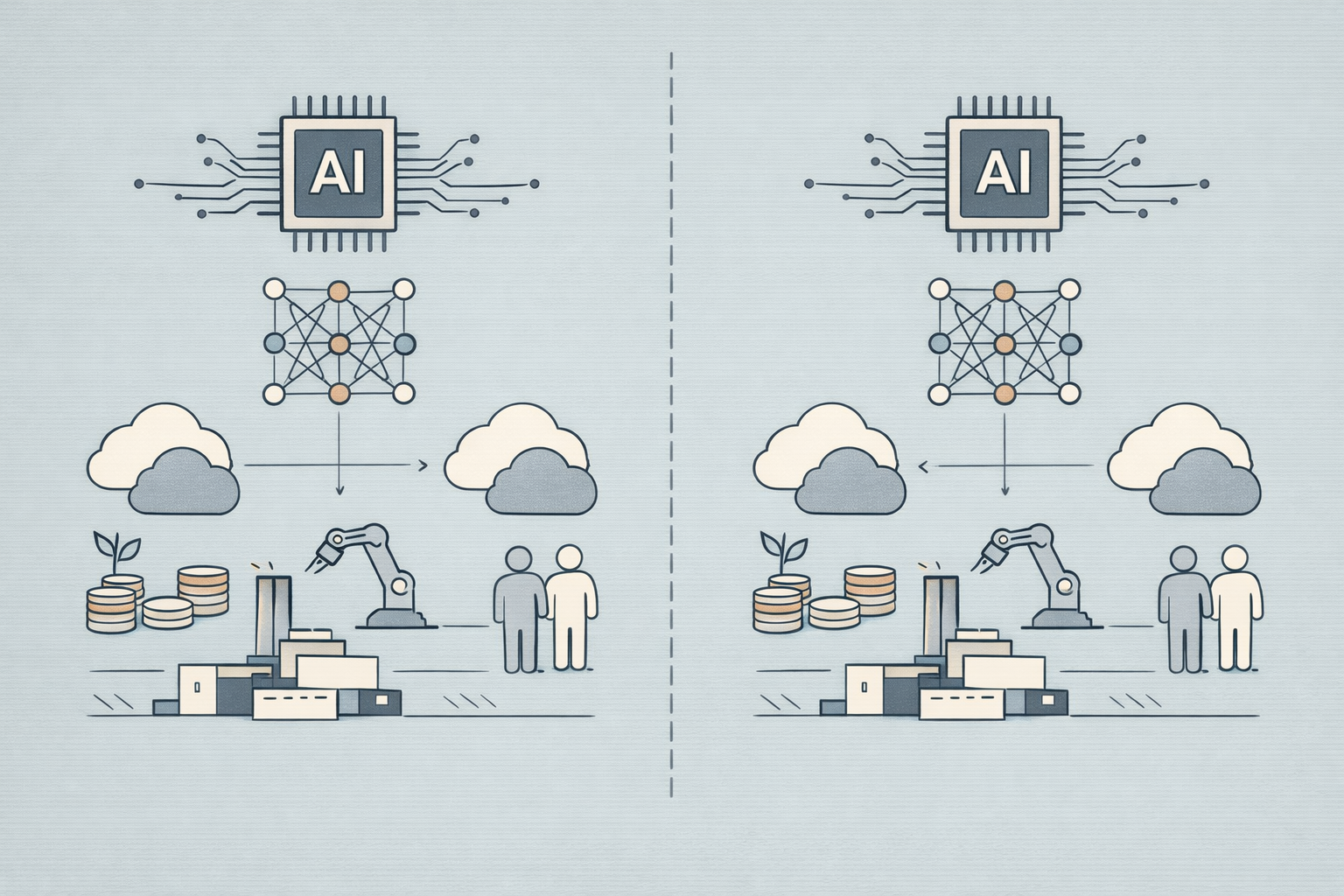
Here’s where things stand across the five dimensions that actually matter. The US leads on model performance, chip manufacturing, and private capital. China leads on research output, open-source proliferation, and AI patents. Neither side dominates outright.
Models: US ahead (narrowing fast).
Chips: US ahead (wide margin).
Data: Split — each side has structural advantages the other can’t replicate.
Talent: Converging — and the trend favours China.
Investment: US ahead on private spend; China closing via state capital.
That’s not a clean victory for anyone. It’s a race where each runner has very different strengths.
Can China’s Models Really Compete with GPT-5 and Claude?
Yes — and in some categories, they’re already winning. DeepSeek V4, previewed in April 2026 and officially released in July 2026 with a new efficiency-focused architecture running roughly one trillion parameters, delivers benchmark scores comparable to frontier US models at approximately 50 times lower API cost. As an illustration of the gap: a complex task costing $15 with GPT-5 ran about $0.50 on DeepSeek in early 2026 (DeepSeek pricing data, March 2026). Pricing has shifted since — GPT-5.6 and DeepSeek V4’s July 2026 peak/off-peak API rates have moved the numbers — but the order-of-magnitude difference holds. DeepSeek-R1, the reasoning model that triggered an 18% drop in NVIDIA’s share price when it launched in January 2025, was developed in two months for less than $6 million — and surpassed OpenAI’s o1 on mathematical reasoning benchmarks with a 97.4% score on MATH (MIT Technology Review, January 2025).
The US frontier still holds the edge on absolute capability. As of July 2026, benchmark leadership is split between OpenAI’s GPT-5.6 (July 2026), Google’s Gemini 3.x line (Gemini 3.6 Flash, July 2026), and Anthropic’s latest Claude models — Anthropic shipped Claude Opus 4.8 in May 2026, then its Fable 5 flagship in June — while Moonshot’s Kimi K3 (July 2026) leads open-weight rankings. Even coding leadership is contested, with Kimi K3 topping some coding leaderboards while Anthropic and OpenAI’s newest models lead overall. But the gap is measured in single-digit percentages, not generational leaps. DeepSeek-V3.2 surpasses all US models on Chinese-language tasks, which matters enormously for the world’s largest internet population.
Alibaba’s Qwen family tells an equally striking story. With 942 million total downloads as of March 2026 — more than double the combined downloads of the next eight competitors — Qwen has become the default open-source foundation for developers across Asia and the Global South (Gizmochina, April 2026). Qwen3.5 is up to eight times faster and 60% cheaper than its predecessor. Baidu went from zero releases on Hugging Face in 2024 to over 100 in 2025. ByteDance and Tencent increased their open-source releases eight to nine times over the same period (Hugging Face, January 2026).
Does NVIDIA’s Chip Dominance Still Matter?
More than anything else in this race. The hardware gap remains the US’s most durable structural advantage — and it’s not close. US and partner manufacturing capacity for advanced AI processor dies is 35 to 38 times that of China’s, adjusted for quality (Council on Foreign Relations, 2026). NVIDIA’s Blackwell Ultra GB300 delivers 15 petaflops of FP4 compute with 288 GB of HBM3e memory at 8 TB/s bandwidth. Huawei’s Ascend 950PR, China’s best current answer, manages 1.56 petaflops — roughly one-tenth of Blackwell’s output.
The manufacturing constraints cut deeper than specs suggest. Huawei’s chip yields sit between 5% and 20%, compared with NVIDIA’s estimated 60-80% on Blackwell (CFR analysis, 2026). SMIC, Huawei’s foundry partner, remains stuck at 7nm — two to three generations behind TSMC’s leading-edge 3nm process. “On a chip-level basis, Huawei has essentially caught up to where NVIDIA was three years ago,“ semiconductor analyst Stacy Rasgon at Bernstein Research noted. That’s progress, but it’s progress on a treadmill.
Huawei’s roadmap targets NVIDIA Blackwell parity with the Ascend 960 in 2027 and aims for 4 ZettaFLOPS FP4 performance by 2028 (Tom’s Hardware, 2026). Ambitious — but every node on that roadmap depends on SMIC clearing manufacturing hurdles that US and allied equipment export controls are specifically designed to prevent.
The catch: US export restrictions have created a pricing paradox. The Ascend 950PR delivers 2.8 times the performance of NVIDIA’s H20 (TrendForce, March 2026) — but the H20 is no longer NVIDIA’s best China-legal part. H200-class chips were cleared for China sales in January 2026 under a 25% surcharge, and against those the Ascend still trails. By restricting its own companies from selling top-tier chips to China, the US has inadvertently created a protected market for Huawei’s domestic alternatives. Who Controls Compute in Asia? The $100 Billion Data Centre Race
Who Has the Data Advantage?
This one’s genuinely split, and it might be the most underrated dimension of the entire race.
China generates more internet data than any other country — 1.4 billion people behind a firewall that keeps most of that data within domestic platforms. WeChat, Douyin, Taobao, and Xiaohongshu produce training corpora at a scale no US company can access. For Chinese-language AI, manufacturing-sector AI, and surveillance applications, China’s data advantage is structural and permanent.
The US advantage is breadth. English remains the lingua franca of the global internet, and American models train on the most linguistically diverse, openly accessible datasets available. For multilingual capability, scientific literature, and code — where GitHub provides an enormous open corpus — the US data environment is richer.
China’s regulatory approach also shapes the data picture. The Cybersecurity Law amendments effective January 2026 brought AI under national law for the first time, introducing both state support for AI research and tighter ethical oversight (Global Policy Watch, October 2025). The AI Plus Action Plan, issued in August 2025, targets 70% AI penetration across key sectors by 2027 and 90% by 2030. That’s a government actively building the pipes for AI data flow — but also controlling the taps.
Where Did All the Talent Go?
This is where the trend lines should worry Washington. The number of AI researchers moving to the US has dropped 89% since 2017, with an 80% decline in the last year alone (Stanford HAI, 2026). Nearly all researchers behind DeepSeek’s five foundational papers were educated and trained in China. The brain drain that built Silicon Valley’s AI dominance is reversing.
China already leads on volume: 23.2% of all global AI publications versus 12.6% for the US, and 20.6% of global AI citations (Stanford HAI, 2026). Chinese entities filed 69.7% of all AI patents worldwide. The US still produces more commercially influential intellectual property, but the pipeline feeding American AI labs is narrowing while China’s is widening.
So Who’s Actually Winning?
It’s not a simple answer — and that’s the point. The US holds the frontier on model capability and chip manufacturing, the two factors that dominate headlines. China leads AI on research volume, open-source adoption, talent pipeline, and cost efficiency, the factors that determine where AI actually gets deployed at scale.
The Stanford AI Index 2026 puts the overall gap at 2.7 percentage points. But that single number obscures a more important reality: the US is winning the sprint while China is building for the marathon. American advantages in chips and capital are real but depend on export controls holding, TSMC remaining aligned, and talent continuing to flow westward — all three of which are shakier than they were two years ago.
China’s advantages are structural: a massive domestic market, state-directed capital ($138 billion in a single state VC fund targeting AI in 2025), a growing talent base, and an open-source strategy that’s turned DeepSeek and Qwen into the default foundation models for half the world’s developers.
The honest scorecard? The US is ahead today. The momentum belongs to China. And the gap between those two statements is closing faster than almost anyone predicted.
Sources & Further Reading
Discover more from Digital in Asia
Subscribe to get the latest posts sent to your email.
