
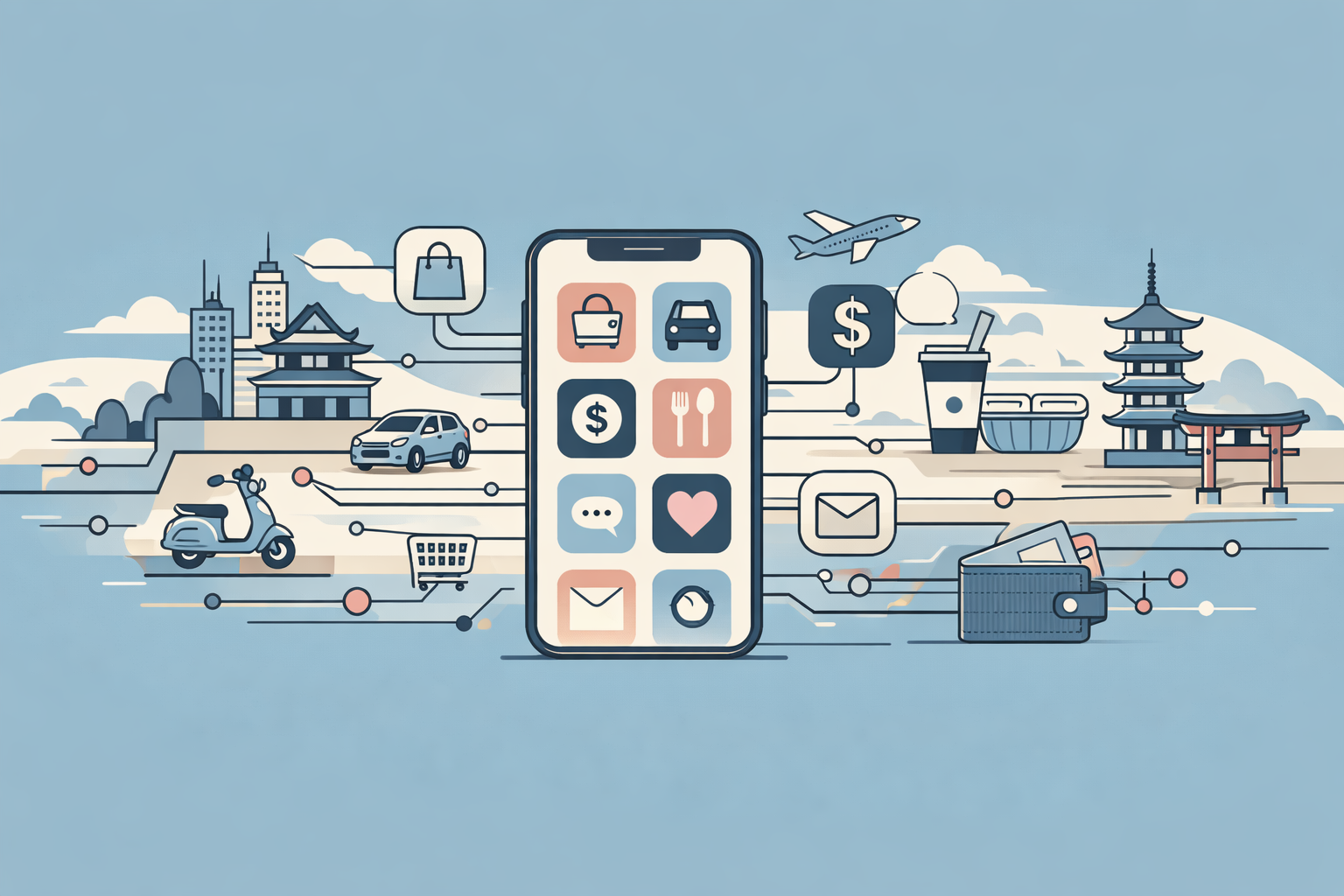
A super app is a single mobile application that bundles multiple services — rides, deliveries, payments, lending, shopping, entertainment — into one platform. The concept barely exists in the West, but in Asia it’s the dominant model for how people interact with digital services. The global super app market reached $127 billion in 2025 and is projected to hit $546 billion by 2031, growing at 27.4% CAGR (Straits Research). Asia-Pacific accounts for 53% of that market. WeChat alone has 1.67 billion monthly active users. Alipay connects over one billion users to more than 10,000 types of consumer services. Grab serves 47 million monthly transacting users across eight countries and 900+ cities. This isn’t a niche format — it’s how a significant chunk of humanity accesses the internet.
Understanding how super apps actually work — the mechanics, the economics, the data layer underneath — matters because the model is reshaping commerce, payments, and advertising across Asia’s largest economies. And the playbook is starting to export.
What makes a super app different from a regular app?
The distinction isn’t just about having multiple features. Plenty of Western apps have added functionality over time. Instagram has shopping. Uber has food delivery. PayPal has crypto. But none of them are super apps. The difference is architectural: a super app is designed from the ground up as a platform that hosts services, not an application that does one thing and bolts on extras.
Think of it this way. A regular app is a tool — you open Uber to get a ride, then close it. A super app is an environment — you open Grab, and you might get a ride, order lunch, pay your electricity bill, apply for a micro-loan, and buy insurance, all without leaving. The app becomes a daily utility rather than an occasional tool. That daily usage generates data, and that data feeds every other service on the platform.
The technical foundation is usually a “mini-program” or “mini-app” architecture, pioneered by WeChat in 2017. Third-party developers build lightweight applications that run inside the super app’s shell, using its payments infrastructure, user identity, and distribution. WeChat now hosts over 3.9 million mini-programs with 945 million monthly users in China and 450 million daily active users. More than 70% of WeChat users access mini-programs at least once a week, with an average session length of 11 minutes. E-commerce alone accounts for 45% of total mini-program GMV, which reached approximately RMB 1 trillion ($138 billion) annually. Grab and Gojek use similar architectures to integrate third-party services alongside their own first-party offerings.
The mini-program model matters because it turns a super app into a platform marketplace. The super app provides the infrastructure — identity, payments, notifications, distribution — and third-party developers build on top of it. This is closer to an operating system than an application. It’s why analysts sometimes describe WeChat as “the operating system of Chinese digital life,” and it’s not hyperbole.
Why did super apps emerge in Asia and not in the West?
This is the question everyone asks, and the answer comes down to three structural conditions that existed in Asia but not in North America or Europe.
Mobile-first populations. Hundreds of millions of consumers in Southeast Asia, India, and China skipped the desktop internet entirely. Their first — and often only — computing device is a smartphone. When your entire digital life runs through a 6-inch screen, consolidation isn’t just convenient, it’s necessary. Screen real estate is scarce. An app that does five things replaces five apps you’d have to download, manage, and switch between. In Southeast Asia, 90% of internet connections are mobile. In Indonesia, 68% of online shoppers have never used a desktop for e-commerce.
Low banking penetration. Across Southeast Asia, roughly 290 million adults remain unbanked or underbanked (World Bank, 2022). Only about 15% of Southeast Asian e-commerce shoppers own a credit card. In 2019, cash-on-delivery represented 52% of all e-commerce payments across the region. Traditional banks didn’t build for these populations. Super apps did. By embedding payments into ride-hailing and delivery — starting with cash on delivery, then gradually migrating users to digital wallets — platforms like Grab, Gojek, and Paytm became de facto financial infrastructure. The result: cash-on-delivery has fallen to 31% as of Q1 2026 and is projected to drop below 10% by 2028. Digital payments now account for over 70% of e-commerce transactions across the region. In Indonesia, 92% of consumers regularly use mobile wallets. In Malaysia, digital payment adoption exceeds 80%. In the Philippines, GCash alone has 94 million users processing 19 million daily transactions. Once you control the payments layer, every adjacent service becomes easier to launch.
Fragmented offline infrastructure. In markets like Indonesia (17,000 islands), the Philippines (7,600 islands), and Vietnam, physical retail and banking infrastructure is unevenly distributed. A super app doesn’t need a branch network — it needs a smartphone and a mobile data connection. The app becomes the infrastructure that the offline world never built. Southeast Asia’s digital economy surpassed $300 billion by end of 2025 (e-Conomy SEA), driven in large part by super app ecosystems filling gaps that traditional institutions left open.
How does the super app flywheel actually work?
Every successful super app follows the same basic flywheel, though they enter it at different points. The model looks simple on paper. In practice, each step is ferociously hard to execute — which is why so few companies have pulled it off.
Step 1: Win a daily-use category. For Grab and Gojek, it was ride-hailing. For WeChat, it was messaging. For Paytm, it was mobile payments. For Alipay, it was e-commerce payments via Taobao. The entry point doesn’t matter much — what matters is that it generates daily or near-daily engagement and captures a user’s identity and location data. The category has to be something people use reflexively, not occasionally. Ride-hailing works because commutes are daily. Messaging works because conversations are constant. A travel booking app wouldn’t work as a super app seed — the frequency isn’t there.
Step 2: Add payments. This is the critical pivot. Once users are transacting through the app regularly, introducing a digital wallet is a natural extension. GrabPay, GoPay, WeChat Pay, and Alipay all followed this path. Payments create the data layer that powers everything else — transaction history, spending patterns, creditworthiness signals. GrabPay’s total payment volume surged 38% year-on-year to approximately $5.8 billion in Q2 2025 alone. WeChat Pay has 935 million users in China. In India, UPI processed 228.3 billion transactions worth approximately ₹300 lakh crore in 2025 — and Paytm, PhonePe, and Google Pay are all competing for super app positioning on top of that rail.
Step 3: Launch adjacent services. With a user base, payment infrastructure, and data, the super app can launch new verticals at dramatically lower customer acquisition costs than a standalone app. Grab went from rides to food delivery to groceries to financial services. Gojek expanded from motorcycle taxis to over 20 services including food delivery, logistics, and healthcare. Each service shares the same user identity, payment method, and — critically — the same driver or delivery network. This shared infrastructure is the economic moat. A standalone food delivery startup needs to recruit drivers from scratch. Grab already has them.
Step 4: Monetise the platform. As the user base and data layer mature, the super app unlocks high-margin revenue streams that look nothing like the original business. Three matter most: advertising, financial services, and platform fees from third-party developers. These aren’t side businesses — they’re the endgame, and they’re where the real economics of super apps live.
The flywheel compounds because each service makes every other service stickier. A user who rides, orders food, and uses GrabPay is far less likely to switch to a competitor than a user who only rides. Grab’s data shows multi-service users transact 3–4x more than single-service users. That cross-service stickiness is the single most important metric in the super app model — it’s what makes the economics work at scale.
What are the biggest super apps in Asia?
Eight platforms dominate the Asian super app landscape. Each operates a version of the model, but with significant local variation in scale, market context, and strategic emphasis.
WeChat (Tencent) — China is the original and most complete super app. With 1.67 billion MAUs and 96% penetration among Chinese mobile users, WeChat is essentially the operating system of Chinese digital life — messaging, payments, mini-programs, social media, government services, and more. WeChat Pay processes billions of transactions annually with 935 million users. The mini-program ecosystem alone generates approximately RMB 1 trillion ($138 billion) in annual e-commerce GMV. No Western equivalent comes close.
Alipay (Ant Group) — China is WeChat’s rival super app, built on a payments-first foundation from its origins as Taobao’s escrow payment system. Alipay connects over one billion users to more than 10,000 types of consumer services. In early 2026, Ant Group reported that its AI-powered payment feature, Alipay AI Pay, surpassed 100 million users — becoming the world’s first AI-native payment product to reach that milestone. During Chinese New Year week alone, AI Pay processed over 120 million transactions. Alipay’s AI-powered fraud detection has reduced fraudulent activity by 83% compared to legacy systems. International adoption grew by 18 million users in Europe and 13 million in Southeast Asia in 2025.
Grab — Southeast Asia operates across eight countries and 900+ cities with 47 million MTUs and $3.2 billion in 2025 revenue (+19% YoY). Its super app spans mobility, deliveries, payments, lending, and advertising. Grab achieved its first full-year net profit of $200 million in 2025, with adjusted EBITDA of $500 million. Over 90% of rides are now AI-dispatched. GrabPay holds dominant wallet market share in Malaysia (38.3%) and Singapore (35.3%). Management has set a 2028 target of $1.5 billion in adjusted EBITDA — a 3x increase from 2025.
Gojek (GoTo) — Indonesia is Indonesia’s dominant super app with over 20 services spanning mobility, food delivery, logistics, payments, and healthcare. GoTo reported its first quarterly profit in Q3 2025, with net revenue of Rp 4.74 trillion (+21% YoY). After the Tokopedia merger with TikTok Shop, GoTo is increasingly focused on GoPay and financial services as its high-margin growth engine. GoPay is the leading digital wallet in Indonesia, where 92% of consumers regularly use mobile wallets.
Paytm — India dominates India’s digital payments space with 270 million monthly active users and over 540 million registered users. Paytm’s revenue hit ₹28,100 crore in FY2025, driven by lending, insurance, and wealth management. The platform processed ₹9.3 trillion in transaction value in Q1 2025 alone, and loan disbursals surged past ₹15,500 crore in 2025 (+29% YoY). Paytm Payments Bank has reached 52 million subscribers. India’s UPI ecosystem — the rail on which Paytm, PhonePe, and Google Pay compete — processed 228.3 billion transactions in 2025, up from 172.2 billion the prior year.
KakaoTalk — South Korea has 53.5 million MAUs and 97% market penetration in South Korea, sending over 1 billion messages daily. Kakao’s consolidated revenue reached KRW 7.87 trillion ($5.42 billion) in 2024. Kakao Bank, its financial services arm, achieved a record net profit of ₩137 billion in Q1 2025, serving 25.45 million customers. KakaoTalk demonstrates that the super app model works in high-income, high-banking-penetration markets too — provided the messaging layer captures enough daily engagement to anchor the ecosystem.
Line — Japan, Thailand, Taiwan, Indonesia boasts 178 million MAUs across its four key markets: Japan (92 million, reaching 88% of adults), Thailand (33 million), Taiwan (17 million), and Indonesia (20 million). Like Kakao, Line started as a messenger and expanded into payments, commerce, content, and financial services. Its geographic spread across high-income (Japan) and emerging (Thailand, Indonesia) markets makes it a useful test case for whether the super app model is truly market-agnostic.
How do super apps make money? The four-layer revenue stack
The revenue model of a mature super app looks nothing like the business that generated its first users. There are four distinct revenue layers, and the highest-margin ones are the newest.
Layer 1: Take-rate commissions. The original revenue source — commissions on rides (10–20%), food delivery (15–25%), and marketplace transactions. This is high-volume but relatively low-margin after driver payments, logistics costs, and promotional subsidies. Grab’s deliveries segment generated $1.8 billion in 2025 revenue; mobility added $1.22 billion. These segments fund the ecosystem but aren’t where the real economics shine.
Layer 2: Financial services. This is the high-margin growth engine for every major super app. Lending, insurance, wealth management, and buy-now-pay-later products leverage the transaction data the platform already has to underwrite risk better than traditional banks can — particularly for unbanked and underbanked populations with no credit history. Grab’s financial services revenue grew 37% year-on-year in 2025, with a gross loan portfolio surpassing $1.3 billion and a target of $2 billion by end of 2026. Sea Group’s SeaMoney has deployed $7.9 billion in consumer and SME loans with a delinquency rate of just 1.3%. Paytm’s lending disbursals hit ₹15,500 crore in 2025. The common pattern: super apps know your spending, your income proxies, and your repayment behaviour before they ever extend a loan.
Layer 3: Advertising. Super apps sit on first-party transaction data that no social media platform can match. Grab knows where you go, what you eat, how often you order, and whether you pay on time. That data creates targeting capabilities that rival Google and Meta’s — and in some ways surpass them, because super app data is transactional, not just behavioural. GrabAds reached a $236 million annualised run-rate by mid-2025, growing 45% year-on-year. Shopee’s advertising revenue grew over 70% year-on-year in Q3 2025. Paytm’s advertising revenue jumped 48% to ₹3,260 crore. As third-party cookies disappear globally, this first-party data advantage becomes more valuable, not less.
Layer 4: Platform and ecosystem fees. Revenue from third-party developers, mini-program operators, and enterprise services. WeChat’s mini-program ecosystem is the most developed example, but Grab and Gojek are building similar models. This layer has the highest margins and the greatest long-term scalability — it’s the app store model applied to an entire services ecosystem.
How is AI changing super apps?
AI isn’t a future feature for Asian super apps — it’s already embedded in the operational core. The difference between Asian super apps and Western tech companies on AI isn’t ambition. It’s data density. A super app generates ride data, delivery data, payment data, and lending data from the same user in the same day. That’s a training dataset no single-purpose app can match.
Grab dispatches over 90% of rides using AI, optimising driver allocation across 900+ cities in real-time. The system processes location data, demand predictions, traffic patterns, and driver availability simultaneously — and the more data it ingests, the more efficient the matching becomes. Grab has also reported that non-capital-city GMV is growing 2x faster than capital cities, driven partly by AI-powered demand forecasting that helps the platform expand into lower-tier markets efficiently.
Alipay’s AI Pay — launched in 2025 — is the world’s first AI-native payment product, surpassing 100 million users by February 2026. It enables transactions through AI agents, and its fraud detection system has reduced fraudulent activity by 83%. This isn’t a chatbot bolted onto a payment app. It’s a fundamental rearchitecting of how payments work.
Sea Group has built Sailor2, a large language model trained on 400 billion Southeast Asian language tokens — a resource nobody else has at that scale. The model powers personalisation across Shopee’s product recommendations, Garena’s gaming experiences, and SeaMoney’s credit underwriting. Advertising conversion rates lifted 10% year-on-year through AI-driven personalisation.
The implication for the super app model is structural: AI increases the returns to data density. The more services a super app offers, the more data it generates, the better its AI becomes, the more effective each service gets. This is the flywheel’s flywheel — and it’s widening the gap between super apps and single-purpose competitors.
What are the limits of the super app model?
The model isn’t invincible, and its weaknesses are becoming clearer as the first generation of super apps matures.
Regulatory risk is real and growing. Governments across Asia are increasingly uncomfortable with platforms that control rides, payments, lending, and data simultaneously. Indonesia’s decision to temporarily ban TikTok Shop in late 2023 — before allowing it back through the Tokopedia merger — showed how quickly regulators can act when they perceive a threat to local businesses. India’s regulatory crackdown on Paytm Payments Bank in early 2024, which restricted new customer onboarding, demonstrated that even dominant players aren’t immune. China’s restructuring of Ant Group in 2023 was the most dramatic example — a reminder that super apps operate at the pleasure of regulators, not the other way around.
Not every vertical is accretive. Super apps face the constant temptation to launch everything, but some services dilute focus without generating meaningful revenue or data value. The discipline is knowing what NOT to add. Grab’s decision to exit grocery delivery in certain markets and refocus on higher-margin financial services reflects this learning. GoTo’s strategic narrowing to Indonesia-first rather than multi-market expansion tells a similar story. Complexity has a cost, and super apps that sprawl without clear unit economics in each vertical end up subsidising services that never pay for themselves.
The West keeps trying and failing. Uber, Meta, PayPal, and Revolut have all attempted super app strategies and pulled back or stalled. The structural conditions that enable super apps in Asia — mobile-first behaviour, low banking penetration, fragmented offline infrastructure — don’t exist in the same way in North America and Europe. Western consumers already have established, trusted solutions for each vertical. Switching from separate best-in-class apps to one bundled platform feels like a downgrade, not an upgrade. The regulatory environment is also less accommodating — European data protection rules, in particular, make the cross-service data sharing that powers super app flywheels much harder to execute.
Credit risk at scale is real. As super apps push deeper into lending, they’re taking on genuine financial risk. Grab’s loan portfolio is heading toward $2 billion. SeaMoney has $7.9 billion deployed. These are meaningful credit exposures in markets with limited credit bureau infrastructure. The delinquency numbers look healthy for now (SeaMoney at 1.3%), but a macroeconomic downturn could pressure asset quality fast, particularly for the underbanked borrowers who are the super apps’ core lending customers.
Why should brands and advertisers care about super apps?
Super apps represent the largest pools of first-party consumer data outside of Google and Meta — and in Southeast Asia and India, they’re arguably more valuable because the data is transactional rather than behavioural.
Consider what Grab knows about a single user: where they live (pickup addresses), where they work (regular weekday destinations), what they eat (order history and cuisine preferences), how much they spend (payment data across categories), whether they’re creditworthy (repayment history), and what time of day they’re most active. No social media platform has this breadth of real-world behavioural data, because social platforms capture intent signals — likes, clicks, searches — while super apps capture actual transactions.
For brands operating in Asia, this creates targeting capabilities that are genuinely differentiated. A food brand can target consumers who order Thai food three times a week from restaurants in central Bangkok. A fintech company can target users who’ve recently taken out a micro-loan and might be receptive to insurance upsells. An auto manufacturer can target users whose ride-hailing spend suggests they’re commuting daily and might be in the market for a vehicle.
GrabAds, GoAds, Shopee Ads, and Paytm’s advertising platform are all growing at 40–70% year-on-year. As third-party cookies disappear globally and privacy regulations tighten, these first-party data moats become more valuable, not less. The super app advertising model is likely the most underappreciated commercial opportunity in Asian digital markets right now.
What’s the outlook for super apps in 2026 and beyond?
The next phase of the super app model isn’t about adding more services. It’s about three structural shifts.
AI-native services. Alipay AI Pay is the first example of a fundamentally new service category that only makes sense inside a super app. Expect more: AI-powered financial advisors that understand your full spending history, AI shopping assistants with access to your transaction preferences, AI health services (Ant Group’s AQ health app has already passed 100 million users). The super app’s data density advantage compounds with AI in ways that single-purpose apps can’t match.
Cross-border interoperability. Southeast Asia’s digital payment systems are beginning to connect. Indonesia’s QRIS system grew 175% in transaction volume in 2024, reaching 30 million MSMEs. QR code interoperability between GrabPay, GoPay, and other regional wallets is expanding across borders. WeChat’s overseas mini-programs achieved 40% year-on-year transaction growth in 2025, reaching 5 billion cross-border usage sessions. This creates the possibility of super app services that work seamlessly across national boundaries — a ride with Grab in Singapore paid with your GoPay wallet from Indonesia. The infrastructure is being built now, and it could unlock a genuinely regional super app economy.
Financial services deepening. The biggest revenue opportunity ahead isn’t more rides or more deliveries. It’s deeper penetration into lending, insurance, wealth management, and embedded finance. The super apps with the best data and the most sophisticated AI underwriting will capture a disproportionate share of the $1 trillion+ Southeast Asian and Indian financial services opportunity. Grab targeting $2 billion in gross loans by end of 2026 is just the beginning.
The super app model redefined how hundreds of millions of people access digital services. It works because it’s built for the conditions that actually exist across Asia — not the conditions that exist in Silicon Valley. That’s the insight the West keeps missing, and it’s why the model keeps winning where it matters most.
Sources & Further Reading
Discover more from Digital in Asia
Subscribe to get the latest posts sent to your email.
