
Asia’s $311 Billion Ad Market, $2.3 Trillion Commerce Engine, and $102 Billion AI Layer Are Fusing Into a Single Stack
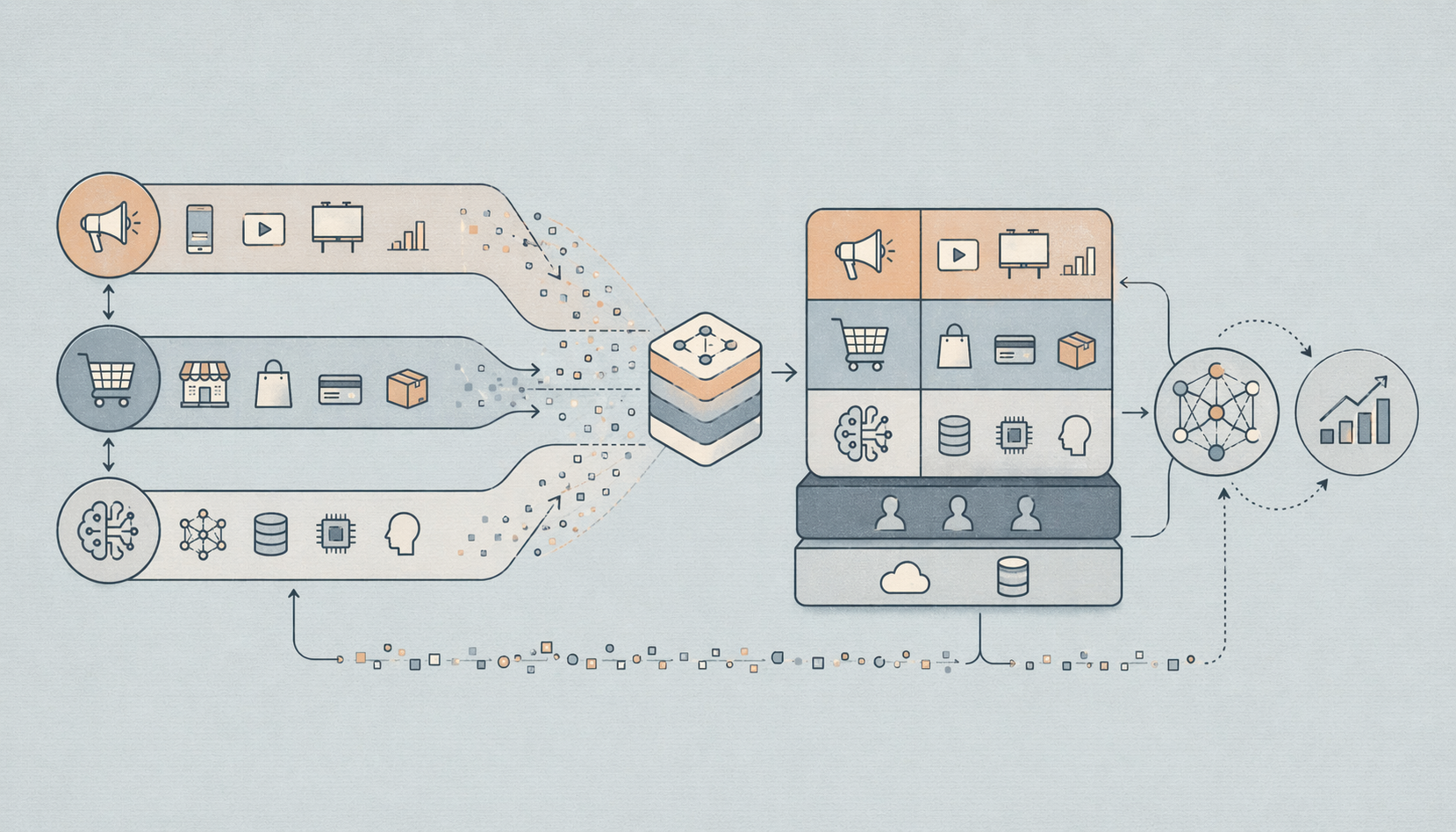
There’s a simple model for understanding Asia’s digital economy, and most people haven’t drawn it yet. Three layers — advertising, commerce, and artificial intelligence — are collapsing into a single integrated stack. Ads generate demand. Commerce monetises it. AI optimises both. That sequence isn’t new, but the speed at which these layers are merging in Asia is unprecedented, and it’s reshaping where value accrues across the region’s digital ecosystem.
The numbers frame the scale. Asia-Pacific’s digital ad spend will hit $311.4 billion in 2026, growing at 14.1% annually (GlobeNewsWire, February 2026). China’s e-commerce GMV alone sits at $2.32 trillion, with Southeast Asia’s platforms adding another $157.6 billion in 2025 — up 23% year-on-year (Momentum Works, 2026). And the AI layer underpinning it all? Asia-Pacific’s AI market reached an estimated $102 billion in 2025, growing at a 34-35% CAGR that makes it the fastest-expanding AI region globally (Stanford HAI, 2025). TikTok, Shopee, Grab, Alibaba, and Tencent aren’t just participants in this stack. They’re building it — each racing to own as many layers as possible. The companies that control the full sequence, from demand generation through conversion to optimisation, will define Asia’s next digital decade.
Where’s the $311 Billion in Ad Spend Actually Going?
The first layer of the stack is demand generation, and the story here isn’t just growth — it’s a structural shift in what advertising does. Asia-Pacific’s digital ad market is forecast to reach $489.3 billion by 2029 (GlobeNewsWire, February 2026), but the more revealing figure is compositional. Retail media is now the fastest-growing digital channel at 14.1% growth, outpacing online video at 11.5% and social at 11.4% (Dentsu, 2026). That order matters. It tells you that advertising spend is migrating toward formats where the ad and the transaction happen in the same environment.
Thailand crossed a milestone in 2024 when digital ad spend surpassed TV for the first time, taking 45% versus 35% (Mordor Intelligence). Southeast Asia’s broader ad market hit $28.34 billion in 2025 and is projected to reach $63.89 billion by 2031. But the real action is inside the platforms. Shopee expanded its advertising tools to full-funnel retail media solutions across Southeast Asia in August 2025, letting brands engage consumers from discovery through to post-purchase. Grab launched GrabAds Enterprise in May 2025, a programmatic suite pulling audience data from ride-hailing, food delivery, and payments — the kind of first-party signal goldmine that traditional ad networks can’t match.
China’s retail media market alone reached an estimated $52 billion in 2025 (TechBullion / RMIQ). Alibaba’s Alimama platform generates over $13 billion in annual advertising revenue across Taobao and Tmall. Globally, retail media hit $184 billion in 2025 and is forecast to reach $312 billion by 2030. The direction is clear: advertising in Asia is becoming a commerce function, not a media function. Brands aren’t buying eyeballs. They’re buying proximity to the checkout.
Has Commerce Become Asia’s Primary Conversion Engine?
The second layer is where demand becomes revenue. China accounts for 83% of retail e-commerce sales in Asia-Pacific (eMarketer, 2025), a dominance so complete it can obscure the dynamism elsewhere. Southeast Asia’s e-commerce platforms — Shopee, Lazada, TikTok Shop — collectively held 99% of regional market share in 2025 and generated $157.6 billion in GMV (Momentum Works, 2026). The region is on track to reach $230 billion in e-commerce GMV by 2026.
But the conversion engine has changed shape. It’s no longer search-and-buy. TikTok Shop’s global GMV nearly doubled to $64.3 billion in 2025, with Southeast Asia accounting for $45.6 billion of that — a doubling year-on-year (TechNode Global, February 2026). Indonesia alone contributed $13.1 billion, making it TikTok Shop’s second-largest market globally. The platform is projected to cross $112 billion in global GMV by end of 2026. Roughly 70% of TikTok Shop purchases are unplanned — products users didn’t know they wanted until the content surfaced them.
This is the structural point. Commerce in Asia now operates across three distinct modes: search commerce (Shopee, Taobao), social commerce (TikTok Shop, WeChat), and live commerce (Douyin, Shopee Live). Each has a different demand-creation mechanism, but all three are converging on the same insight: the closer you place the transaction to the content, the higher the conversion rate. Live commerce increased its share of TikTok Shop GMV from 10% to 14% in 2025, and Thailand’s adoption of livestream selling is driving some of the fastest growth rates in the region.
The commerce layer isn’t just a place where ads land. It’s an active participant in demand creation. When Shopee runs a livestream or TikTok surfaces a product video, the platform is simultaneously generating demand, hosting the transaction, and collecting the data that feeds back into the advertising layer. The stack is circular.
Is AI the Optimisation Layer — or the New Control Layer?
The third layer is where the thesis gets sharp. AI doesn’t sit above or below ads and commerce. It runs through both, optimising ad targeting, predicting purchase intent, automating logistics, and — increasingly — executing transactions autonomously.
Asia-Pacific’s AI market hit $102 billion in 2025 (Stanford HAI / Statista). China invested an estimated $125 billion in AI that year, representing 38% of global AI investment (Stanford HAI). Goldman Sachs projects hyperscalers will invest over $500 billion in AI infrastructure globally in 2026, with a significant share flowing to Asia-Pacific data centres. Alibaba alone has committed 380 billion yuan ($53.7 billion) over three years to AI and cloud infrastructure (Alizila, 2025).
The practical applications are already live at scale. ByteDance’s Interest Graph 3.0, rolled out in early 2026, surfaces products based on velocity signals — views-to-add-to-cart ratios — and forecasts viral product moments 24 to 48 hours before they peak with 79% accuracy (Cruva, 2026). That’s not a recommendation engine. It’s a demand-prediction system that collapses the gap between the ads layer and the commerce layer.
But the bigger shift is agentic commerce. In January 2026, CNBC reported that Chinese tech giants had entered an “agentic commerce“ race, turning chatbots into full-service shopping and payment tools. Alibaba’s Qwen chatbot hit 100 million monthly active users within two months of launch, enabling users to compare Taobao products, book Fliggy flights, and pay via Alipay without leaving the conversation. Tencent is integrating AI agents into WeChat to automate ride-hailing, restaurant bookings, and purchases. ByteDance upgraded its Doubao chatbot to handle ticket bookings through Douyin’s e-commerce features. During Chinese New Year 2026, the three giants spent approximately $647 million subsidising AI shopping adoption — Alibaba at $431 million, Tencent at $144 million, Baidu at $72 million (CNBC, January 2026). Alipay processed 120 million AI-agent transactions in a single week in February 2026.
McKinsey estimates that agentic transactions could influence up to $5 trillion in sales by 2030. China’s AI agent sector is projected to scale from under $1 billion in 2024 to over $30 billion by 2028. AI isn’t just optimising the stack. It’s becoming the interface through which consumers interact with it.
Why Does This Stack Model Matter — and Where Does the Value Accrue?
Here’s the bet. The three-layer stack — ads, commerce, AI — isn’t just a way to describe what’s happening in Asia’s digital economy. It’s a framework for predicting where the value will concentrate. The companies that control all three layers capture the full margin. The companies that control only one layer become commoditised.
Alibaba understands this. Its consolidation of Taobao, Tmall, Ele.me, and Fliggy under a single e-commerce group, paired with its Qwen AI investment and Alimama ad platform, is an explicit play to own the full stack. ByteDance gets it too — TikTok Shop’s fusion of content-driven advertising, native checkout, and AI-powered recommendation is the stack in miniature. Grab’s move into retail media via GrabAds Enterprise extends a logistics-and-payments company upward into the ads layer.
The companies at risk are the ones trapped in a single layer. A pure-play ad network without commerce integration loses to retail media. A marketplace without AI-powered personalisation loses to one that predicts demand before the shopper searches. An AI company without distribution loses to a platform that can deploy models directly into hundreds of millions of daily transactions.
Southeast Asia’s fastest-growing AI markets — Indonesia at 31% CAGR, Malaysia at 29-34%, Vietnam at 28.6% (Source of Asia, 2025) — are growing precisely because the ads and commerce layers are already in place. The AI investment follows the transaction volume, not the other way around.
The stack model also explains why global tech companies struggle in Asia. They tend to excel at one layer — Google in ads, Amazon in commerce — but Asian platforms have built the full sequence natively. When your ad platform, your marketplace, your payments system, your logistics network, and your AI models all share the same data loop, the compounding effects are formidable.
Asia’s digital economy isn’t three separate markets totalling half a trillion dollars. It’s one integrated system where ads create demand, commerce captures it, and AI accelerates the entire cycle. The winners won’t be the biggest spenders in any single layer. They’ll be the ones who’ve welded all three together.
Sources & Further Reading
Discover more from Digital in Asia
Subscribe to get the latest posts sent to your email.
