
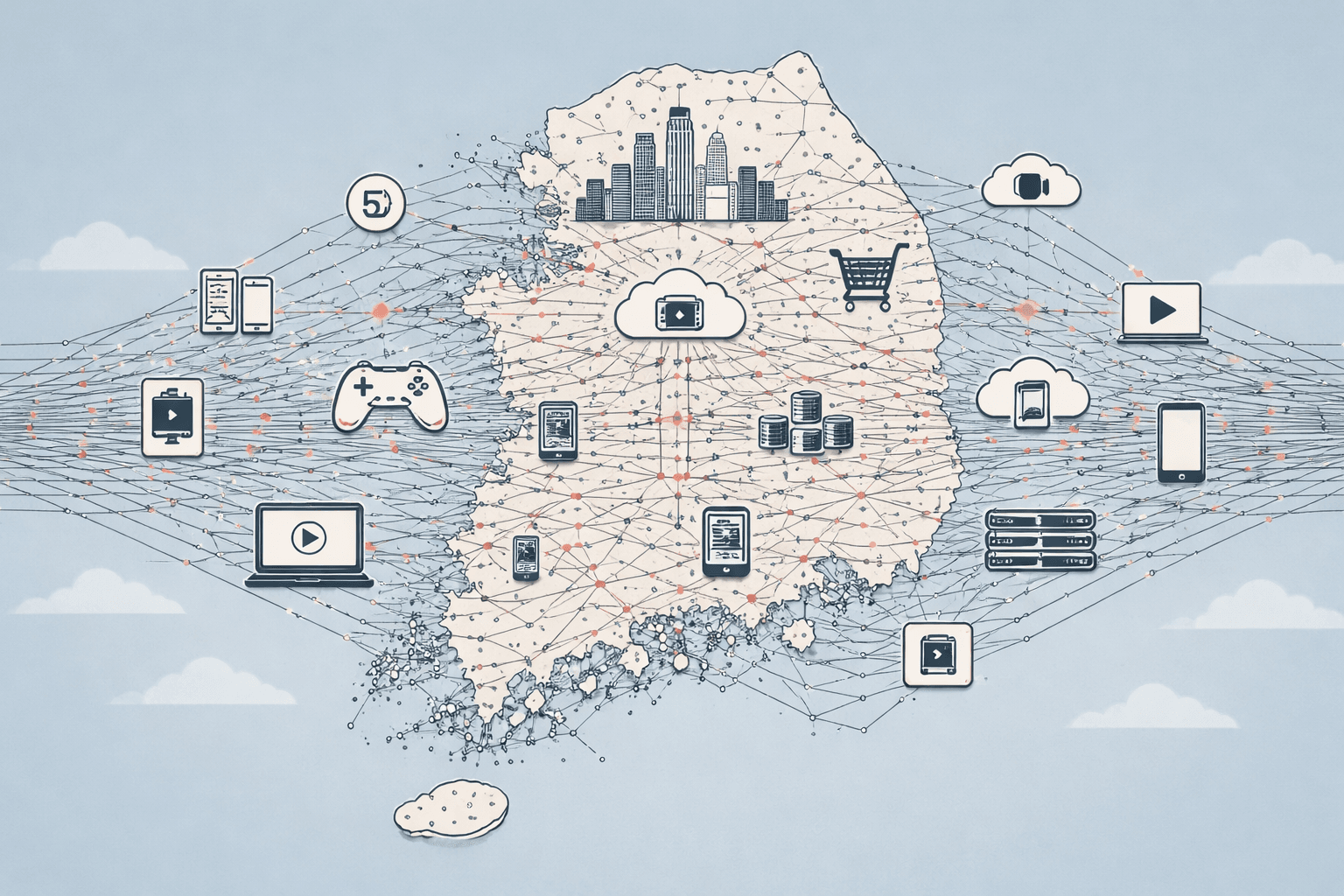
South Korea is the most intensely connected country on earth. With 50.4 million internet users representing 97.4% of the population, 5G download speeds averaging 1,064 Mbps on SK Telecom’s network, and a digital transformation market worth $61.17 billion in 2025 growing at 24.7% CAGR (Mordor Intelligence), Korea doesn’t have a digital economy alongside its traditional economy. The digital layer is the economy. What makes it distinctive isn’t just the connectivity — it’s the density of homegrown platforms. Naver, Kakao, Coupang, and a constellation of gaming companies have built an ecosystem where Korean platforms compete with, and frequently beat, global giants on their home turf.
How big is South Korea’s digital economy?
South Korea’s digital transformation market is projected to grow from $61.17 billion in 2025 to $184.52 billion by 2030. By 2028, digital activities are forecast to drive 31% of GDP (Access Partnership). If fully leveraged, digital technologies could create KRW 281 trillion ($236 billion) in economic value by 2030.
The population — 51.6 million with a median age of 46.2 — is aging rapidly, with a total fertility rate of 0.72 children per woman (Worldometer, 2024). That demographic pressure is one of the strongest drivers of digital adoption: automation, AI, and robotics aren’t optional for Korea. They’re existential. A shrinking workforce means every efficiency gain from digital technology matters more here than in younger markets.
There are 69.2 million active cellular connections — 134% of the population. Smartphone penetration is forecast to reach 95.1% by 2029 (Statista). This is a market where near-universal connectivity isn’t an aspiration. It’s been the baseline for years.
What role does AI play in South Korea’s digital economy?
Korea launched a $735 billion sovereign AI initiative in 2025 — positioning the country as the world’s third AI superpower behind the US and China (Introl/NVIDIA, 2025). The government allocated KRW 6.8 trillion (~$4.9 billion) in 2025 for R&D across 12 strategic technologies including AI and semiconductors. The investment target is $6.94 billion (9.4 trillion won) in AI by 2027.
Five consortia — Naver, SK Telecom, LG Group, NCSoft, and Upstage — were selected in August 2025 to compete for sovereign AI development, sharing $381 million in government funding. Samsung Electronics announced a $230 billion AI infrastructure investment through 2030. NVIDIA committed 260,000 Blackwell GPUs for the Korean government, Samsung, SK Group, Hyundai Motor Group, and Naver. The target is 500,000 GPUs deployed by 2027.
The AI Framework Act, passed in January 2025, takes effect in January 2026 — making Korea the first APAC jurisdiction with comprehensive AI legislation. It introduces specific obligations for “high-impact” AI systems in healthcare, energy, and public services.
Naver claims a unique position as Korea’s only company with a genuine “AI full stack” — having built HyperCLOVA X while operating massive data centres, cloud services, and AI platforms. SK Telecom’s A.dot AI service attracted approximately 10 million subscribers by August 2025. Samsung Gauss is being embedded across Samsung’s device ecosystem.
Korea’s AI chip spending is forecast to grow at 15% CAGR, reaching $3.4 billion by 2027. This is inseparable from the semiconductor story: Korea unveiled plans to invest KRW 700 trillion ($534 billion) to bolster the semiconductor sector. AI chip demand and memory prices are driving semiconductor exports — which hit $173.4 billion in 2025, up 22.2% from 2024.
How advanced is South Korea’s mobile and connectivity infrastructure?
Korea achieved nationwide 5G coverage in April 2024. SK Telecom delivers 99% 5G population coverage, serving 17.49 million 5G subscribers as of Q4 2025, with average nationwide 5G download speeds of 1,064 Mbps — among the fastest in the world (OpenSignal, 2025). The three operators — SK Telecom, KT, and LG U+ — were mandated to upgrade to 5G standalone by 2026.
What comes next is 6G. Korea’s K-Network 2030 plan aims for the first commercial 6G services by 2028, with KRW 625 billion (~$480 million) earmarked for early R&D. The roadmap calls for a test-launch of a LEO satellite by 2027 and a domestic constellation of 14 LEO satellites by 2031 for 6G demonstrations.
Korea is one of the rare markets where iPhone adoption is substantial but not dominant. Samsung holds the majority of the smartphone market — it’s the home market, after all. But iOS has a meaningful share among premium consumers, particularly in Seoul. The platform dynamic matters less here than in markets with extreme Android dominance, because Korea’s homegrown apps (KakaoTalk, Naver) are strong on both platforms.
Who is winning South Korea’s e-commerce war?
Korea’s e-commerce market hit $230 billion in 2024, with mobile shopping accounting for 75% of transactions. Two platforms dominate: Coupang and Naver Shopping together control roughly 65% of the market (KED Global, 2025). Coupang raked in 40 trillion won ($27.7 billion) in sales in 2024 with 39.7% market share. Naver’s commerce GMV exceeded 50 trillion won for the year. Behind them, Gmarket claims 15% and 11Street holds 13%.
Coupang’s competitive advantage is logistics. Rocket Delivery — same-day or next-day delivery for millions of products — has set the standard that every competitor must match. The company has invested billions in fulfilment centres, last-mile delivery networks, and the technology infrastructure that makes sub-24-hour delivery reliable at scale.
Live commerce is growing rapidly. Korea’s live commerce market generated revenue of $2.8 billion in 2024, projected to reach $56.2 billion by 2033 at 40.5% CAGR (Grand View Research). Live-stream retail is forecast to capture one-fifth of online revenue by end of 2025. 60% of Korean consumers have purchased through live shopping formats. Naver Shopping Live and Grip are the leading platforms, but every major player is building live commerce capabilities.
The broader trend is content-led discovery replacing search-led browsing. Korean consumers increasingly find products through video content, creator recommendations, and livestreams rather than keyword search. That shift advantages platforms with strong content ecosystems — which explains why Naver (with its integrated blog, café, and shopping infrastructure) and content-first players are gaining ground.
How big is South Korea’s digital advertising market?
Korea’s digital advertising market generated $5.91 billion in 2024, projected to reach $16.19 billion by 2030 at 18.1% CAGR (Grand View Research). Video advertising is the largest segment at 42.4% of spend.
The search market is a Naver story. Naver captured 62.9% of search engine market share in 2025 — more than twice Google’s share (InterAd, 2025). More recent 2026 data puts Naver at 64.25%, with Google at 29.55%, Bing at 3.12%, and Daum at 2.94%. This is one of only a handful of markets globally where Google doesn’t dominate search — which has profound implications for how brands buy search advertising in Korea.
The streaming landscape is fiercely competitive. Netflix leads the subscription video market with 31% of subscribers and 14.2 million users. But domestic platforms collectively represent 40%: Tving (16%, backed by CJ ENM), Coupang Play (13%, 7.6 million users), and Wavve (11%). Disney+ has 2.4 million users. CJ ENM committed KRW 1 trillion in content investment for 2025, with Tving targeting 15 million global subscribers by 2027.
K-content — Korean dramas, films, variety shows, and music — is the cultural export engine that drives streaming globally and creates demand for Korean advertising inventory. The content production ecosystem is a competitive advantage that no amount of technology investment from foreign platforms can easily replicate.
What does South Korea’s gaming market look like?
Korea is the world’s fourth-largest gaming market with over 33 million gamers. The market is growing at 8.4% CAGR between 2025 and 2034 (Expert Market Research). This is a market defined by its publishers — Korean gaming companies are global powerhouses.
The numbers tell the story. Nexon recorded KRW 4.51 trillion in revenue. Krafton posted record Q1 2025 revenue of KRW 874.2 billion, up 31.3% year-on-year, with full-year revenue of KRW 3.33 trillion. Netmarble hit record performance at KRW 2.84 trillion in revenue. NCSoft reported KRW 1.51 trillion. These aren’t small studios — they’re global entertainment companies competing with the largest publishers in the world.
Esports is embedded in Korean culture in a way it isn’t anywhere else. Korea hosts over 20 major esports tournaments annually. The Korean Esports Association (KeSPA) treats professional gamers as athletes. League of Legends, StarCraft, and Valorant are the marquee titles, but the ecosystem extends deep into mobile gaming, streaming, and content creation.
PC gaming remains culturally significant through Korea’s PC bang (internet café) culture, though the trend is shifting toward mobile and console. Krafton’s PUBG franchise and Smilegate’s CrossFire demonstrate how Korean developers build for both domestic and global audiences. The international revenue for Korea’s top publishers increasingly exceeds domestic revenue — these companies are exporters as much as domestic operators.
How does fintech work in South Korea?
Korea’s mobile payment market is valued at $44.38 billion in 2025, growing to $73.33 billion by 2031 at 8.7% CAGR (Mordor Intelligence). Four platforms define the market: Naver Pay, Kakao Pay, Toss Pay, and Samsung Pay.
Samsung Pay, launched in Korea in 2015, supports both NFC and Magnetic Secure Transmission (MST) technology for wide terminal compatibility — accepted at over 3 million merchants. Kakao Pay expanded internationally, enabling overseas payments without currency exchange. In July 2025, Kakao Pay acquired BNPL specialist Finnq for KRW 620 billion ($470 million), integrating instalment financing for younger consumers and SMEs.
Neobanking is mature. Korea has three licensed internet-only banks: KakaoBank (the world’s most profitable neobank according to Unit Economics rankings), K Bank, and Toss Bank. The Financial Services Commission is considering licensing a fourth. Toss has built one of the most comprehensive fintech ecosystems in Asia — payments, banking, investing, insurance, and credit scoring all within one app.
Korea’s MyData initiative upgraded to MyData 2.0 in 2025, expanding access to offline channels and lowering the minimum user age to 14. Open banking infrastructure is among the most advanced globally, enabling consumers to view and manage all their financial accounts through any participating app.
On crypto, the Act on Protection of Virtual Asset Users came into force in July 2024. The forthcoming Digital Asset Basic Act (DABA) will reauthorise domestic ICOs for the first time since 2017 — but regulatory deadlock over stablecoin oversight (Bank of Korea wants bank-only issuance; the Financial Services Commission warns this could stifle innovation) has delayed passage. Both Kakao Bank and Toss Bank are expanding into crypto and stablecoin services.
Which social media and content platforms dominate in South Korea?
KakaoTalk is the dominant messaging platform at 48.9 million monthly active users — 97.1% of Korea’s internet population (DataReportal, 2025-2026). It’s not just messaging: KakaoTalk is payments, commerce, content, taxi-hailing, and increasingly AI services. The Kakao ecosystem (KakaoTalk, Kakao Pay, KakaoBank, Kakao Mobility, Kakao Entertainment) is the closest thing to a Western-style super-app outside of China and Southeast Asia.
YouTube reaches 42.9 million users (91% of the internet population). Instagram has 27.41 million MAUs. Naver’s community products — Band (17.08 million MAUs) and Café (9.3 million MAUs) — remain significant for interest-based communities. TikTok has 7.18 million users, with time spent averaging 19 hours 54 minutes per month — more than 300% of Instagram’s usage time (DataReportal, 2025).
The global story is webtoons and webnovels. Naver Webtoon and Kakao Entertainment together control 67.5% of global webtoon revenue, serving 170 million monthly active users across 150 countries (Korea Centre, 2025). The South Korean webtoon market alone reached $1.54 billion in 2024, projected to hit $8.2 billion by 2034 at 18.2% CAGR (Expert Market Research). Titles like Sweet Home and All of Us Are Dead successfully adapted into Netflix series, creating a content pipeline from webcomic to global streaming hit.
Korea’s X (Twitter) usage is significant — Japan and Korea are the two largest Asian markets. The platform serves a different function in Korea than in Western markets: it’s heavily used for K-pop fandom, real-time cultural commentary, and news dissemination.
What digital infrastructure supports South Korea’s growth?
Korea’s data centre colocation market generated $2.64 billion in 2024, projected to reach $7.23 billion by 2030 at 18.6% CAGR (Mordor Intelligence). The National AI Computing Center is the flagship project: a KRW 2.5 trillion ($1.7 billion) facility being developed by a Samsung SDS-led consortium that will host 15,000 GPUs by 2028 and 50,000 by 2030.
OpenAI, Samsung SDS, and SK Telecom are building data centres in Korea, starting as early as March 2026, with initial capacity of 20MW. Naver Cloud is expanding with over 60,000 NVIDIA GPUs for enterprise and physical AI workloads. The infrastructure buildout is driven by sovereign AI requirements — Korea wants domestic compute capacity rather than dependency on foreign cloud providers.
Coupang’s logistics network is itself critical digital infrastructure. The Rocket Delivery system — which promises same-day or next-day delivery across the country — required billions in investment in fulfilment centres, sorting technology, and delivery fleet management. For e-commerce, Coupang’s logistics is as foundational as the payments or connectivity layers.
Korea’s semiconductor supply chain is the other infrastructure story. Samsung and SK hynix together produce the majority of the world’s memory chips. The global AI boom has made Korean memory (HBM — high bandwidth memory) a critical bottleneck component. Korea is part of the proposed “Chip 4” alliance with the US, Japan, and Taiwan, and is exploring joint procurement of raw materials with Japan and Singapore.
What’s happening in healthtech and edtech?
Korea’s AI-driven digital healthcare market is expected to hit $1.75 billion by 2025, with annual growth of 45%. Physician-to-patient telemedicine has been permitted as a pilot programme since June 2023, with permanent legislation pending amendments to the Medical Service Act. The Ministry of Food and Drug Safety issued regulatory guidelines in January 2025 for approving generative AI as medical devices — a global first.
Samsung Medical Center is Asia’s digital health benchmark: the world’s first institution to achieve Level 7 (the highest) in four of six areas accredited by HIMSS, with a perfect 400-point score on the Digital Health Index. Samsung’s AI health coach initiative — using Galaxy wearables, Galaxy Ring, and Galaxy Watch to analyse health data and integrate doctors’ prescriptions into daily routines — represents the consumer-facing edge of Korea’s healthtech ambitions.
The aging population (median age 46.2, fertility rate 0.72) is the structural driver. AI-powered care, remote patient monitoring, and robotic assistance aren’t luxury innovations in Korea — they’re approaching demographic necessity.
Edtech is a $6.2 billion market in 2024, projected to reach $10.4 billion by 2030 at 9% CAGR. The government introduced AI digital textbooks in 2025, starting with maths and English. By December 2024, Korea achieved over 100% distribution of digital devices for target grades, supported by $70 million in high-speed internet infrastructure investment. 13 of 17 regional education offices opted to implement AI digital textbooks for the 2025 academic year.
How is South Korea’s regulatory environment shaping the digital market?
Korea’s Personal Information Protection Act (PIPA) was substantially revised in 2025. From March 2025, individuals can request transfer of personal data to another service provider in a secure, machine-readable format — true data portability. Foreign businesses operating in Korea must appoint a domestic privacy representative by October 2025. The September 2024 amendment emphasised “truly voluntary” consent, limiting companies’ ability to collect data without explicit permission.
The AI Framework Act (effective January 2026) makes Korea the first APAC jurisdiction with comprehensive AI legislation. Organisations must provide transparency on algorithmic processes, user profiling, and cross-border data transfers. The Personal Information Protection Commission (PIPC) added AI-specific evaluation criteria to privacy impact assessments in September 2025.
Platform regulation is a priority. Korea’s fair competition framework targets the Naver-Kakao duopoly’s market power, ensuring smaller players can access the infrastructure these platforms control. The tension between supporting national champions and preventing anti-competitive behaviour is a defining regulatory challenge.
The crypto landscape is evolving. The Virtual Asset Users Protection Act (July 2024) prohibits market manipulation. The forthcoming Digital Asset Basic Act will reauthorise domestic ICOs, introduce a unified rulebook for digital assets, and set a digital asset strategy covering stablecoins, exchange-traded funds, and blockchain in public finance. But passage has been delayed by the stablecoin dispute between the Bank of Korea and Financial Services Commission.
What should you watch over the next 12 to 18 months?
Three themes.
First, the sovereign AI buildout. Korea committed $735 billion and 500,000 GPUs. The National AI Computing Center, Samsung’s $230 billion investment, and NVIDIA’s 260,000 Blackwell GPU allocation are all 2025–2028 deliverables. When this infrastructure comes online, it positions Korea as a global AI compute hub — not just a chip supplier, but a country that trains and deploys AI at sovereign scale. The AI Framework Act’s January 2026 effective date means the regulatory rails will be in place as the hardware arrives.
Second, K-content as digital infrastructure. Webtoons, K-dramas, K-pop, and live commerce are increasingly interconnected. A webtoon becomes a Netflix series becomes a gaming IP becomes merchandise sold through live commerce. Korea is building a content-to-commerce pipeline that no other country has replicated. The $10+ billion global webtoon market, CJ ENM’s trillion-won content budget, and 170 million monthly webtoon users are the visible numbers. The structural advantage is the integrated ecosystem that connects creation, distribution, and monetisation.
Third, the demographic squeeze. A fertility rate of 0.72 means Korea’s population is shrinking. The working-age population will contract significantly by 2035. Every digital adoption metric — AI, automation, robotics, telemedicine, edtech — needs to be read through this lens. Korea isn’t adopting technology because it’s exciting. It’s adopting technology because the alternative is economic decline. That urgency makes Korea one of the most important markets in the world for understanding how advanced economies adapt to demographic contraction through digital transformation.
