
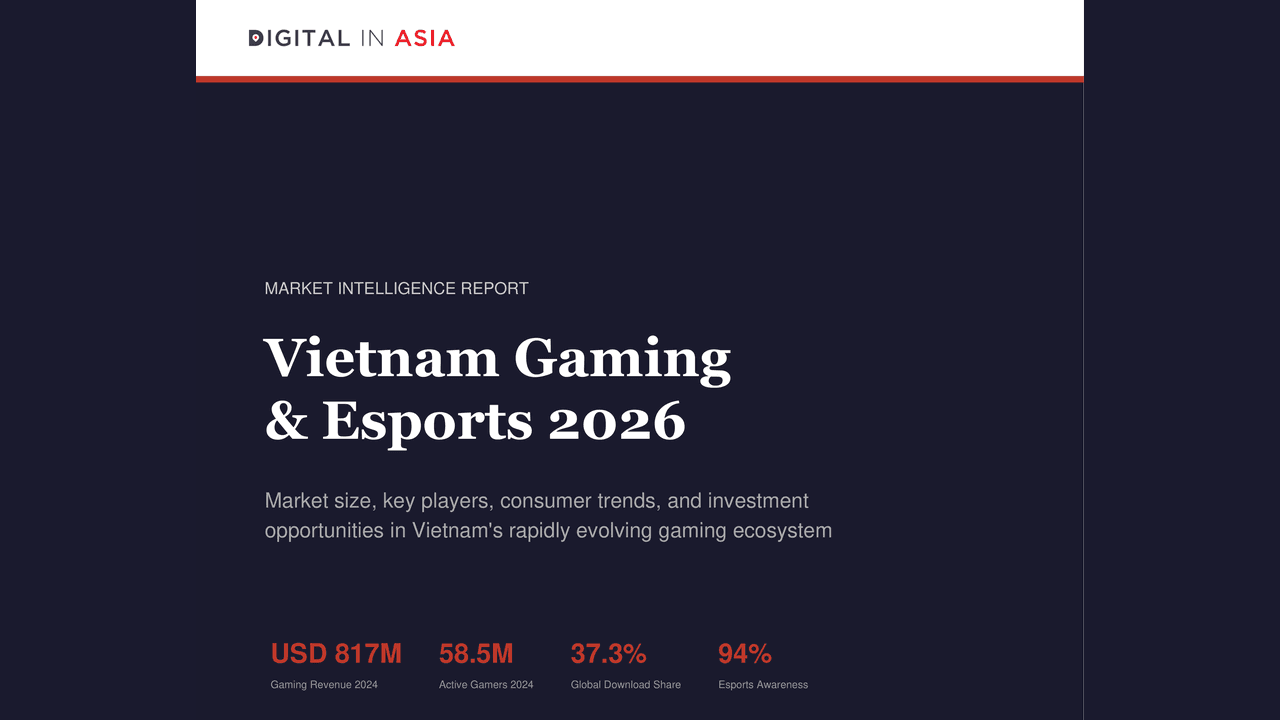
Digital in Asia | March 2026
Vietnam is having a moment in gaming — and most of the world hasn’t noticed yet.
A country of 101 million people holds the global record for mobile game downloads and ranks a modest fifth in Southeast Asia by revenue. That paradox is the entire story of where this market sits right now.
Here are the 7 key findings from the Vietnam Gaming & Esports 2026 report.
1. Vietnam Is the World’s #1 Mobile Game Exporter by Download Volume
Vietnamese studios generated 9.6 billion total downloads in 2024 across Google Play and iOS — claiming the global #1 position on Google Play, surpassing China by 700 million downloads. That’s roughly 37.3% of all global game app downloads from a single country.
The studios behind this — iKame Global, ABI Games Studio, Amanotes, Bravestars — are largely unknown outside the industry. That’s about to change.
2. But There’s a 12× Revenue Gap That Changes Everything
Export studios earn approximately USD 0.06 in daily revenue per active user. The global benchmark is USD 0.70. A 12× monetization gap — the central structural tension in this market.
The reason is straightforward: Vietnam’s export success was built on hyper-casual games monetized almost entirely through advertising. The industry is now mid-pivot toward hybrid-casual and midcore models that can generate in-app purchase revenue at scale. Export revenue is already moving: USD 315 million in 2024, projected to exceed USD 430 million in 2025 — a 36.4% year-on-year jump.
3. A New Regulation Just Reset the Playing Field
Decree 147/2024, effective December 25, 2024, is the most significant regulatory change in Vietnamese gaming in a decade. It bans casino-style games, extends playtime limits to all game categories, mandates phone-number verification for every player, and gives regulators authority to compel app stores to remove unlicensed titles.
Approximately 85% of games on Vietnamese app stores are currently unlicensed. Foreign publishers face a clear binary — establish a local Vietnamese entity, or exit. Supercell’s 2019 exit remains the reference case: forgoing the Vietnamese market of Brawl Stars, a game that earned USD 662 million globally in 2024.
4. Vietnam Is Becoming a Development Hub, Not Just a Labor Play
The NCSOFT acquisition of Indygo Group for USD 103.8 million in Q4 2025 — the largest disclosed M&A in Vietnamese gaming history — was explicitly motivated by Vietnam’s “development agility.”
iKame Global has reached the top 7 studios globally by download volume. ABI Games Studio has 2+ billion total downloads and 10 million daily active users. Amanotes is the world’s #1 music game publisher with 3+ billion downloads and 100 million MAU. These are original IP businesses, not outsourcing arrangements.
5. Esports Has Surpassed Soccer as Vietnam’s Most-Watched Content Category
94% of the population has esports awareness — highest in Southeast Asia. 59% are regular viewers — nearly double the SEA average.
There are 28.2 million esports participants in Vietnam — roughly the population of Australia. Only 17% live in large cities, meaning esports has achieved national distribution that no traditional sports media ever managed. The commercial implication: an audience of this scale, significantly under-sponsored, that is only beginning to attract brand investment.
6. 5G Is Here, and It Actually Matters
Viettel deployed 30,000 5G base stations achieving 90% outdoor population coverage in approximately 14 months. Mobile download speeds hit 152 Mbps by August 2025 — up from 57 Mbps a year earlier. Vinaphone ranked 2nd worldwide for 5G download speed.
For gaming: latency drops from 30–50ms to 1–30ms. The infrastructure precondition for cloud gaming is now in place. Cloud gaming is growing at 22–35% CAGR — from a near-zero base, but on a trajectory that matters for 2027–2030 planning.
7. The Government Has Made Gaming a National Priority
In November 2025, Prime Minister Pham Minh Chinh’s National Cultural Industries Strategy named gaming one of Vietnam’s 12 key cultural industries. The government targets USD 1 billion in gaming revenue by 2030 and has committed to training 5,000 developers to build games rooted in Vietnamese history and culture.
And as of March 1, 2026, Vietnam became the first country in Southeast Asia with a standalone AI law. The framework places most gaming AI tools in low-to-medium risk tiers, with a 12-month grace period. VNGGames’ AI platform has already reduced art production costs by 50–70% — giving compliant studios a first-mover edge over less-regulated regional peers.
The Bottom Line
Vietnam is one of the most consequential gaming markets in Asia for the 2026–2030 window, precisely because so much of its potential remains unmonetized. The gap between downloads and revenue is not a weakness — it is the opportunity.
The full picture is more nuanced than any summary can capture. That’s what the 40+ page report is for.
Read the full Vietnam Gaming & Esports 2026 report — market sizing, company profiles, esports analysis, regulatory deep-dive, and 2026–2028 outlook → digitalinasia.com/reports
