
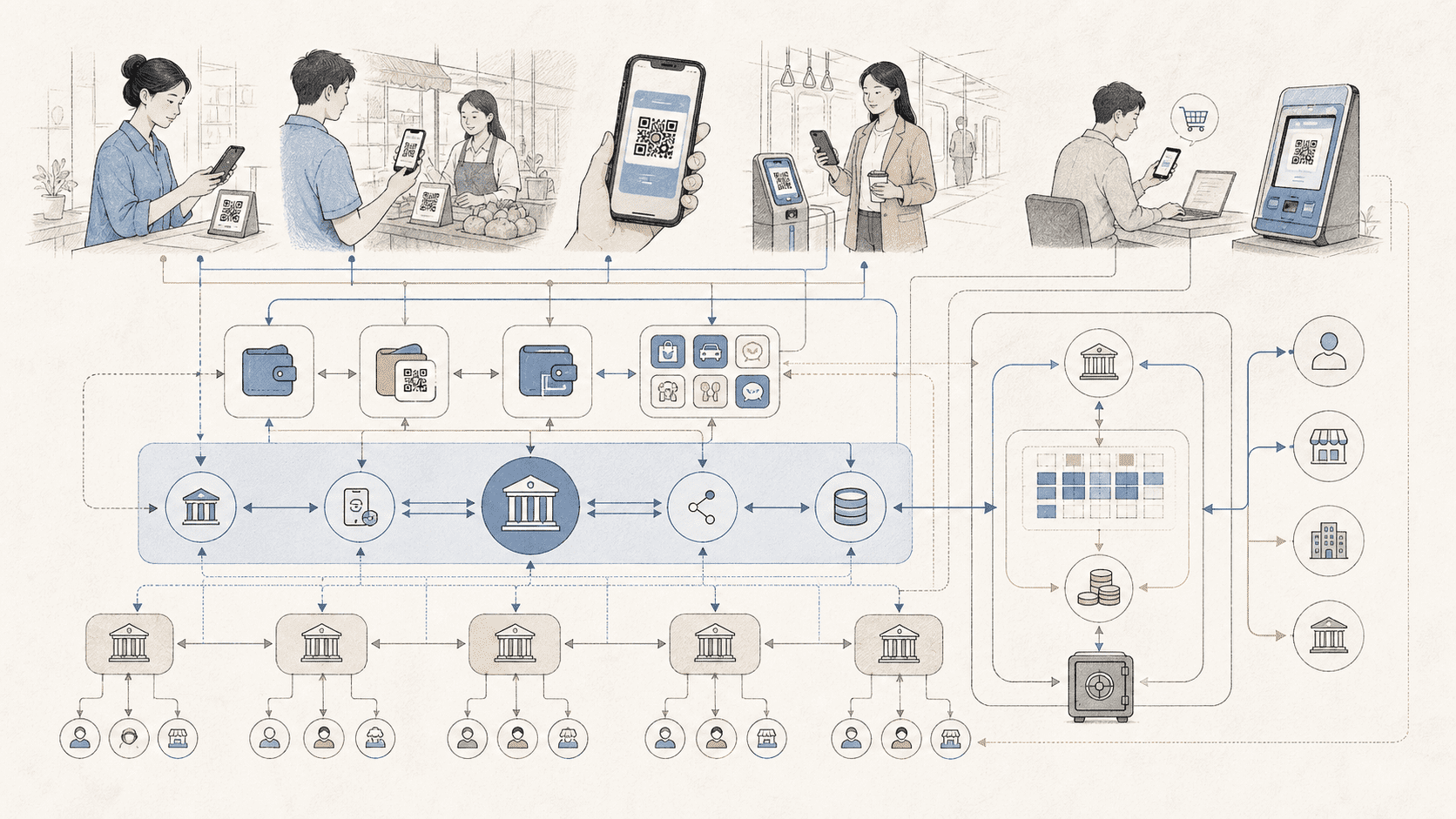
In December 2025, India’s Unified Payments Interface processed 21.63 billion transactions in a single month — a daily average of 698 million payments, more than Visa handles globally. Across all of 2025, UPI ran 228 billion transactions worth roughly $3.6 trillion, and now accounts for around 50% of the world’s real-time digital payment volume and 85% of digital payments inside India. None of this runs on Visa or Mastercard. None of it runs on Apple Pay or Google Pay. The infrastructure was built by India’s central bank and a non-profit it owns. The same pattern repeats across Asia digital payments in different national accents: every market has its own dominant payment rail, and almost none of them are global card networks.
Asian payment infrastructure is the mirror image of Asian e-commerce. Where DIA’s marketplace tracker showed that regional and domestic platforms have out-competed global players for consumer attention, the payment rails story goes further. Western platforms didn’t just lose — they were never structurally relevant in the first place. Most Asian rails were built either by central banks (UPI in India, PromptPay in Thailand, PayNow in Singapore, Bakong in Cambodia, QR Ph in the Philippines, DuitNow in Malaysia) or by domestic super-apps (Alipay/WeChat Pay in China, GoPay/OVO/DANA in Indonesia, GCash/Maya in the Philippines, MoMo in Vietnam, KakaoPay/Naver Pay/Toss in Korea, PayPay in Japan, bKash in Bangladesh, KBZPay in Myanmar). Visa and Mastercard remain present, but as the rails of last resort rather than the default infrastructure.
This is a working tracker of payment rails across fifteen Asian markets as of May 2026. It will be updated as the picture moves — and across a region where five new cross-border QR linkages were added in the last twelve months, the picture moves often.
The Asia Payment Rails Master Comparison
The headline reference. Best rail by transaction volume / market share, plus the structural architecture and operator type for each of fifteen markets.
Legend: – Architecture describes the dominant payment model: A2A (account-to-account, bypassing card networks), Wallet (e-money or stored-value account), Card (issued by banks, processed by Visa / Mastercard / UnionPay / JCB), or hybrid combinations. – Operator type distinguishes State-built (central bank or central-bank-owned NPCI-equivalent), Platform-built (private super-app or fintech), and Bank-led (commercial bank consortium).
| Market | Best Rail | Architecture | Operator | Operator Type | Market Penetration | Notes |
|---|---|---|---|---|---|---|
| Mainland China | Alipay + WeChat Pay | Wallet (super-app) | Ant Group + Tencent | Platform-built | 92% Alipay, 85% WeChat Pay (urban adults); 90%+ of QR transactions | UnionPay leads in card issuance; e-CNY rolling out alongside |
| Hong Kong | AlipayHK + Octopus | Wallet + Stored-value card | Ant Group + Octopus consortium | Platform + Bank-led | Alipay 23% wallet share; Octopus near-universal | Most fragmented APAC market; 12+ wallet providers |
| Japan | PayPay | Wallet | SoftBank / Yahoo / Z Holdings | Platform-built | 70M+ users; ~55% of QR market | LINE Pay terminating April 2025, balances transferring to PayPay; cards still ~50% retail value |
| South Korea | Samsung Pay + Naver Pay + KakaoPay + Toss | Wallet + Card-tokenised | Multiple | Platform-built | Samsung Pay 42%; Naver/Kakao/Toss together ~50% online | Apple Pay launched 2023; cards still meaningful share |
| Taiwan | LINE Pay + JKoPay | Wallet (QR-led) | LINE / domestic | Platform-built | LINE Pay leads online; JKoPay leads offline QR | Cards still dominant for higher AOV |
| Vietnam | MoMo | Wallet | M_Service | Platform-built | 63% wallet market share; 40M+ users | 49 licensed e-wallet operators; VietQR national standard |
| Indonesia | GoPay / OVO / DANA (three-way) | Wallet (QRIS) | GoTo / Grab / Sinar Mas | Platform-built | GoPay 32%, DANA 28%, OVO 23% | QRIS is the unifying state-built rail; 60M+ users, 40M+ merchants |
| Thailand | PromptPay | A2A | Bank of Thailand | State-built | 16B+ transactions in 2023; 44% e-commerce, 43% POS value | TrueMoney leads wallet tier; 66% wallet share where wallets used |
| Philippines | GCash | Wallet | Globe Telecom / Mynt | Platform-built | 94M users (~80% of population), 6M+ merchants | Cash still 42% in-store value; QR Ph (state-built) growing fast |
| Singapore | PayNow + SGQR | A2A + QR overlay | Association of Banks Singapore / MAS | Bank-led + State-coordinated | 68% Gen Z preference for PayNow; SGQR universal | Most fragmented wallet tier (14+ wallets); DBS PayLah! leads at 26% |
| Malaysia | DuitNow + DuitNow QR | A2A + QR | PayNet / Bank Negara Malaysia | State-built | 2.6M+ DuitNow QR merchant points (end 2024) | A2A forecast to reach 40% online value by 2030 |
| India | UPI | A2A | NPCI / Reserve Bank of India | State-built | 85% of India digital payments; 228B annual transactions (2025) | Larger than every other rail in this tracker combined |
| Cambodia | Bakong + KHQR | A2A (blockchain-based) | National Bank of Cambodia | State-built | 30M wallets; 4.5M+ merchants; transactions 330% of GDP | Soramitsu Hyperledger Iroha base; cross-border to Korea, Japan, Malaysia, Alipay+ |
| Bangladesh | bKash | Wallet (mobile money) | Brac Bank subsidiary | Platform-built | 70M+ projected 2025 users; dominant MFS leader | Nagad and Rocket are challengers; Bangla QR national standard rolling out |
| Myanmar | KBZPay | Wallet | KBZ Bank | Bank-led | Largest Myanmar mobile wallet; ~3.5M users at scale | Wave Money is challenger; sanctions complicate cross-border |
Three things jump out of the table.
First, India is in its own category. UPI’s 228 billion transactions in 2025 is roughly larger than every other rail in this table combined. December 2025 alone — 21.63 billion transactions — exceeded the full 2024 throughput of any other Asian rail. The structural significance: India is the world’s largest real-time payment market and the only Asian rail of its kind operating at population scale (1.4 billion people, 85% of digital payments running on it). When operators or analysts talk about “Asian payments,” India deserves to be treated as a separate analytical category, not as one entry in a fifteen-market grid.
Second, Cambodia’s Bakong is the table’s most striking surprise. Transaction volume reached 330% of GDP in 2024 — the highest payments-to-GDP ratio in the table by a substantial margin, and dramatically higher than countries with ten or twenty times Cambodia’s GDP per capita. 30 million wallets in a 17-million-person country. 4.5 million merchants. Built by the National Bank of Cambodia on Soramitsu’s Hyperledger Iroha framework, with cross-border interoperability into Korea, Japan, Malaysia, and the broader Alipay+ network. The infrastructure is dramatically more developed than the $1.78B Cambodian e-commerce GMV might suggest. Cambodia’s payments build is the strongest argument in this tracker for the proposition that small markets can build world-class digital payment infrastructure when central banks treat it as priority infrastructure.
Third, the lowest-resource Asian markets in this tracker — Bangladesh, Cambodia, Myanmar — have built payment infrastructure that compares favourably with much wealthier peers. Bangladesh’s bKash serves 70M+ users in a country where credit card penetration is under 5%. Myanmar’s KBZPay reached 3.5M+ users despite the country’s third year of civil conflict. The pattern: where formal banking infrastructure is thin, mobile money fills the gap, and the gap-filling has produced some of the most operationally robust digital payment systems in the region. For operators thinking about Asian market entry, the headline implication is that “build for cards as primary, then layer wallets” misreads the economics in eight or nine of these fifteen markets — including all three at the lowest end of GDP per capita.
Why Asian Payments Look Different
Standard Western framings — Visa / Mastercard duopoly, debit vs credit, contactless NFC, Apple Pay / Google Pay overlays — translate badly to Asia. Five structural differences shape the actual market.
State-built rails are the default, not the exception. Outside the United States, where private card networks built infrastructure first and have defended it for sixty years, most countries with mature digital payments now operate on infrastructure built by central banks. Asia is the most advanced version of this story. UPI launched in 2016. PromptPay in 2017. PayNow in 2017. QRIS in 2019. DuitNow in 2019. Bakong in 2020. QR Ph as a unified standard in 2023. The result: in most Asian markets, paying for something through a public rail is faster and cheaper than paying through a card, and the operator economics are radically different. Merchants who would pay 1.5-3% on a card transaction pay 0% on UPI in India, 0% on QRIS in Indonesia for transactions under Rp 500,000, and well under 0.5% on most state-built rails. The structural cost advantage shapes what merchants accept and what consumers prefer.
QR codes are the universal interface. Every country in this tracker has a national QR code standard or is building one. SGQR (Singapore), KHQR (Cambodia), DuitNow QR (Malaysia), QR Ph (Philippines), QRIS (Indonesia), VietQR (Vietnam), PromptPay QR (Thailand), Bharat QR / UPI QR (India), Bangla QR (Bangladesh), and Lao QR (Laos) all use EMVCo-compliant standards designed for cross-border interoperability. Even Japan and Korea — the most card-dependent of Asia’s high-income markets — are unifying around national QR frameworks (JPQR in Japan; Korea’s January 2025 unified QR standard mandating compatibility across KakaoPay, Naver Pay, Toss, and card-issuer wallets). For an operator entering Asia, the practical effect: build for QR-led acceptance first, and let Apple Pay or Google Pay sit alongside as a secondary tier.
Wallets and A2A are the payment endpoints, not cards. The architectural distinction matters because it shapes how money moves. Wallet-led markets (China, Indonesia, Philippines, Vietnam, Bangladesh, Myanmar) settle through e-money providers’ books rather than through bank-to-bank rails. A2A-led markets (India, Thailand, Singapore, Malaysia, Cambodia) settle through real-time bank transfer. Card-led markets (only Japan among the fifteen, and even there with declining share) settle through Visa/Mastercard/JCB networks. The implications for cross-border, fee structure, fraud, and regulatory oversight are all different across these architectures — and the architecture choice is one of the most under-explained things about each market.
Cross-border interoperability is a real and accelerating regional project. ASEAN’s Project Nexus (BIS Innovation Hub-led) connected India, Malaysia, the Philippines, Singapore, and Thailand into a hub-and-spoke gateway in 2025-2026. Bilateral QR linkages now cover almost every ASEAN-internal pair plus connections to India, Hong Kong, Japan, and Korea. By December 2025, ASEAN had 29 cross-border QR and P2P linkages with millions of monthly transactions. The ambition: a fully integrated regional QR zone by 2030, with multi-currency support, deeper financial inclusion, and CBDC integration. This is the EU equivalent for payments — except it’s happening faster than the EU’s SEPA story did, on infrastructure that’s mostly under five years old.
Cash and card don’t disappear at the same rate. The Philippines retains 42% in-store cash usage despite GCash reaching 94M users. Japan retains roughly 50% card share despite PayPay’s 70M user base. Thailand has high cash use outside Bangkok. India’s UPI dominates digital but cash still anchors the rural informal economy. The “cashless transition” framing implies a linear trajectory; the actual data shows differentiated trajectories where rails layer rather than replace, and where some markets (Indonesia, Korea) have moved faster off cash than others (Philippines, Japan) despite having similar GDP per capita. For operators: don’t assume cashless is a single trend with a single endpoint.
The combination produces a market where Visa and Mastercard remain present but rarely dominant, where state-built rails set the floor on transaction costs, and where local specialists with tight integration into local regulatory environments and consumer apps consistently out-compete global card networks on the metrics that matter.
Mainland China: Alipay and WeChat Pay’s Duopoly Plus the Digital Yuan
China is the world’s most developed mobile payment market and its largest by transaction value. The Mordor Intelligence 2025 estimate puts the China payments market at $43.65 trillion, projected to reach $65.30 trillion by 2030 at 8.39% CAGR. Mobile payment penetration exceeds 85% in urban areas and 65% in rural areas. Cash usage has dropped further than in any other Asian market, and credit card adoption never reached the heights it did in Western economies — China leapfrogged from cash directly to wallet.
Alipay and WeChat Pay together control over 90% of digital transaction volume. Alipay holds approximately 54% market share with 1.4 billion global monthly active users; WeChat Pay holds approximately 42% with about 935 million Chinese users. Both operate as super-apps where payment is the entry point to a vast ecosystem — Alipay covers e-commerce, wealth management, insurance, micro-loans, and government services; WeChat Pay covers the same ground anchored by social messaging. By mid-2024, 92% of Chinese consumers reported using Alipay and 85% used WeChat Pay. QR codes account for over 90% of mobile payment transactions, and Alipay’s late-2024 “Alipay Tap!” NFC feature reached 100M users in 11 months — 80% of users prefer it over QR when both are available, signalling the next phase of payment UX.
UnionPay remains the dominant card network but functions as a state-owned card-issuance backbone rather than a competitor to the wallets. UnionPay’s Cloud QuickPass enables tokenised NFC checkout and digital-yuan compatibility but doesn’t have anything like Alipay or WeChat Pay’s consumer mindshare. For most Chinese consumers, UnionPay is the network that makes their bank card work; Alipay and WeChat Pay are the apps they actually pay with.
The e-CNY (digital yuan) continues to roll out alongside private wallets. Both Alipay and WeChat Pay have integrated e-CNY support; pilot programmes show high willingness to adopt for small transactions. The strategic significance is twofold: e-CNY provides the People’s Bank of China with payment-data visibility that Alipay and WeChat Pay don’t naturally surrender, and it creates a state-backed alternative if regulators ever want to constrain super-app dominance. For consumer adoption in 2026, e-CNY remains a complementary rail rather than a replacement.
Ant Group’s 2025 expansion — the $362M Hong Kong securities firm acquisition, the Sanabil-backed Saudi PIF partnership flows, the Stripe partnership for cross-border merchant acceptance, the Shopify integration enabling 250,000 merchants to accept Alipay from Chinese shoppers globally — signals that Alipay’s playbook for the rest of the world is partnership rather than direct consumer-facing entry. WeChat Pay’s overseas reach is more limited (20+ countries vs Alipay’s 220+), but it serves the Chinese tourist market effectively. For non-Chinese operators, the practical question is rarely “compete with Alipay or WeChat Pay” — it’s “integrate with them to serve Chinese customers wherever they shop.”
DIA covered the broader China digital economy in Inside China’s AI Machine. The payment-rails view reinforces the same thesis: China is its own internet, with infrastructure that doesn’t connect to global card networks at the consumer level and never will. Operators building for China build inside the Alipay/WeChat Pay ecosystem; operators building for Chinese tourists abroad integrate at the point of sale.
Hong Kong: The Most Fragmented Wallet Market in Asia
Hong Kong’s payment landscape diverges from both mainland China and other high-income Asian markets. The territory has 12+ identifiable mobile wallet providers, no single dominant rail, and a structural mix of legacy stored-value (Octopus), cross-border Chinese wallets (AlipayHK, WeChat Pay HK), and global card networks (Visa, Mastercard, Apple Pay).
Octopus — the contactless stored-value card launched in 1997 for transit — remains near-universally adopted in Hong Kong. Originally for MTR, bus, and tram payments, Octopus expanded to retail, vending, and small-value payments and now functions as the backbone of low-value daily commerce. Octopus’s mobile app integration, NFC card support, and partnership with FPS (Hong Kong’s Faster Payment System launched 2018) keeps it relevant despite the rise of QR-based wallets.
AlipayHK is the largest mobile wallet by Thunes’ 2025 share data at approximately 23%, ahead of Apple Pay at 20%. AlipayHK is structurally separate from mainland Alipay (it operates in Hong Kong dollars, with local KYC and regulatory compliance) but interoperates with mainland Alipay for cross-border transactions. WeChat Pay HK occupies a smaller but meaningful share, particularly for transactions involving mainland Chinese visitors.
FPS (Faster Payment System) is Hong Kong’s state-built A2A rail launched by HKMA and operated by Hong Kong Interbank Clearing Limited. FPS enables instant transfers using mobile numbers or email addresses and connects to Thailand’s PromptPay (since December 2023) for cross-border QR interoperability. FPS adoption is growing but hasn’t reached the dominance that PayNow or PromptPay achieved in their respective markets — Hong Kong’s payment culture is too card-anchored and too fragmented across competing wallets for any single state-built rail to consolidate share quickly.
For operators: Hong Kong is the Asian market where the right answer is “support all of them.” Octopus for transit and small value, AlipayHK and WeChat Pay HK for tourists from mainland China, FPS for bank transfers, Apple Pay and Visa/Mastercard for higher-value retail. Hong Kong’s banking sector is sophisticated enough that the absence of a single dominant rail isn’t a problem — but the operational complexity for merchants is real.
Japan: PayPay Won the QR Wallet War, but Cards Still Anchor Half the Market
Japan’s mobile payments market is forecast at $0.28 trillion in 2025, growing at 31% CAGR to $1.07 trillion by 2030 (Mordor Intelligence). The trajectory is steep, but Japan starts from a low base relative to other high-GDP Asian markets — Japan’s cashless transition has been slower than Korea’s, Singapore’s, or even Indonesia’s, despite the government’s “cashless vision” targeting 40% non-cash share of household consumption by 2025.
PayPay is the unambiguous winner of Japan’s QR wallet war. Launched 2018 by SoftBank Corp and Z Holdings (now LINE Yahoo, formed October 2023 by the Z Holdings / LINE merger), PayPay has 70M+ registered users — the largest single mobile wallet user base in Japan. PayPay’s growth was driven by aggressive cashback promotions that competitors couldn’t sustain, plus tight integration into Yahoo! Shopping and SoftBank’s mobile distribution. The April 2025 termination of LINE Pay (also under the LINE Yahoo umbrella) and the migration of LINE Pay balances to PayPay consolidated PayPay’s position further.
Rakuten Pay sits second in the QR wallet tier, leveraging the Rakuten Points loyalty ecosystem (cumulative points issued exceed three trillion yen-equivalent) to maintain user retention in the face of PayPay’s cashback advantage. Rakuten Pay integrates with Rakuten Card (credit), Rakuten Bank (digital banking), Rakuten Mobile (mobile network), and Rakuten Ichiba (e-commerce) — same ecosystem-as-moat playbook as the Japanese e-commerce side.
au PAY (KDDI), d-Barai (NTT DOCOMO), and Suica Mobile (JR East) round out the second tier. Suica Mobile is structurally distinctive — it’s a transit card extended to retail, similar to Octopus in Hong Kong — and remains essential for Tokyo metro and other rail commerce.
Cards still anchor approximately half of Japanese retail by value. JCB (the domestic card network), Visa, and Mastercard remain meaningful in higher-AOV transactions, including most online shopping where Rakuten and Yahoo! Shopping route transactions through stored cards. Apple Pay and Google Pay are present but represent overlays on top of stored cards rather than independent payment rails — a different position from their counterpart in Korea, where Apple Pay’s 2023 launch was a meaningful structural event.
Cross-border integration has accelerated. The Kakao Pay / PayPay partnership (September 2025) enables Japanese PayPay users to make offline payments at 2M+ Korean merchants, and Korean tourists can use KakaoPay at PayPay’s Japanese network. Alipay+ extends PayPay’s acceptance to 16 partner wallets across Asia. Japan’s METI has indicated full ASEAN cross-border QR interoperability is a 2026 target — connecting JPQR or PayPay’s network to the Project Nexus framework.
For operators: PayPay is the must-integrate Japanese rail, with Rakuten Pay as the close second. Cards remain meaningful for higher-AOV. The cashless trajectory is genuine but slower than the rest of upper-income Asia, so multi-rail strategy is essential.
South Korea: Samsung Pay Leads NFC, KakaoPay/Naver Pay/Toss Lead Wallet
Korea’s mobile payments market reached $44.4 billion in 2025 and is forecast to grow to $48.3 billion in 2026 (Mordor Intelligence), with daily wallet transactions hitting 29.71 million in H1 2024. The market structure differs from any other Asian market: Samsung Pay holds a dominant 42% NFC payment share (the highest Samsung Pay penetration globally outside its home market), but the QR wallet tier — KakaoPay, Naver Pay, and Toss — collectively dominates the online and super-app side.
Samsung Pay benefits from its MST (Magnetic Secure Transmission) compatibility, which allows it to work with older terminals that lack NFC. Samsung Pay supports both contactless and tokenised card payments, and is accepted at 3M+ Korean merchants. The structural disadvantage: Samsung Pay’s adoption among non-Samsung device users is limited, and Korea’s iPhone share is rising. Apple Pay’s 2023 Korean launch (after multi-year regulatory deliberation requiring local card-issuer partnerships) gave non-Samsung users a credible NFC alternative.
KakaoPay processed KRW 167.3 trillion in payments in Q4 2024 and integrates ride-hailing, parking, insurance, and securities trading inside its super-app. The July 2025 Finnq acquisition (KRW 620 billion, ~$470M) added BNPL specialist capability. KakaoPay’s user base spans Korea’s full demographic, and the app functions as primary financial interface for many users.
Naver Pay logged KRW 22.7 trillion in Q3 2025, anchored by Naver Shopping integration and Naver Webtoon’s 160M monthly users (who pay for digital comics through Naver Pay). Naver Plus Membership bundles shipping, video streaming (Netflix partnership), and food delivery (Yogiyo). Naver Pay’s 2024 integration with Samsung Pay for offline NFC payments was structurally important — it eliminated one of the few remaining gaps between online wallet adoption and offline commerce.
Toss (Viva Republica) reaches 9.5 million active users with banking, securities, insurance, brokerage, and payment all consolidated into a single app. Toss reached profitability in 2024 and continues growing in retail payments. Toss’s competitive advantage is UX — among Korean digital natives in their 20s and 30s, Toss is widely cited as the financial app of choice.
Cross-border integration is multi-vectored. Bank of Korea joined BIS’s Project Agora in 2024. The 2024 BoK / Bank Indonesia MoU strengthened Korea-Indonesia rails. KakaoPay’s outbound expansion into Japan (November 2024) and PayPay’s reciprocal offline access in Korea (September 2025) represent two of the most consumer-facing cross-border partnerships in Asia. Korea-Cambodia cross-border credit reporting cooperation supports remittance flows. Project Agora and Project Nexus eventual connection are pencilled for 2026-2027.
Korea’s structural distinction is that it’s the only Asian market where a hardware vendor (Samsung) holds dominant share of one payment architecture (NFC) while super-app wallets dominate another (QR/online). Most other Asian markets have a single dominant rail or a clear duopoly within a single architecture. Korea operates as a multi-rail market by structural necessity, and that’s likely to remain the equilibrium.
Taiwan: LINE Pay Leads Online QR, Cards Still Anchor Higher AOV
Taiwan’s mobile payment market is meaningfully smaller than Korea or Japan in absolute terms but has unusually high QR adoption for a high-income Asian market. The dominant wallet players are LINE Pay (anchored by LINE messaging’s near-universal Taiwanese adoption) and JKoPay (the leading domestic QR wallet for retail).
LINE Pay sits inside the LINE messaging app — used by approximately 90% of Taiwanese internet users — and functions as both wallet and payment overlay. LINE Pay leads online and chat-native commerce, with LINE Shopping handling 12 million monthly shoppers through chat-native checkout flows.
JKoPay is Taiwan’s leading domestic QR wallet, with strong adoption in retail and small businesses. JKoPay’s structural advantage is local-merchant integration and Bank Foundation backing.
Apple Pay, Google Pay, and Samsung Pay all operate in Taiwan with meaningful adoption among iPhone and Android users. Apple Pay’s Taiwan launch was earlier than Korea’s, and Apple Pay penetration among Taiwanese iPhone users is high.
Card networks remain dominant for higher-AOV transactions. Taiwan’s credit card adoption rates are among Asia’s highest — banks issue cards aggressively with co-branded promotions, and credit card use for higher-value purchases (electronics, travel, dining over a certain threshold) remains the default behaviour. The wallet tier has captured small-value commerce but hasn’t displaced cards for big-ticket spend.
Cross-border integration is constrained by Taiwan’s distinct geopolitical position. Most ASEAN cross-border QR linkages don’t include Taiwan as a signatory; bilateral linkages tend to come through commercial partnerships (LINE’s Japan-Korea-Taiwan corridor) rather than central-bank-led infrastructure. Taiwan’s payment system interoperates with mainland China only through commercial workarounds rather than direct linkages.
For operators: support LINE Pay first, JKoPay second, plus Apple Pay/Visa/Mastercard for general retail. Taiwan is the smallest of the upper-tier high-income Asian markets but commercially developed enough that multi-rail support is standard.
Vietnam: MoMo Dominant, ZaloPay Strong, VietQR Unifying
Vietnam’s mobile payments market is among the fastest-growing in Asia. Vietnam has 49 licensed e-wallet operators as of 2025, but the market is dominated by two players: MoMo and ZaloPay. MoMo holds approximately 63% market share with 40M+ users; ZaloPay sits at second with strong integration into Zalo (Vietnam’s dominant messaging app).
MoMo started as a P2P transfer app and evolved into a full payment platform handling utility bills, transit tickets, hospital payments, gaming microtransactions, and merchant payments. MoMo reached 40M+ users in 2023 and continues growing across both urban and rural Vietnam. The app’s structural advantage is its ability to operate even on slow connections — important for rural Vietnamese users — and its broad bank-account integration.
ZaloPay leverages its parent app Zalo (a domestic messaging service that has out-competed Facebook Messenger and WhatsApp in Vietnam) for distribution. ZaloPay’s chat-native commerce flows and integration with VNG’s broader gaming ecosystem give it a meaningful share without challenging MoMo for the top spot.
ShopeePay is the third notable player, anchored by Shopee Vietnam’s e-commerce dominance. ShopeePay’s structural growth ceiling: it’s tightly integrated with Shopee’s marketplace but lacks the broad utility-bill / financial services depth that MoMo and ZaloPay provide.
VietQR is Vietnam’s national QR code standard, operated through NAPAS (the National Payment Corporation of Vietnam). VietQR’s adoption surged through 2024-2025, with QR-based payments accounting for 41% of e-commerce and 29% of POS value in 2025. Apple Pay’s Vietnam launch via NAPAS partnership in April 2025 brought Tap to Pay to 80M+ contactless cardholders.
Cross-border integration: Vietnam connected VietQR to Thailand (PromptPay), Lao PDR (Lao QR), and Cambodia (Bakong/KHQR) through 2024-2025. Indonesia and Malaysia linkages are in development. Cross-border QR with China, Japan, and Korea is on Vietnam’s central bank roadmap.
For operators: MoMo is the must-integrate Vietnamese rail, with ZaloPay as essential second and ShopeePay for e-commerce-anchored merchants. Cash-on-delivery still represents 16% of Vietnamese e-commerce by value, so payment-rail strategy needs COD orchestration too.
Indonesia: GoPay, OVO, DANA — A Three-Way Wallet Race on QRIS Rails
Indonesia is Southeast Asia’s largest payment market and the only major SEA market with three dominant wallet players rather than one. GoPay holds approximately 32% share, DANA 28%, OVO 23%. Together with ShopeePay (the fourth player), they cover the majority of Indonesian digital payment volume.
QRIS (Quick Response Code Indonesian Standard), launched by Bank Indonesia in 2019, is the unifying state-built rail beneath all four wallets. QRIS allows any wallet to scan any merchant QR code, eliminating the need for merchants to display separate QR stickers for each payment provider. As of August 2025, QRIS connects 60M+ users to 40M+ merchants. Transaction volumes grew 162.7% YoY through 2024-2025. QRIS’s growth has driven Indonesia’s cash share of POS value to fall from 77% in 2019 to 36% in 2025 — the fastest cash decline in SEA.
GoPay sits inside the GoTo Group ecosystem (Gojek + Tokopedia, formed 2021). GoPay’s standalone app, launched 2023, reached 24.2M monthly transacting users in Q3 2025, with GoTo surpassing 500M monthly transactions in September 2025. GoPay is integrated into TikTok Shop checkout (since TikTok’s Tokopedia acquisition in late 2023) and partners with Bank Jago for embedded banking. Q4 2025 digital payments volume hit IDR 120 trillion (~$7.5B) for the quarter.
OVO is majority-owned by Grab Holdings and benefits from Grab super-app integration plus Sinar Mas banking partnership through Bank Sinarmas / Superbank. OVO Nabung (the savings product) gives OVO a deposit-funded lending advantage.
DANA is jointly owned by Emtek Group and Ant Group (Alipay’s parent), with strong integration into Indonesian banking and Alipay+ for cross-border tourist payments. DANA’s positioning as the most “neutral” wallet — not tied to a specific super-app — has helped it capture user share where consumers want to avoid platform lock-in.
ShopeePay is the e-commerce-anchored fourth player, supported by Sea Group’s broader Monee fintech arm. Monee grew its loan book over 80% in 2025 to reach $9.2 billion.
BI-FAST is the Bank Indonesia-built A2A rail launched in 2021, providing instant bank-to-bank transfers underneath the wallet tier. BI-FAST plus QRIS together represent Indonesia’s central-bank-built infrastructure layer; the wallets compete on consumer experience above this layer.
Cross-border integration: QRIS is now interoperable with Thailand’s PromptPay, Singapore’s PayNow, Malaysia’s DuitNow, China’s UnionPay (2024-2025 pilot), and Japan’s QR systems. Indonesia is among the most ambitious cross-border QR participants alongside Singapore and Thailand.
For operators: support all three of GoPay, OVO, and DANA for Indonesian consumer commerce. ShopeePay matters where you’re integrated with Shopee. The three-wallet competition keeps merchant pricing reasonable, but no single integration wins the Indonesian market.
Thailand: PromptPay Is the Default, TrueMoney Leads Wallets
Thailand has the most dominant state-built payment rail in Southeast Asia. PromptPay, launched by the Bank of Thailand in 2017, processed 16+ billion transactions in 2023 and has become the country’s most common payment method. A2A payments accounted for 44% of e-commerce value and 43% of POS value in 2025 — the highest A2A share of any SEA market. PromptPay’s interoperability with Singapore’s PayNow (the first ASEAN cross-border real-time linkage, launched 2021), Malaysia’s DuitNow, Hong Kong’s FPS, India’s UPI, and Vietnam’s VietQR makes it one of the most interconnected national rails in Asia.
PromptPay allows users to send money instantly using mobile numbers or national ID numbers linked to bank accounts. Settlement is bank-to-bank, real-time, and free for retail consumers. The Bank of Thailand’s adoption push — particularly during COVID — created a near-universal merchant base, and PromptPay’s QR codes are ubiquitous from Bangkok malls to rural street vendors.
TrueMoney is the leading wallet in Thailand with approximately 66% wallet market share — though the wallet category itself is smaller relative to PromptPay than wallet shares are in non-A2A-led markets. TrueMoney is owned by Ant Financial / Charoen Pokphand Group and serves both Thai consumers and the meaningful Burmese, Cambodian, and Lao migrant populations.
ShopeePay is the e-commerce-anchored second wallet, supported by Shopee Thailand’s market-leading position. Rabbit LINE Pay integrates LINE messaging plus the Rabbit transit card system. AliPay Thailand serves Chinese tourists and increasingly Thai consumers.
Cross-border: Thailand is the most cross-border-connected payment system in Asia. PromptPay-PayNow (Singapore, 2021), PromptPay-DuitNow (Malaysia, 2023), PromptPay-FPS (Hong Kong, December 2023), PromptPay-VietQR (Vietnam), PromptPay-Lao QR, PromptPay-UPI (India). Cambodia-Thailand is in the 2025-2026 pipeline.
For operators: PromptPay is the must-integrate Thai rail, with TrueMoney as essential wallet partner. ShopeePay where Shopee-anchored. Foreign cards still work for tourists and high-AOV transactions, but PromptPay accounts for nearly half of all e-commerce value — building Thai commerce without PromptPay support means missing half the market.
Philippines: GCash Dominates with 94 Million Users, but Cash Still Holds 42% of POS Value
The Philippines has the most concentrated wallet market in Asia. GCash, owned by Globe Telecom’s Mynt subsidiary, has 94+ million users — roughly 80% of the Filipino adult population — connected to 6+ million merchants. Maya (formerly PayMaya) sits second with approximately 5-6M active users and a younger, urban user base anchored by crypto and BNPL features.
GCash functions as the de facto Filipino digital wallet. It handles utility bills, transit, retail, P2P transfers, savings (through GSave with CIMB Bank), insurance (GInsure), investments (GFunds), and remittances. The platform’s structural dominance reflects three factors: Globe Telecom’s distribution, regulatory support from BSP, and an early mover advantage in the period when other wallets failed to scale. Jollibee’s GCash partnership (QR-only express counters in Metro Manila) reportedly cut checkout times 30% and lifted average order value 12% — a typical example of the GCash-anchored consumer integration.
Maya is the credible second player, with stronger positioning among younger urban Filipinos who prefer Maya’s crypto, banking, and cashback features. Maya Bank (separate licensed digital bank under the Maya umbrella) extends the platform into deposits and lending.
Cash and COD remain unusually prominent. Worldpay’s 2026 Global Payments Report shows the Philippines has the highest cash usage of any market in the report — 42% of in-store transaction value. Cash-on-delivery represents 23% of Philippine e-commerce value. About 50% of the Philippine population remained unbanked per World Bank 2024 data, which underpins both COD persistence and GCash’s role as a banking substitute.
QR Ph and InstaPay are the state-built rails. QR Ph is the BSP-mandated unified QR code standard (transition from fragmented QR landscape completed July 2023). InstaPay handles real-time bank-to-bank transfers. A2A-based payments (InstaPay and QR Ph combined) reached 13% of e-commerce and 7% of POS transaction value in 2025 — growing fast. The Philippines joined Project Nexus through BSP’s BIS Hub participation; cross-border QR with ASEAN-5 is expected to launch through Nexus in 2026.
For operators: GCash is the must-integrate Filipino rail. Maya as essential second. COD orchestration remains structurally necessary in a market where 23% of e-commerce settles on delivery. QR Ph adoption is growing but hasn’t reached PromptPay-equivalent share yet.
Singapore: PayNow + SGQR + a Fragmented Wallet Tier
Singapore has the most sophisticated combination of state-built A2A rails plus card networks plus fragmented wallet competition in Asia. PayNow (the bank consortium real-time A2A rail, launched 2017 by the Association of Banks Singapore under MAS regulation) is the dominant payment infrastructure for both P2P and B2C. SGQR (the unified QR code standard launched 2018, now upgraded to SGQR+ for fee transparency and merchant-side reconciliation) sits as the universal interface.
PayNow allows instant transfers using mobile numbers or NRIC/UEN identifiers. PayNow is preferred by 68% of Singapore Gen Z consumers per Xero research and has become near-universal across both consumer and B2C use cases. PayNow-PromptPay (Thailand) was the first ASEAN cross-border QR linkage in 2021; PayNow-UPI (India) launched February 2023; subsequent linkages cover Malaysia, Indonesia, and more.
Wallet tier is fragmented. Singapore has 14+ identifiable mobile wallets plus bank-owned apps. DBS PayLah! leads at 26% wallet share. GrabPay, ShopeePay, Apple Pay, Google Pay, and FavePay all hold meaningful but smaller positions. The fragmentation reflects MAS’s regulatory openness — Singapore deliberately encourages payment competition rather than consolidating around a single super-app.
SGQR+ (rolling out 2024-2025) addresses the merchant pain point of needing separate contracts with each payment provider supporting SGQR. SGQR+ provides interoperable acquiring through NETS (track 1) and Liquid Group (track 2). For hawker stalls and SMEs, SGQR+ means one QR code, one bank account, and the option to choose payment providers without switching infrastructure.
Card networks remain meaningful — Singapore has the highest average transaction value per digital commerce user in SEA, and credit cards retain a 3-to-1 preference over debit by transaction value. Cards account for 44% of e-commerce and 40% of POS value in 2025. Apple Pay and contactless are nearly universal.
Cross-border: Singapore is among the most cross-border-connected payment systems in Asia. PayNow connects to Thailand (PromptPay), India (UPI), Malaysia (DuitNow), Indonesia (BI-FAST/QRIS), and through Project Nexus the broader ASEAN+India network. Nexus Global Payments is headquartered in Singapore.
For operators: PayNow is the must-integrate Singapore rail. SGQR or SGQR+ for QR-based acceptance. Cards remain essential for higher-AOV retail. The wallet tier is fragmented enough that “support GrabPay and DBS PayLah! as default; add others as needed” is a defensible position.
Malaysia: DuitNow Is the State-Built Rail Beneath Everything
Malaysia’s payment infrastructure runs on DuitNow (the state-built A2A rail operated by PayNet, owned by Bank Negara Malaysia and the major Malaysian banks). DuitNow QR has reached 2.6+ million merchant acceptance points as of end-2024, and A2A payments are projected to reach 40% of online value and 16% of POS value by 2030 (Worldpay).
DuitNow allows real-time bank-to-bank transfers using mobile numbers, MyKad ID numbers, or business registration numbers. DuitNow QR provides the QR code interface. Together they function as Malaysia’s equivalent of Thailand’s PromptPay or Singapore’s PayNow.
Touch ‘n Go eWallet is the leading wallet in Malaysia, anchored by integration with Malaysia’s near-universal Touch ‘n Go transit card. Touch ‘n Go’s Alipay+ partnership extends acceptance to Chinese, Korean, Singaporean, and broader ASEAN visitors.
ShopeePay, GrabPay, Boost, and Maybank’s MAE are second-tier wallets with meaningful but smaller share. The fragmentation is meaningful but less extreme than Singapore’s.
FPX is the older online banking transfer rail, still widely used for e-commerce checkout where consumers prefer direct bank transfer over wallet.
Cross-border: DuitNow connects to Thailand’s PromptPay (NETS-DuitNow QR, launched 2023), Singapore’s PayNow, and Indonesia’s QRIS. Malaysia is among Project Nexus’s five founding member systems.
For operators: support DuitNow QR plus Touch ‘n Go eWallet first; ShopeePay if Shopee-anchored; cards remain meaningful for higher-AOV. Malaysia’s payment infrastructure is one of the most operator-friendly in SEA — state-built rails plus interoperable wallet competition without extreme fragmentation.
India: UPI Is Bigger Than Every Other Asian Rail Combined
India’s Unified Payments Interface deserves its own analytical category. UPI processed 21.63 billion transactions in December 2025 alone — more transactions than every other Asian rail in this tracker combined, and more than Visa handles globally on a daily basis. Annual 2025 volume reached 228 billion transactions worth Rs 300 lakh crore (approximately $3.6 trillion). UPI accounts for 85% of India’s digital payment volume.
UPI was launched by NPCI (National Payments Corporation of India) under Reserve Bank of India regulation in 2016. It’s a real-time A2A interface supporting peer-to-peer (P2P) and person-to-merchant (P2M) transactions through a unique UPI ID rather than account numbers. The infrastructure is open-source and sits on top of NPCI’s IMPS (Immediate Payment Service). 703 banks are live on UPI as of mid-2025.
The structural significance: UPI is the world’s largest real-time payment system. India’s adoption metrics are extraordinary — December 2025’s 21.63 billion transactions averaged 698 million payments per day, more than Visa’s global daily volume of 639 million. P2M payments accounted for 67 billion transactions in H1 2025 alone, growing 37% YoY. QR codes in India have expanded to 678 million, with 11.2 million PoS terminals. The average transaction value is ₹1,348 (~$16), reflecting UPI’s reach into the smallest-ticket transactions including street vendor payments and informal commerce.
Top UPI apps: PhonePe, Google Pay, and Paytm dominate (NPCI doesn’t release app-specific share publicly). Each handles billions of transactions monthly. PhonePe is the volume leader; Google Pay’s share has grown through Android distribution; Paytm has retained position despite Paytm Payments Bank’s regulatory issues in 2024.
Cross-border UPI has scaled rapidly. Volumes grew from 180 transactions in FY22 to 7,55,000+ in FY25, and 6,01,000 in just the first four months of FY26. UPI is now live in UAE, Singapore, Bhutan, Nepal, Sri Lanka, France, and Mauritius, with Tanzania added through the 2025-2026 bilateral trade framework. The PayNow-UPI linkage with Singapore (February 2023) was India’s first major cross-border real-time payment integration; subsequent linkages are accelerating.
Credit on UPI: the next phase. NPCI expanded UPI’s scope to include credit lines (UPI on credit cards, then bank-issued pre-approved credit through UPI in 2024-2025). The Razorpay/NPCI/OpenAI agentic-payments pilot (October 2025) is testing AI-mediated UPI transactions through ChatGPT.
The merchant economics: UPI is free for consumers, and zero-MDR (merchant discount rate) for transactions below ₹2,000. Above ₹2,000 P2M, MDR varies but is structurally lower than card networks. The fee structure has been heavily debated — sustained zero-MDR creates revenue gaps for banks and PSPs that the government has subsidised through targeted incentives.
Other rails: RuPay (NPCI’s domestic card network) is meaningful particularly for government direct-benefit transfer programmes. UPI Lite and UPI 123Pay extend access to feature-phone users. ONDC (Open Network for Digital Commerce, also NPCI-related) is the e-commerce-protocol equivalent.
For operators: UPI is the must-integrate Indian rail, full stop. RuPay for card-based government programmes. Cards retain meaningful share for higher-AOV (over ₹10,000) and international transactions, but the ₹0-2,000 small-ticket bulk runs on UPI.
Cambodia: Bakong Is the Most Successful Central Bank Digital Payment Project Globally
Cambodia’s payment infrastructure punches dramatically above its weight class. Bakong, launched by the National Bank of Cambodia in October 2020, is built on Soramitsu’s Hyperledger Iroha blockchain framework and functions as a tokenized deposit system — digital balances are fully backed by funds in traditional bank accounts. The NBC officially distinguishes Bakong from a CBDC (digital balances are still claims on commercial bank deposits, not central bank liabilities) but operationally Bakong looks like the most successful central-bank-led digital payment project anywhere.
The numbers are striking. As of 2024, 30 million Bakong wallets had been registered in a country of 17 million people (the wallet count includes business accounts, multiple per individual, and dormant registrations). Active monthly users sit closer to 642,500 per NBC’s narrower metric. 4.5 million+ businesses accept Bakong or KHQR payments. In 2024, Bakong processed 608 million transactions totaling $104.81 billion — a 95% increase year-on-year, and 330% of Cambodian GDP. The ratio is the highest payment-volume-to-GDP figure in this tracker.
KHQR is Cambodia’s national QR code standard, launched July 2022 and built on top of Bakong. It provides EMV-compliant interoperability — merchants display a single KHQR code, consumers scan with any participating bank app or e-wallet, and the transaction settles through Bakong in under five seconds.
Dollarisation context: Cambodia is heavily dollarised (USD accounts for 70% of transaction value despite Bakong supporting both KHR and USD). One of Bakong’s strategic objectives is encouraging Khmer Riel adoption. The number of Riel-denominated transactions grew 334% YoY through 2024, lifting KHR’s share to 49% of transaction count (though USD still dominates value).
Cross-border KHQR: Cambodia has been one of the most cross-border-active payment systems despite its small market size. KHQR connects to Korea, Japan, Malaysia, and through Alipay+ to the broader Asia-Pacific. Vietnam-Cambodia and Cambodia-Thailand integrations are in development for 2026.
Other rails: Cambodian Shared Switch (CSS) is the interbank card-clearing infrastructure (separate from Bakong, handling Visa/Mastercard/UnionPay/JCB transactions). ABA Pay (ABA Bank’s wallet) and Wing (mobile money) are the leading commercial wallets, both operating on top of Bakong rails.
For operators: KHQR + Bakong is the must-integrate Cambodian rail. ABA Pay for higher-AOV and bank-anchored transactions. The structural quality of Cambodian payment infrastructure means commerce can scale faster than its $1.78B e-commerce GMV (covered in DIA’s marketplace tracker) might suggest.
Bangladesh: bKash Is the 70-Million-User Mobile Money Backbone
Bangladesh’s payment system is mobile-money-dominant in a way that distinguishes it from any other Asian market. bKash, owned by Brac Bank, has approximately 70 million projected users in 2025 and serves as the de facto digital payment infrastructure for a country of 170+ million people where credit card penetration remains under 5%. Nagad (operated by Bangladesh Post Office) and Rocket (Dutch-Bangla Bank’s mobile financial service) are challengers, but bKash’s scale advantage is durable.
bKash functions as a “mobile financial service” (MFS) rather than a wallet in the SEA sense — it’s regulated as a bank-led service, integrates directly with bank accounts and ATM networks, and supports cash-in/cash-out at agent points across the country. Bill payments, merchant payments, salary disbursement, and international remittances (Bangladesh has $20B+ in annual remittance flows, much routed through bKash) are all core use cases. bKash’s USSD platform (`*247#`) supports feature-phone users without smartphones — important in rural Bangladesh.
Nagad has grown rapidly through aggressive customer acquisition and a more permissive regulatory framework (operated through the Bangladesh Post Office rather than as a bank subsidiary). Rocket sits as the third player with smaller share.
Bangla QR is the emerging national QR code standard rolling out through 2024-2026. Adoption is earlier-stage than the Indian, Thai, or Singaporean equivalents.
Cross-border: Limited compared to ASEAN markets. bKash international remittance flows operate through bilateral partnerships (DeeMoney, Wise, Western Union) rather than instant cross-border QR linkages. The Saudi Arabia / Gulf corridor is meaningful — 3M+ Bangladeshis live in Saudi Arabia, and the SILQ Group merger (covered in the marketplace tracker) signals deepening Gulf-Bangladesh financial integration.
For operators: bKash is the must-integrate Bangladesh rail. Nagad and Rocket as second-tier. Visa/Mastercard cards remain present for higher-AOV but are a minority of consumer transactions. Most Bangladesh e-commerce platforms — Daraz, Chaldal, Pickaboo — process the bulk of payments through MFS rather than cards.
Myanmar: KBZPay Anchors a Mobile Wallet Market Built on Smartphone Leapfrogging
Myanmar’s payment infrastructure is the most distinctive in this tracker. The country leapfrogged credit cards almost entirely, going from a heavily cash-dependent economy in the early 2010s directly to mobile wallets after 4G arrived. Mobile penetration sits at 116% of population (multiple SIMs per user is common). Smartphone penetration is approximately 80%. Banking penetration is much lower.
KBZPay is Myanmar’s largest mobile wallet, operated by KBZ Bank. KBZPay reached 3.5+ million users with full e-KYC onboarding in its first year (2018-2019) and has continued growing despite the 2021 coup and ongoing civil conflict. KBZ Bank’s branch network — roughly 18,000 employees — was redeployed into a financial-inclusion outreach force, onboarding customers, merchants, and agents face-to-face. KBZPay supports QR payments at 230,000+ merchants, in-app purchases (airtime, bus tickets, mobile gaming), cardless ATM withdrawals, bill payments, and digital life insurance products that brought first-time insurance access to millions of Myanmar consumers.
Wave Money is the second-largest mobile money provider, operated as a joint venture (Telenor/Yoma Bank historically; ownership reorganised post-2021). Wave Money’s strength is rural reach through its agent network.
MPU (Myanmar Payment Union) is the domestic card network — analogous to UnionPay in China but at a much smaller scale. MPU cards work at most Myanmar ATMs and POS terminals; some are co-badged with Visa or Mastercard for international use.
Cross-border: Heavily constrained. International sanctions exposure (Tatmadaw-related) limits international card-network operations. Most cross-border consumer payments route through informal channels, hawala networks, or specific partner integrations (DeeMoney offers KBZPay-overseas remittance corridors). Digital cross-border QR is minimal.
For operators: KBZPay and Wave Money are the must-integrate Myanmar rails. MPU for card-based transactions. Note that doing business in Myanmar carries sanctions-compliance considerations independent of payment-rail choice. The payment infrastructure exists; the regulatory and operational complications are external to it.
Cross-Border Interoperability: ASEAN’s Quiet Revolution
The most under-covered story in Asian payments isn’t any individual rail — it’s the pace at which they’re connecting to each other. By December 2025, ASEAN had 29 cross-border QR and P2P linkages with millions of monthly transactions. Five years ago, almost none of this existed.
The bilateral foundation: Thailand-Singapore (PromptPay-PayNow, launched April 2021) was Asia’s first real-time cross-border payment linkage. By 2026, Thailand connects to Malaysia, Hong Kong, India, Vietnam, Lao PDR, and Cambodia. Singapore connects to Thailand, India, Malaysia, and Indonesia. Malaysia-Indonesia is live. Cambodia-Korea, Cambodia-Japan, Cambodia-Malaysia are all live through KHQR/Bakong. The China-Indonesia QR linkage (2024-2025) brought Alipay/UnionPay acceptance to millions of Indonesian merchants with reciprocal Indonesian wallet access in China.
Project Nexus is the multilateral architecture replacing bilateral spaghetti. Led by the Bank for International Settlements Innovation Hub with central banks from India, Malaysia, the Philippines, Singapore, and Thailand, Nexus creates a hub-and-spoke model where each national payment system connects once to a central gateway and gains access to all others. Nexus Global Payments (the operating non-profit) was established in Singapore in March 2025 by the five founding central banks. The system is on track for live operation in 2026.
Why it matters: Bilateral linkages scale poorly — five participants requires up to ten bilateral connections; ten participants requires up to forty-five; fifteen participants requires up to one hundred and five. Nexus collapses this to fifteen connections to a single hub. The cost reduction for cross-border payments is dramatic: traditional correspondent banking remittances in ASEAN charged 6%+ of transaction value with multi-day settlement; Nexus targets near-instant settlement at minimal cost (single-digit basis points).
The 2030 ambition: A fully integrated ASEAN QR zone by 2030, with multi-currency support, deeper financial inclusion, and CBDC integration. Connections to China, India, Hong Kong, Japan, Korea, EU, and beyond. The roadmap is the most ambitious regional payment integration project anywhere — comparable in scope and pace to what SEPA achieved in Europe but built faster, on more modern infrastructure, and with explicit CBDC compatibility.
For cross-Asia operators: cross-border QR is no longer a future story. Tourists from Singapore can pay at Thai street vendors with PayNow. Indian travelers can pay in Singapore with UPI. Korean tourists in Cambodia use Bakong via KHQR. Japanese tourists in Korea use PayPay through KakaoPay’s network. The regulatory and consumer-experience implications are still being worked out, but the underlying infrastructure is shipping faster than any other regional payment integration in history.
What This Map Tells You
Three forward-looking takeaways follow from the fifteen-market view.
First, China and Japan are the platform-built outliers in upper-income Asia, and their structural distinctness is unlikely to converge with the state-built norm. Alipay and WeChat Pay built China’s payment infrastructure before any state-built alternative existed; e-CNY rolls out alongside but won’t displace them at consumer level. Japan’s PayPay sits inside SoftBank’s broader ecosystem with 70M+ users but cards still anchor 50%+ of retail value. Both markets remain operationally distinct from the broader Asian state-built-rail pattern. The structural takeaway: when private platforms got there first, state alternatives play a smaller role; when the state moved first, private rails layer on top of public infrastructure rather than displacing it. The two patterns coexist across Asia rather than converging — and the next decade’s payment-infrastructure investments are unlikely to flip them. Operators planning regional integrations should build for both architectures, not pick one and assume the other will catch up.
Second, cross-border interoperability is the major payment infrastructure investment of 2025-2030, and the trajectory is accelerating faster than most operators are tracking. ASEAN’s 29 bilateral QR/P2P linkages plus Project Nexus’s hub-and-spoke architecture are creating a regional payment zone faster than SEPA created Europe’s — and on more modern infrastructure. The 2030 ambition (full ASEAN QR zone with multi-currency support, deeper financial inclusion, and CBDC integration) is genuinely on track. The implications run beyond consumer convenience: cross-border SME trade settlement times will collapse from days to seconds; remittance corridor pricing will fall by orders of magnitude; tourism payment friction will functionally disappear; and the CBDC integration layer will give central banks programmable-money tools that didn’t exist anywhere five years ago. For Asian-market operators, the ASEAN payment integration story is the structural change in regional commerce that compounds across every other vertical — e-commerce, gaming, travel, financial services, B2B trade.
Third, the regulatory dimension is the under-examined risk for foreign operators. Asian payment rails are public infrastructure in a way that creates regulatory exposure US payments don’t. UPI’s zero-MDR economics depend on government subsidy; if Indian fiscal pressure forces a fee revision, the entire merchant-acceptance equilibrium shifts. Indonesia’s QRIS subsidy for sub-Rp 500,000 transactions is similarly fiscally dependent. China’s e-CNY rollout could be accelerated as a regulatory tool against Alipay/WeChat Pay if Beijing wanted to constrain super-app dominance further. Korea’s 2026 AI Basic Act parallels exist for payments — high-trust workloads (finance, healthcare) face data-localisation and operator-licensing requirements that foreign processors can’t easily satisfy. None of these are immediate threats, but for any operator building cross-Asia payment strategy with a five-year horizon, the regulatory architecture matters more than the technology architecture.
This is a working document. Markets shift. Project Nexus goes live in 2026. Cross-border QR linkages are added monthly. UPI’s expansion to East Asia and the Gulf continues. Korea’s Samsung Pay vs Apple Pay competition reshapes annually. The next material update will land when the picture moves meaningfully. If you’re tracking a specific market or rail and the data here is wrong or stale, hit me up.
Related DIA coverage: – Who Owns E-commerce in Asia? An Asia-by-Asia Marketplace Tracker – Which LLMs Work in Your Market? An Asia-by-Asia Accessibility Tracker – How Well Do LLMs Actually Speak Asian Languages? A Benchmark Tour – Inside China’s AI Machine: Models, Chips, Strategy, and What Comes Next – Every National AI Strategy in Asia: A Policy Tracker
{“@context”: “https://schema.org”, “@type”: “Dataset”, “name”: “Asia Digital Payments Market Tracker”, “alternateName”: “Mobile Payment Market Share Across Asian Markets”, “description”: “A working tracker of mobile payments and digital payment infrastructure across fifteen Asian markets. Documents transaction volumes, market share, and leading payment providers — Alipay and WeChat Pay in China, UPI in India, PayPay in Japan, KakaoPay and Naver Pay in Korea, GCash in the Philippines, GoPay and DANA in Indonesia, MoMo and ZaloPay in Vietnam, PromptPay in Thailand, GrabPay regionally.”, “url”: “https://digitalinasia.com/asia-digital-payments-tracker/”, “keywords”: [“Asia digital payments”, “mobile payments Asia”, “UPI India”, “Alipay WeChat Pay”, “GCash Philippines”, “GoPay DANA Indonesia”, “MoMo Vietnam”, “PromptPay Thailand”, “GrabPay”, “fintech Asia”, “payment volumes”], “creator”: {“@id”: “https://digitalinasia.com/#organization”}, “publisher”: {“@id”: “https://digitalinasia.com/#organization”}, “license”: “https://digitalinasia.com/credits/”, “isAccessibleForFree”: true, “spatialCoverage”: [{“@type”: “Country”, “name”: “China”}, {“@type”: “Country”, “name”: “Japan”}, {“@type”: “Country”, “name”: “South Korea”}, {“@type”: “Country”, “name”: “India”}, {“@type”: “Country”, “name”: “Vietnam”}, {“@type”: “Country”, “name”: “Singapore”}, {“@type”: “Country”, “name”: “Malaysia”}, {“@type”: “Country”, “name”: “Thailand”}, {“@type”: “Country”, “name”: “Indonesia”}, {“@type”: “Country”, “name”: “Philippines”}, {“@type”: “Country”, “name”: “Taiwan”}, {“@type”: “Country”, “name”: “Hong Kong”}, {“@type”: “Country”, “name”: “Bangladesh”}, {“@type”: “Country”, “name”: “Pakistan”}, {“@type”: “Country”, “name”: “Sri Lanka”}], “temporalCoverage”: “2024-01-01/..”, “variableMeasured”: [“Mobile payment transaction volume”, “Market share by provider”, “Leading payment app by country”, “Annual transaction count”, “Year-over-year growth”], “citation”: “Digital in Asia, Asia Digital Payments Market Tracker (2026)”}Sources & Further Reading
- Mordor Intelligence — Asia-Pacific Payments Market Report — Market sizing data referenced in this tracker
- DataReportal — Digital 2026 Reports — Country-level digital adoption data underlying payment penetration
- NPCI — UPI Statistics — Live UPI transaction volumes and value (India)
- Worldpay — Global Payments Report — A2A payment forecasts cited for Malaysia and SEA
- Bank for International Settlements — Project Nexus — Cross-border interoperability initiative referenced for ASEAN
- Statista — Mobile Wallet Users by Country — User counts for major wallets referenced
Discover more from Digital in Asia
Subscribe to get the latest posts sent to your email.
