
The Future of Ecommerce When AI Controls Demand: $5 Trillion in Spending Up for Grabs
AI shopping agents are already redirecting how consumers find, evaluate, and buy products online — and McKinsey estimates that agentic commerce could orchestrate between $3 trillion and $5 trillion in global retail spending by 2030 (McKinsey, 2025). That’s not a projection about distant technology. It’s a description of infrastructure that Amazon, Alibaba, Perplexity, and OpenAI are building right now. During the 2025 holiday season alone, AI-driven platforms generated $262 billion in global retail revenue — roughly 20% of total sales (Ringly.io, 2026). Traffic from AI sources to US retail sites grew 805% year-on-year on Black Friday 2025 (Salesforce data via Ringly.io). The shift isn’t coming. It’s here, and it’s rewriting the economics of demand itself.
How Does Demand Work in Ecommerce Today?
For two decades, ecommerce has operated on a fairly stable model: consumers search, browse, or click an ad, and platforms compete to capture that intent. Google processes the query, Amazon indexes the catalogue, Shopee and Lazada bid for the click. The entire architecture — from sponsored product listings to retargeting campaigns to SEO — assumes a human being is making decisions at every step. Search, discover, compare, buy.
That model turned platforms into attention brokers. The more eyeballs they could attract, the more ad inventory they could sell. Sellers optimised for visibility: keywords, reviews, pricing algorithms, all calibrated to win in a system where a human scrolls, taps, and decides.
It’s a model that works — spectacularly well, in fact. In Southeast Asia, where Shopee, Lazada, and TikTok Shop collectively control 98.8% of platform GMV (Momentum Works, 2025), this ad-funded discovery model has driven the entire $230 billion market to a compound annual growth rate of 22%. Every seller strategy, every platform fee structure, every ad unit is built around the assumption that a person is on the other side of the screen.
That assumption is now breaking down.
What Changes When AI Intermediates the Purchase Decision?
The critical shift isn’t that AI helps people shop. It’s that AI increasingly shops for them. Amazon’s Rufus assistant has reached 250 million users, with interactions up 210% year-on-year (Amazon Q3 2025 earnings). Customers who engage with Rufus are 60% more likely to complete a purchase. Amazon projects the tool will generate an additional $10 billion in annualised sales. In November 2025, Rufus gained agentic features — it can now autonomously purchase products when prices hit a target the customer has set.
Perplexity launched its own free shopping agent with PayPal integration across 5,000+ merchants (Perplexity, 2025). Alibaba rolled out “AI Mode“ on Alibaba.com, interpreting natural language queries and matching buyers to suppliers across pricing, logistics, and certifications in seconds (Alibaba, 2025). OpenAI built shopping directly into ChatGPT.
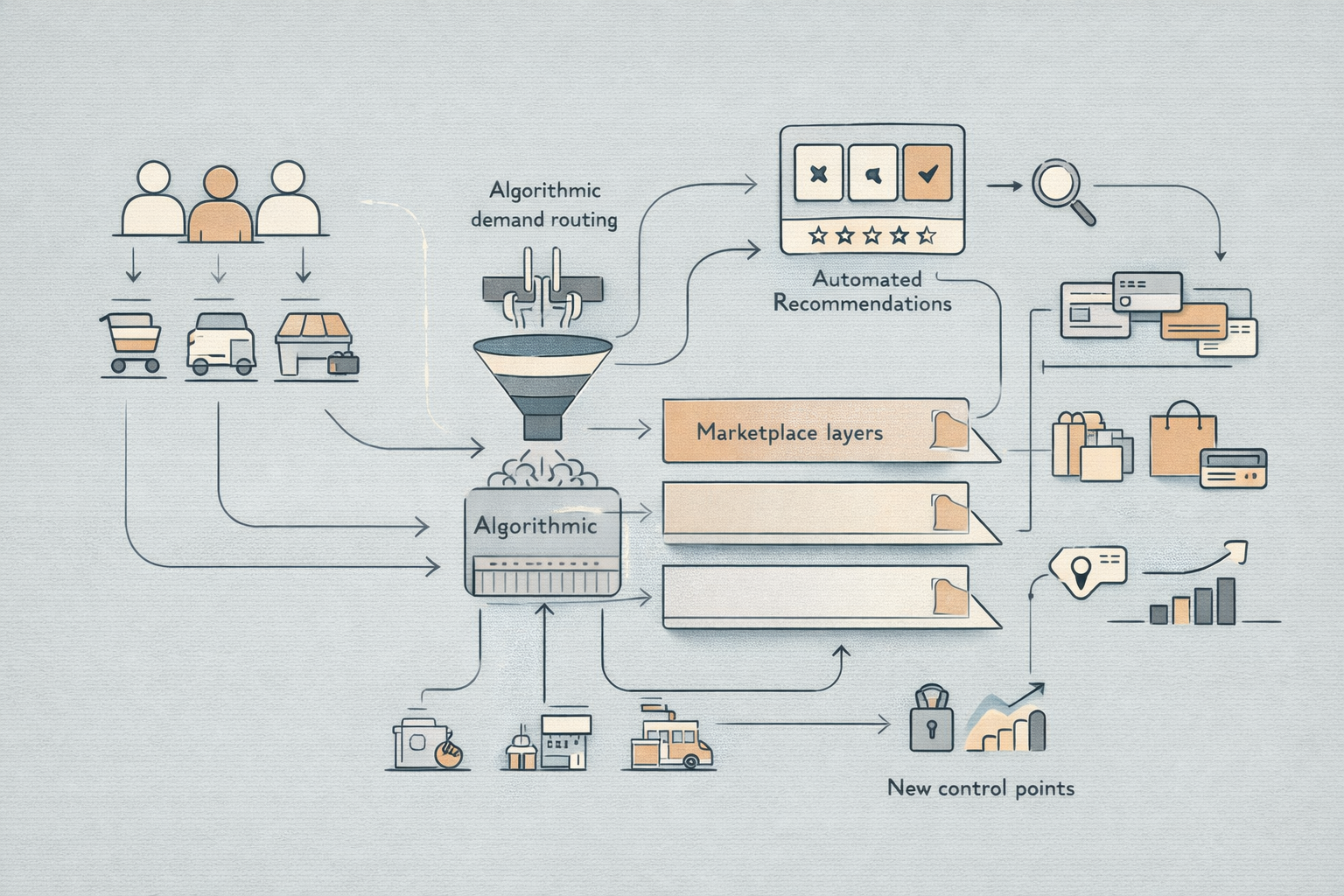
Here’s the structural consequence: when an AI agent handles discovery and comparison, the traditional funnel collapses. There’s no browsing phase to monetise, no scroll to fill with sponsored placements, no impulse purchase triggered by a banner ad. The agent evaluates, narrows, and acts — often before the consumer sees a single product page. Morgan Stanley predicts that nearly half of online shoppers will use AI shopping agents by 2030, accounting for roughly 25% of their total spending (Morgan Stanley, 2025). That’s a quarter of all ecommerce flowing through a layer the consumer doesn’t directly control.
Can Brands Survive When the Algorithm Decides What Gets Bought?
For sellers, this creates an uncomfortable new reality. Brand awareness — the thing that decades of advertising has been built to create — matters less when an AI agent is making the recommendation. Only 22% of products on Amazon’s first results page overlap with those Rufus recommends, and 36% of Rufus’s suggestions don’t appear on that first page at all (Nova Analytics, 2025). Visibility in the old system doesn’t guarantee visibility in the new one.
This cuts both ways. Smaller sellers with strong product fundamentals — good reviews, competitive pricing, genuine differentiation — can surface through AI recommendations in ways the old ad-auction model wouldn’t allow. A niche skincare brand with outstanding review sentiment could outperform a multinational that’s spent millions on display ads, simply because the agent weighs product data differently than a search algorithm weighs ad spend.
But it also means brands lose control of the narrative. You can’t buy your way to the top of an AI agent’s shortlist the same way you can bid on a sponsored placement. The agent optimises for the consumer’s stated criteria, not the seller’s marketing budget. And the consumer’s criteria are getting more specific — an AI agent doesn’t just search for “running shoes,“ it searches for “lightweight trail runners under $120 with good wet-grip reviews and next-day delivery.“
In Southeast Asia, where the ecommerce market hit $159 billion in GMV in 2025 and competition has evolved from Singaporean platform-based rivalry to a multi-market model shift between search-driven and content-driven commerce (Source of Asia, 2026), this transition will be particularly disruptive. Sellers who’ve built entire businesses around Shopee’s search algorithm or TikTok Shop’s content feed will need to optimise for a third paradigm: agent-mediated discovery, where the AI evaluates product data, reviews, and specifications directly rather than responding to keywords or viral content.
Shopee vs Lazada vs Tokopedia: Who’s Winning Southeast Asia’s $159 Billion E-Commerce War?
Who Wins When the Algorithm IS the Marketplace?
For platforms, the stakes are existential. If AI agents become the primary interface for product discovery — sitting between the consumer and the catalogue — then the platform’s role shifts from destination to infrastructure. You don’t visit Amazon; your agent queries Amazon’s API. You don’t browse Shopee; your agent pulls the best match from Shopee’s inventory.
That’s a problem if your business model depends on attention. Advertising revenue, which underpins the economics of every major ecommerce platform, requires human eyeballs. No eyeballs, no ad impressions. Amazon recognised this early — building Rufus in-house means keeping the agent layer proprietary, capturing the demand signal before it leaves the platform. It’s projected to contribute over £700 million in operating profits in 2025 (Fortune, 2025).
Alibaba is making a similar bet. Its $2 billion investment in Lazada includes substantial AI and logistics upgrades (Benzinga, 2024), and AI Mode on Alibaba.com is designed to unlock what the company calls the “hidden product shelf“ — specialised suppliers invisible under traditional keyword search. The platform that owns the best agent wins the transaction, regardless of where the consumer started.
But third-party agents — Perplexity, ChatGPT, independent shopping bots — threaten to disintermediate platforms entirely. If an external agent can query multiple marketplaces simultaneously and surface the best option across all of them, platform loyalty evaporates. AI-referred shoppers already convert 38% more than those from traditional channels (Ringly.io, 2026). The platforms that survive will be those that make themselves indispensable to agents — through superior data, faster fulfilment, or exclusive inventory — not those that try to keep humans browsing.
Where Is This Heading?
The honest answer: we’re watching demand itself become programmable. When 45% of shoppers already use AI assistants for product ideas and 70% are comfortable letting an agent make purchases on their behalf (Ekamoira, 2026), we’re past the early-adopter phase. This is mainstream behaviour forming in real time. Over two-thirds of shoppers aged 25-44 say they’d delegate repetitive purchases to an AI agent entirely (Ekamoira, 2026). Groceries, household supplies, personal care — the categories that drive the highest purchase frequency are exactly the ones consumers are most willing to hand over.
Three things will define the next two years. First, the protocols — Anthropic’s Model Context Protocol, the Agent-to-Agent Protocol, the Agentic Commerce Protocol — will determine whether agents operate in open or closed systems. Second, the advertising model will need to reinvent itself; when agents replace eyeballs, “cost per impression“ becomes meaningless and platforms will need to price for “cost per agent recommendation“ instead. Third, in Asia specifically, the three-way race between Shopee, Lazada, and TikTok Shop will be reshaped by whichever platform builds the most effective agent layer fastest.
The global generative AI in ecommerce market reached $1.11 billion in 2026 and is forecast to hit $3.95 billion by 2035 (Ringly.io, 2026). Those numbers are still small relative to total ecommerce, but they’re measuring the tooling layer, not the spend it influences. The $3-5 trillion McKinsey figure measures the transactions these tools will orchestrate. That’s the number that should keep platform executives awake.
The ecommerce industry spent twenty years perfecting the art of capturing human attention. The next decade will be about capturing algorithmic preference. Those are fundamentally different games, and most of the playbook hasn’t been written yet.
Discover more from Digital in Asia
Subscribe to get the latest posts sent to your email.
