
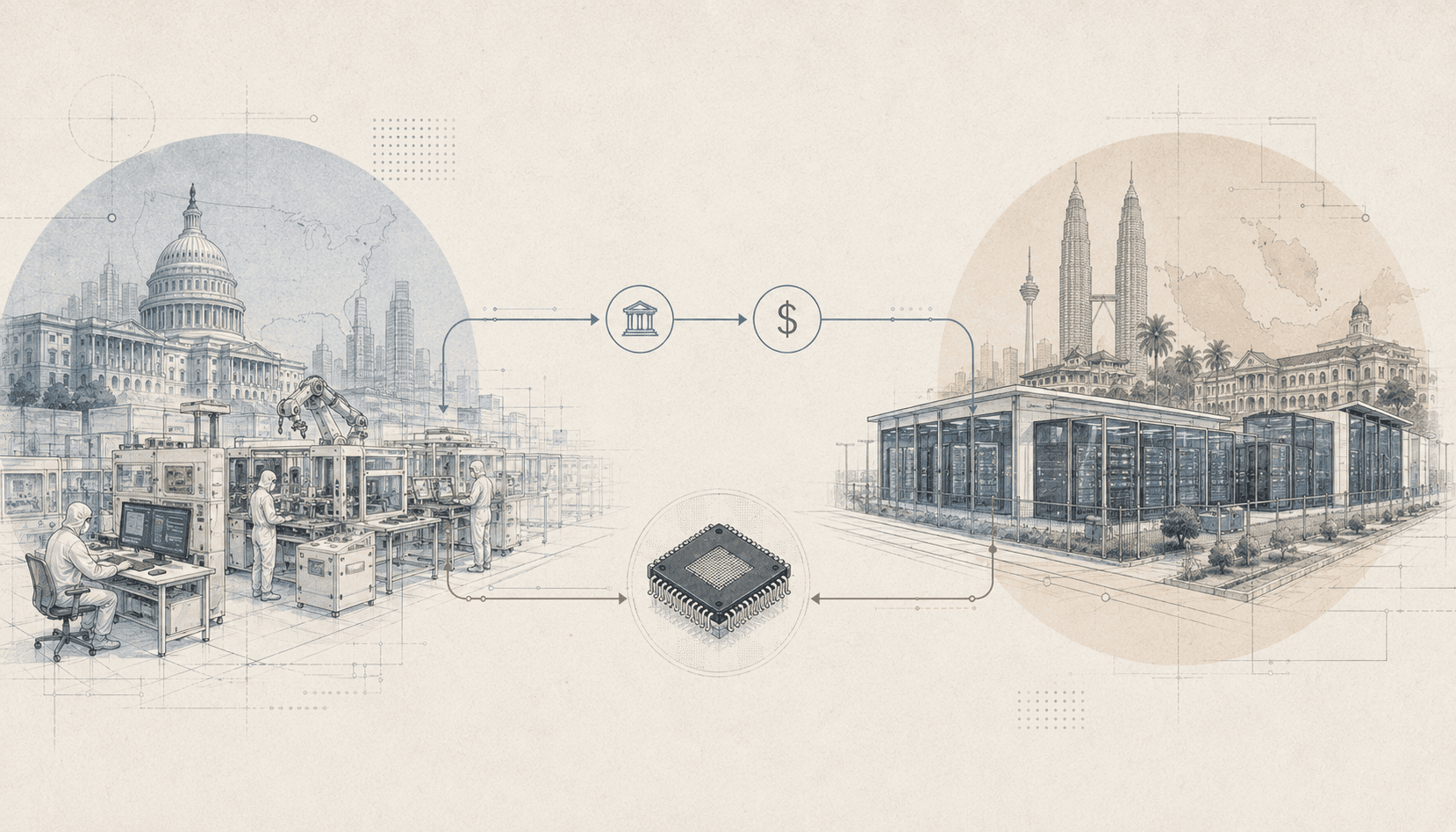
Malaysia is becoming more important to US technology strategy through chips, cloud, AI infrastructure and advanced manufacturing.
Malaysia attracted more than US$30 billion in data centre investment in 2024, making it the world’s hottest data centre destination for two consecutive years according to property consultancy Knight Frank — and most of that capital is American.
Johor state alone has approved RM164.45 billion (roughly US$36 billion) in data centre investments across 42 projects as of Q2 2025, contributing 78.6% of Malaysia’s operational IT capacity, according to Johor’s state government. Malaysia’s overall data centre market was valued at US$6.14 billion in 2025 and is projected to reach US$11.40 billion by 2031 at a 10.86% CAGR. Microsoft announced its second cloud region (Southeast Asia 3) in Johor in November 2025. AWS committed RM25.5 billion (around US$5.5 billion) to Malaysian cloud infrastructure. Google has multi-billion-dollar Malaysian investments. Equinix has opened multiple Malaysian data centres.
This is the part of the US tech footprint in Asia that gets least attention and matters most for AI infrastructure.
Why Malaysia became the AI infrastructure base
Three forces converged to make this happen.
Singapore’s data centre moratorium. Singapore halted new data centre construction from 2019 to 2022 over power and water concerns, redirecting hyperscale expansion plans across the causeway. Even after the moratorium was lifted under a selective framework, Johor continued to attract outsized investment supported by a 5.7GW development pipeline. The Johor–Singapore Special Economic Zone now formalises this division of labour.
The AI infrastructure super-cycle. AI capex globally is projected to exceed US$400 billion in 2025 and reach US$500 billion in 2026 per MBSB Research. Hyperscalers needed locations with reliable power, political stability, regulatory pragmatism and proximity to major Asian demand. Malaysia ticked every box.
Malaysia’s policy response. The 2022 Digital Ecosystem Acceleration tax incentive scheme, the August 2023 Green Lane Pathway for accelerated data centre grid connections (cutting wait times from 36–48 months to 12), and the Sustainable Data Centre Framework released in October 2025 turned Malaysia into the most operator-friendly large data centre market in Asia. The Malaysian Investment Development Authority (MIDA) serves as a single approval authority.
The combined effect: Johor specifically expanded data centre supply at 145% annual growth from 2019 to 2024.
The semiconductor layer
Malaysia’s semiconductor relationship with the US runs deeper than data centres. The country accounts for 13% of global semiconductor packaging, assembly and testing capacity, with deep operations from Intel, AMD, Texas Instruments, Lam Research, ON Semiconductor and Western Digital concentrated in Penang and Kulim.
Malaysia’s National Semiconductor Strategy, announced in 2024 with US$5.3 billion in fiscal support, aims to push the country up the value chain into design, advanced packaging and equipment. The first phase targets RM500 billion (US$107 billion) in semiconductor exports by 2030 and US$25 billion in industrial revenue.
For US firms, Malaysia is the most mature semiconductor partner in Southeast Asia. Vietnam is growing faster, but Malaysia has decades of operating experience, a deep technical workforce, and proven supply chain integration. Penang has been Intel’s largest single packaging site outside the US for years.
The Johor–Singapore SEZ changes the dynamic
The Johor–Singapore Special Economic Zone, formalised in early 2025, is the most important regional infrastructure development of the decade. It allows Singapore to concentrate on premium digital services, capital functions and frontier R&D while Johor absorbs lower-margin data centre, manufacturing and back-office capacity.
For US firms, JS-SEZ effectively creates one operating zone with two regulatory regimes. A hyperscaler can run its high-cost-per-watt frontier AI training in Singapore and its bulk inference and storage in Johor, with the workloads moving across the causeway through dedicated infrastructure.
This is unprecedented in Southeast Asia and structurally important to US AI capacity outside North America.
What’s at stake
US AI infrastructure investment in Malaysia is large enough to matter strategically.
Microsoft’s commitment to a second Southeast Asia cloud region in Johor is a multi-year, multi-billion-dollar investment. Google’s Malaysian data centre and cloud regions are similar in scale. Oracle has expanded Malaysian cloud capacity. NVIDIA has direct partnerships with Malaysian operators including YTL Power’s data centre business.
Beyond the hyperscalers, US semiconductor capital equipment makers (Applied Materials, Lam Research, KLA) have all expanded Malaysian operations. The result is that Malaysia now hosts a meaningful share of the US AI supply chain — not the frontier R&D, but the infrastructure layer that frontier R&D depends on.
The risks
Two structural risks could disrupt this trajectory.
Power and water. The data centre boom has put real pressure on Malaysian electricity supply and water resources, particularly in Johor. The Sustainable Data Centre Framework is designed to address this, but if it fails to keep up with demand, Malaysia will hit infrastructure constraints similar to Singapore’s.
Geopolitical pressure. As US export controls on advanced chips tighten, Malaysia’s role as a semi-conducting ground for chip flows between the US, China and the rest of Asia gets more politically sensitive. Malaysia has historically played pragmatic non-alignment well, but the AI export control regime may force harder choices.
Where this goes next
Three things to watch.
Continued AI infrastructure scaling. Malaysia’s 5.7GW data centre pipeline implies several more years of major US investment. The hyperscalers are committed.
Semiconductor advanced packaging. Malaysia’s National Semiconductor Strategy specifically targets advanced packaging — exactly the segment where US firms (Intel, AMD, NVIDIA) most need partner capacity outside Taiwan. Expect significant US investment in Malaysian packaging facilities.
The JS-SEZ operational ramp. As the Johor–Singapore SEZ matures, the way US firms structure Southeast Asia operations will shift. Expect headquarters in Singapore, primary infrastructure in Johor, and a more integrated cross-border operating model.
Most coverage of US tech in Asia focuses on India, China and Japan. Malaysia is the quiet but critical piece — the infrastructure layer that lets the rest of the region run.
For DIA readers building or following the AI infrastructure stack in Asia, this is the relationship that matters most operationally.
Part of a Digital in Asia series on the digital relationships shaping Asia’s next decade.
Related DIA coverage: Malaysia data centres, Asia AI infrastructure, Southeast Asia semiconductors.
Sources & Further Reading
- Office of the US Trade Representative — bilateral trade and tariff data
- IMF — World Economic Outlook — macro and trade indicators
- NASSCOM — Strategic Review — IT and GCC sector data
- Bain & Company — e-Conomy SEA Report — Southeast Asia digital economy
- World Economic Forum — global digital trade analysis
Discover more from Digital in Asia
Subscribe to get the latest posts sent to your email.
