
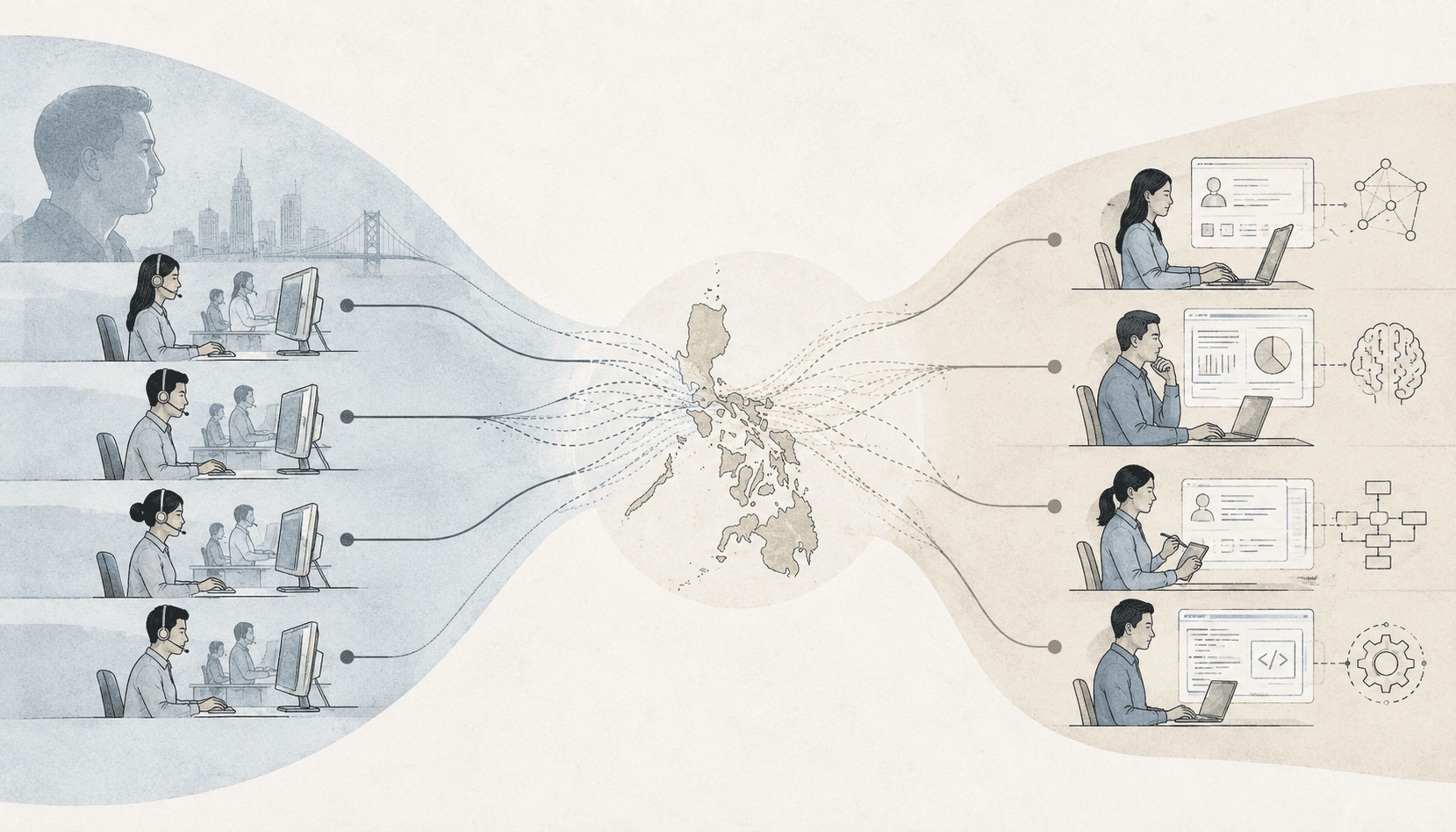
The Philippines‘ services economy is entering a new phase as AI changes outsourcing, customer support, content operations and cyber work.
The Philippines IT-BPM industry generated US$38–40 billion in export revenue in 2024–2025, employing approximately 1.9 million workers — and US clients account for around 65% of that revenue.
The Philippine BPO sector represents 7.5–8.5% of national GDP and roughly 10–15% of the global outsourcing market, according to the IT-Business Process Association of the Philippines (IBPAP) and the Philippine Statistics Authority. North America accounts for approximately 70% of Philippine BPO client revenue. IBPAP’s Roadmap 2028 targets US$59 billion in revenues and 2.5 million workers by 2028 — a 55% revenue increase over 2024.
These numbers describe one of the most concentrated bilateral services relationships in the world. They also describe a relationship now being rewired by AI faster than either side has fully adjusted to.
Why the Philippines became America’s outsourcing partner
The structural advantages are well-known: English fluency at native level, cultural alignment with American business practices stemming from the country’s colonial history, lower labour costs, a young workforce, and strong government support through the IT-BPM Industry Roadmap and PEZA tax incentives. The PEZA recognises 788 BPO companies operating across the country.
What’s less appreciated is how vertical the integration has become. American companies don’t just send call centre work to the Philippines — they run customer service, finance and accounting, HR operations, legal process work, healthcare claims processing, and increasingly software engineering through Philippine teams. JPMorgan, Citi, AIG, UnitedHealth, Concentrix and Teleperformance all run significant Philippine operations. Tech firms including Google, Microsoft, Amazon and Meta have expanded their Philippine footprints for content moderation, customer support and Trust & Safety operations.
The Philippines became, in effect, America’s back office. The next phase is harder to summarise.
The AI question
A February 2025 IMF working paper identified the BPO sector as having the highest proportion of jobs at risk of AI-driven displacement in the Philippines. Routine customer service, basic data processing and entry-level content operations are exactly the categories that generative AI is most credibly automating.
This frames the central strategic question for both the Philippines and its US clients: does AI hollow out Philippine BPO, or transform it?
The current evidence points strongly to transformation, not hollowing. Several patterns are emerging.
Filipino agents augmented by AI achieve 85–92% first-contact resolution rates versus 65–72% for traditional outsourcing, per industry surveys from PITON-Global and others. AI chatbots autonomously handle 60–75% of routine inquiries in mature deployments. Filipino agents handle the harder cases that the AI escalates.
The Philippine BPO industry is positioning itself as the human-in-the-loop layer for AI deployments rather than the layer being replaced. Rather than competing with AI, Filipino workers are being trained to work alongside it — using AI tools for analysis and process automation while applying human judgement to complex problems and relationship management. SME retailers using Philippine AI-augmented BPO report 28–35% upsell conversion rates and 73% fraud loss reduction, capabilities that previously required enterprise-scale internal investment.
This is a real shift. It means the Philippines is moving from labour arbitrage (cheaper humans doing the same work) to capability arbitrage (humans plus AI doing better work than either could alone).
What this looks like in practice
Several specific developments illustrate the shift.
Knowledge process outsourcing (KPO) — legal, medical transcription, fraud analytics, market research, web development — has been growing as a share of total BPO revenue. The global KPO market was projected to generate US$125 billion by 2025, and the Philippines is positioning to capture a meaningful share.
The Philippine government launched the National AI Strategy Roadmap 2.0 (NAISR 2.0) and established the Center for AI Research (CAIR) to drive R&D. These are infrastructure investments designed to keep the Philippine workforce ahead of the AI displacement curve rather than absorb its impact.
Companies including TaskUs, Concentrix and Teleperformance — all major US-listed BPO operators with significant Philippine exposure — have rebranded as “digital experience” or “trust and safety” providers, reflecting the move up the value chain.
Private-equity-backed boutique BPOs specialising in AI ops, content moderation, fraud detection and AI training data are scaling fast. The Philippines is one of the most important markets globally for AI training data labelling and reinforcement learning from human feedback (RLHF).
The structural risks
Three things could disrupt this trajectory.
Aggressive automation by US clients. If a major US enterprise decides to automate 80% of its customer support stack rather than 50%, the Philippine workforce takes a sharp hit. The current evidence suggests most enterprises are moving cautiously, but the technology will keep improving.
Competition from emerging markets. India is a much larger BPO market with the capability to take on more sophisticated work. Vietnam, Eastern Europe and Latin America are scaling alternatives. The Philippines’ English-language and cultural advantage is durable but not absolute.
Domestic infrastructure constraints. The Philippines’ digital infrastructure — especially internet reliability outside Metro Manila — is a real constraint as the work moves up the value chain. The government’s investments in broadband, digital infrastructure and skills training are meaningful but not yet at the scale required.
Where this goes next
The most likely trajectory: the Philippines absorbs the AI shift better than feared but worse than ideal.
Three things to watch.
The IBPAP Roadmap 2028 targets. Hitting US$59 billion in revenue and 2.5 million workers requires the AI-augmentation strategy to actually work. If it does, the Philippines remains America’s primary services partner through 2030 and beyond. If not, US firms will diversify more aggressively to Latin America and Eastern Europe.
The creator economy and Trust & Safety layers. Both are growing categories where the Philippines has structural advantages. Content moderation for US platforms, AI training data, RLHF, and creator support roles will continue to expand.
Onshoring of higher-value functions. As Philippine BPO providers move into legal process work, healthcare informatics, and AI ops, the relationship with US clients shifts from vendor to strategic partner. This is the same evolution India’s IT services industry went through over the past two decades.
For DIA readers tracking the Asian digital economy, the Philippines is the cleanest case study in how AI is reshaping a services-heavy bilateral relationship in real time.
That makes it one of the most important relationships to watch.
Part of a Digital in Asia series on the digital relationships shaping Asia’s next decade.
Related DIA coverage: Philippines BPO outlook, AI in Asia services, Asia outsourcing market.
Sources & Further Reading
- Office of the US Trade Representative — bilateral trade and tariff data
- IMF — World Economic Outlook — macro and trade indicators
- NASSCOM — Strategic Review — IT and GCC sector data
- Bain & Company — e-Conomy SEA Report — Southeast Asia digital economy
- World Economic Forum — global digital trade analysis
Discover more from Digital in Asia
Subscribe to get the latest posts sent to your email.
