
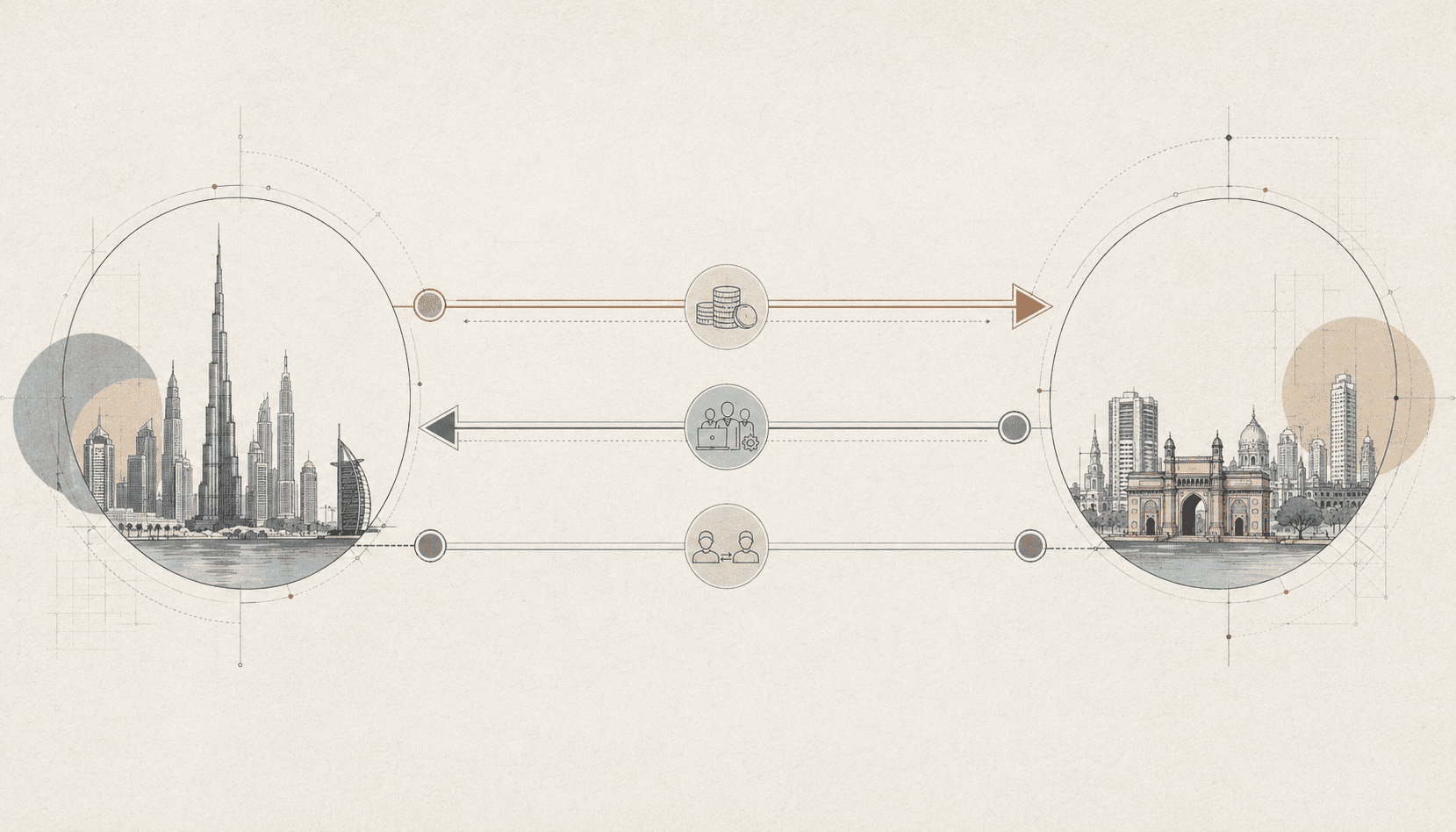
The UAE–India relationship is becoming a major channel for fintech, AI, remittances, logistics, capital and digital infrastructure.
UAE–India bilateral merchandise trade reached US$83.7 billion in FY24, almost double the US$43.3 billion recorded in FY21 — and the digital layer of the relationship is what’s driving the next phase.
The UAE–India Comprehensive Economic Partnership Agreement (CEPA), in force since May 2022, eliminated tariffs on more than 80% of products and opened market access for UAE service providers across 11 sectors and 100-plus sub-sectors, according to the UAE Ministry of Economy. The UAE–India remittance corridor exceeds US$20 billion annually, the world’s second largest after US–Mexico, and contributes 33% of inward remittance volume to India. The Indian fintech sector was projected to reach US$150 billion by 2025. UPI is now linked with the UAE’s payment systems, allowing real-time mobile-based transfers.
These numbers add up to one of the most consequential capital and technology corridors in Asia, and most coverage still treats it as a remittance story.
What the digital relationship actually contains
Three things matter most.
Indian software talent and digital public infrastructure. India’s IT industry generated US$224 billion in exports in FY25, and a growing share of that is delivered into the UAE. Tata Consultancy Services, Infosys, Wipro, HCL and Tech Mahindra all run substantial Dubai and Abu Dhabi operations. Beyond services, India’s digital public infrastructure stack — UPI, Aadhaar, DigiLocker, ONDC — is increasingly being adopted as a reference architecture by UAE government agencies and financial institutions.
UAE capital flowing into Indian tech. Mubadala, ADIA, ADQ, IHC and a long tail of UAE family offices now hold significant positions in Indian tech. ADIA committed multi-billion-dollar exposure to Indian gaming, fintech, e-commerce and SaaS. Mubadala has been an active investor in Indian unicorns. Lulu Group has expanded retail and digital services across both countries.
Cross-border fintech infrastructure. The UAE hosts more than 50% of the fintech firms operating in the MENA region. The integration of UPI with UAE payment networks, plus partnerships between the National Payments Corporation of India (NPCI) and Network International, are turning the corridor into a real-time, low-cost payments rail.
Why the UAE is taking India seriously now
The UAE’s strategic shift toward AI and technology, formalised through the National Strategy for Artificial Intelligence 2031, requires more talent and software depth than the UAE’s domestic ecosystem can supply. India is the natural source.
Several specific channels matter.
The UAE–India CEPA Start-Up Series, launched in 2025, identifies five high-potential Indian startups annually for UAE incubation, with full sponsorship including flights, accommodation, licensing support and investor access. The UAE government is treating Indian startups as a strategic asset for its own ecosystem.
The 13th India–UAE High-Level Joint Task Force on Investments, held in September 2025, formally elevated maritime, space, fintech and AI as new investment priorities. This was co-chaired by India’s Commerce and Industry Minister Piyush Goyal and Sheikh Hamed bin Zayed Al Nahyan of ADIA.
The India–UAE Business Council has held annual meetings focused specifically on fintech, trade facilitation mechanisms and logistics corridors.
These aren’t ceremonial. They translate into deal flow.
The remittance corridor as fintech testbed
The US$20 billion+ annual flow between the UAE and India makes this corridor uniquely attractive for fintech innovation. Three reasons.
Volume. There’s enough transaction flow to support multiple business models — wallets, blockchain rails, UPI integrations, traditional MTOs, FX-optimised platforms — without any of them cannibalising each other.
Friction. Transaction fees on the corridor are around 5.31% — below the global average of 6.3% but still high enough that fee compression is a real commercial opportunity. Indian fintechs and UAE-licensed payment firms are competing aggressively to drive this lower.
Regulatory headroom. Both governments have signalled willingness to let new payment models operate. The UPI–UAE link is the most visible example. NPCI is expanding UPI to 10 countries by 2025, with the UAE as one of the most active.
For Indian fintechs, the UAE is one of the few overseas markets where they can deploy domestic playbooks without major adaptation. For UAE fintechs and capital providers, India is the largest, fastest-growing fintech market they can credibly access.
What this looks like commercially
Specific bets being made:
LuLu Financial Holdings, anchored in the UAE, has built one of the largest cross-border remittance and exchange networks in the GCC, with significant India exposure.
Network International, the UAE’s payments leader, has deepened its India partnership through NPCI integration.
Indian fintechs including BillDesk, Cashfree, Skydo and HiWiPay have either entered or scaled UAE operations in 2024–2025. Cashfree raised US$53 million Series C led by KRAFTON in March 2025 specifically to expand cross-border offerings.
UAE sovereign and family-office capital continues to flow into Indian gaming, AI, content platforms and consumer brands at multi-hundred-million-dollar scale.
Where this goes next
Three structural shifts likely to define the next phase.
CEPA’s renegotiation cycle. The agreement is up for review and amendment under its Joint Committee mechanism. Expect digital trade, data flows and fintech licensing to become more central in the next iteration.
The AI infrastructure layer. The UAE’s G42, in partnership with Microsoft, is positioning the country as a regional AI hub. Indian engineering talent and Indian software depth are both essential to making that work. Expect significant Indian developer populations in Abu Dhabi and Dubai by 2030.
Digital public infrastructure export. India’s UPI–Aadhaar–ONDC stack is being actively pitched as a model for the UAE’s payment, identity and commerce infrastructure. If the UAE adopts even parts of it, India’s DPI becomes a global standard with one of the wealthiest economies in the world as a reference customer.
The UAE–India relationship looks like a remittance and trade story when you read the headlines. The actual mechanics — capital flowing west to east, talent flowing east to west, fintech rails being built across the corridor in real time — are something more interesting.
It’s becoming one of the most important digital partnerships in Asia. And almost no Western coverage frames it that way.
Part of a Digital in Asia series on the digital relationships shaping Asia’s next decade.
Related DIA coverage: India fintech, UAE AI strategy, Asia–Gulf capital flows.
Sources & Further Reading
- Office of the US Trade Representative — bilateral trade and tariff data
- IMF — World Economic Outlook — macro and trade indicators
- NASSCOM — Strategic Review — IT and GCC sector data
- Bain & Company — e-Conomy SEA Report — Southeast Asia digital economy
- World Economic Forum — global digital trade analysis
Discover more from Digital in Asia
Subscribe to get the latest posts sent to your email.
