
How Many Smart Factories Does China Operate and What Does That Mean for Global Manufacturing?
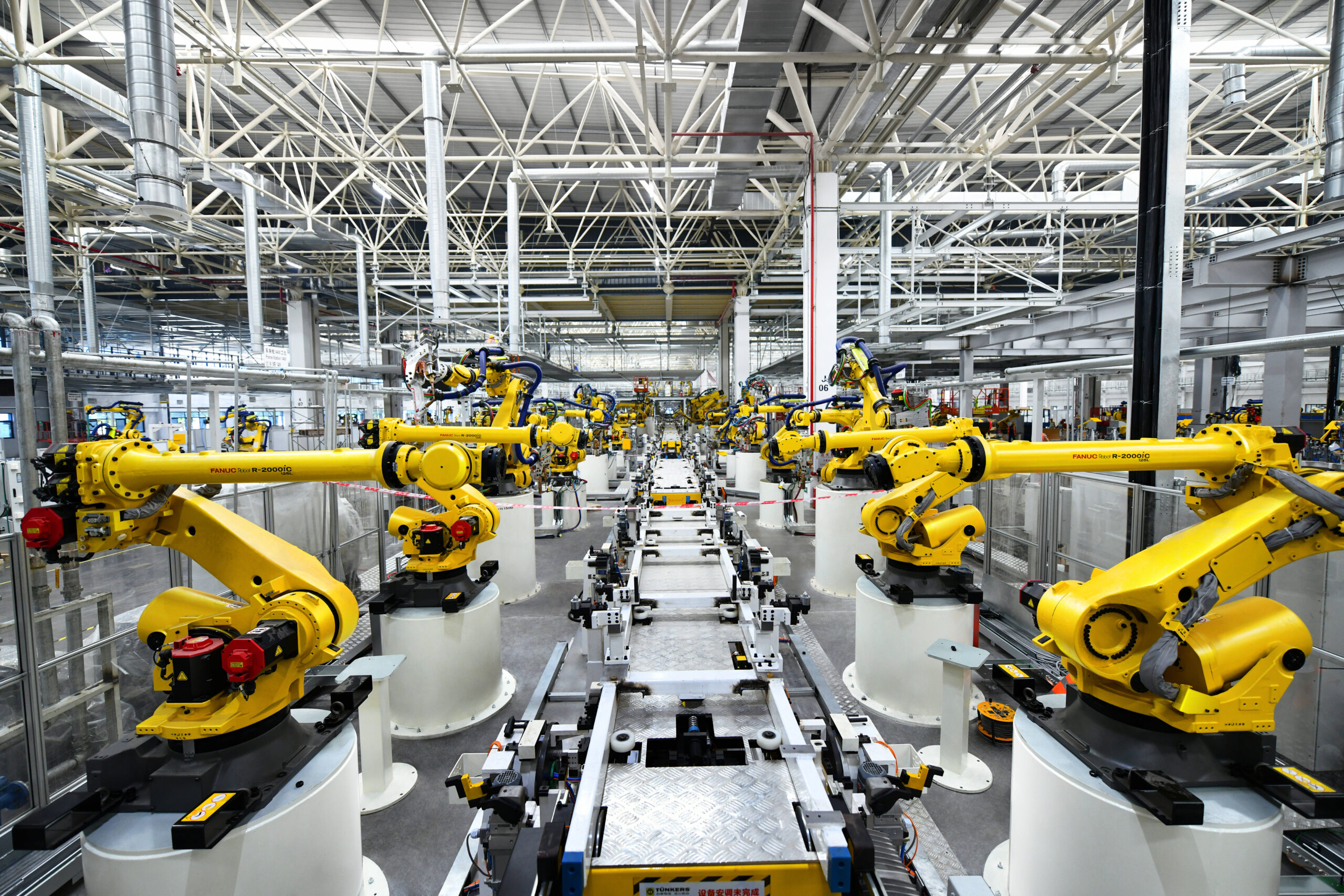
China operates over 30,000 smart factories as of early 2026, making it the world’s dominant force in industrial AI deployment. Nvidia CEO Jensen Huang has described China’s approach as “physical and industrial AI” — a characterisation that captures how China has focused AI investment on manufacturing automation, logistics optimisation, and industrial robotics rather than consumer-facing chatbots. China holds 82.4% of global AI patents and produces 34.5% of global AI research publications (Stanford HAI AI Index \S2025), with industrial applications representing a disproportionate share of both patents and deployment.
China’s AI market was valued at USD 21.63 billion in 2024 and is projected to reach approximately USD 378 billion by 2030 at a 32–39% CAGR (Fortune Business Insights). The country’s GenAI market alone is projected to nearly match North America’s by 2030. But what distinguishes China’s AI trajectory from the US is the emphasis on deployment over development — China may produce fewer frontier research papers, but it deploys AI into production environments at unmatched speed and scale.
What Is Driving China’s Industrial AI Deployment??
Three structural forces accelerate China’s smart factories and industrial AI adoption. First, the government’s AI Plus Action Plan and 15th Five-Year Plan explicitly prioritise AI integration across manufacturing, agriculture, and healthcare. Provincial governments compete to attract AI-intensive manufacturing facilities, creating a policy environment that actively subsidises industrial AI deployment.
Second, China’s manufacturing base provides enormous scale for AI applications. The country remains the world’s largest manufacturer by output, and the transition from labour-intensive to AI-augmented production is a strategic imperative as labour costs rise and demographics shift. China’s working-age population peaked in 2015 and is declining, creating the same demographic pressure for automation that Japan faces — but at a scale 10 times larger.
Third, China’s domestic AI compute infrastructure is now substantial enough to support industrial-scale deployment. With 788 intelligent EFLOPS of compute capacity and over 8 million server racks, China can run the inference workloads that industrial AI requires without dependence on foreign cloud providers. Huawei’s Ascend 910C chips, while less capable than Nvidia’s H100s on peak benchmarks, are sufficient for the inference-heavy workloads that characterise factory AI, quality control systems, and logistics optimisation.
Which Sectors Are Most Affected by China’s Industrial AI Push?
Manufacturing leads the deployment. China’s smart factories integrate AI across the production chain: computer vision for quality inspection, predictive maintenance algorithms that reduce downtime, digital twins that simulate and optimise production lines, and autonomous mobile robots that manage warehouse logistics. Baidu’s AI Cloud, generating RMB 33.2 billion in revenue (up 17% year-on-year in 2025), provides the platform infrastructure for many of these industrial deployments.
Healthcare represents one of China’s most aggressive AI deployment sectors. Ping An’s Good Doctor platform uses AI for medical image analysis and preliminary diagnosis, while Tencent’s Miying system has been deployed across hundreds of hospitals for cancer screening. SenseTime, Hong Kong’s most prominent AI company, has extended its computer vision capabilities into Smart Healthcare, achieving H1 2025 revenue of RMB 2.4 billion (up 36% year-on-year) with GenAI comprising 77% of total revenue.
Agriculture is an underappreciated frontier. China’s agricultural AI deployments include drone-based crop monitoring, AI-driven precision irrigation, and automated harvesting systems. These applications address a critical labour shortage in rural China while improving yields — and the model is being exported to Southeast Asian agricultural economies through technology transfer and investment.
What Are the Strategic Implications of China’s Industrial AI Leadership?
China’s industrial AI leadership creates competitive pressure across Asia. South Korea’s response includes Samsung’s AI Megafactory initiative and government investment in 1,000-plus “K-Smart Lighthouse Factories” integrating 5G and AI. Japan’s manufacturing sector, while technologically sophisticated, has been slower to deploy AI at scale — a gap that could erode Japan’s traditional manufacturing advantages.
For Southeast Asia, China’s industrial AI represents both opportunity and threat. The opportunity is technology transfer: Chinese AI companies are actively expanding into ASEAN markets, bringing industrial AI capabilities to Vietnamese, Thai, and Indonesian manufacturers that lack the resources to develop them domestically. The threat is competitive displacement: as Chinese factories become more automated and efficient, the cost advantages that drew manufacturing to Southeast Asia may erode.
The 2030 outlook projects China as the world’s dominant AI industrial deployment market with over 60 million AI-controlled industrial robots, a fully integrated AI healthcare system, and near-parity with the US in GenAI market size. The key constraint is the geopolitical bifurcation of AI ecosystems: US semiconductor export controls have forced China to build an alternative chip supply chain, and the resulting parallel AI stacks may limit interoperability between Chinese and Western industrial AI systems for years to come.
Read the full AI Ecosystem Across Asia 2026 report — market data, country analysis, company profiles, investment landscape, and 2026–2030 outlook → digitalinasia.com/reports
Also Read
- How DeepSeek Disrupted Global AI Economics From China
- The Asian AI Chip Race: TSMC, Samsung, and the Semiconductor Supply Risk
- Asia’s $150 Billion AI Market in 2026: Country-by-Country Breakdown
- Sovereign AI in Asia: Why Every Country Is Building Its Own LLM
Data sourced from the Digital in Asia “AI Ecosystem Across Asia 2026” report. Last updated: March 2026.
