
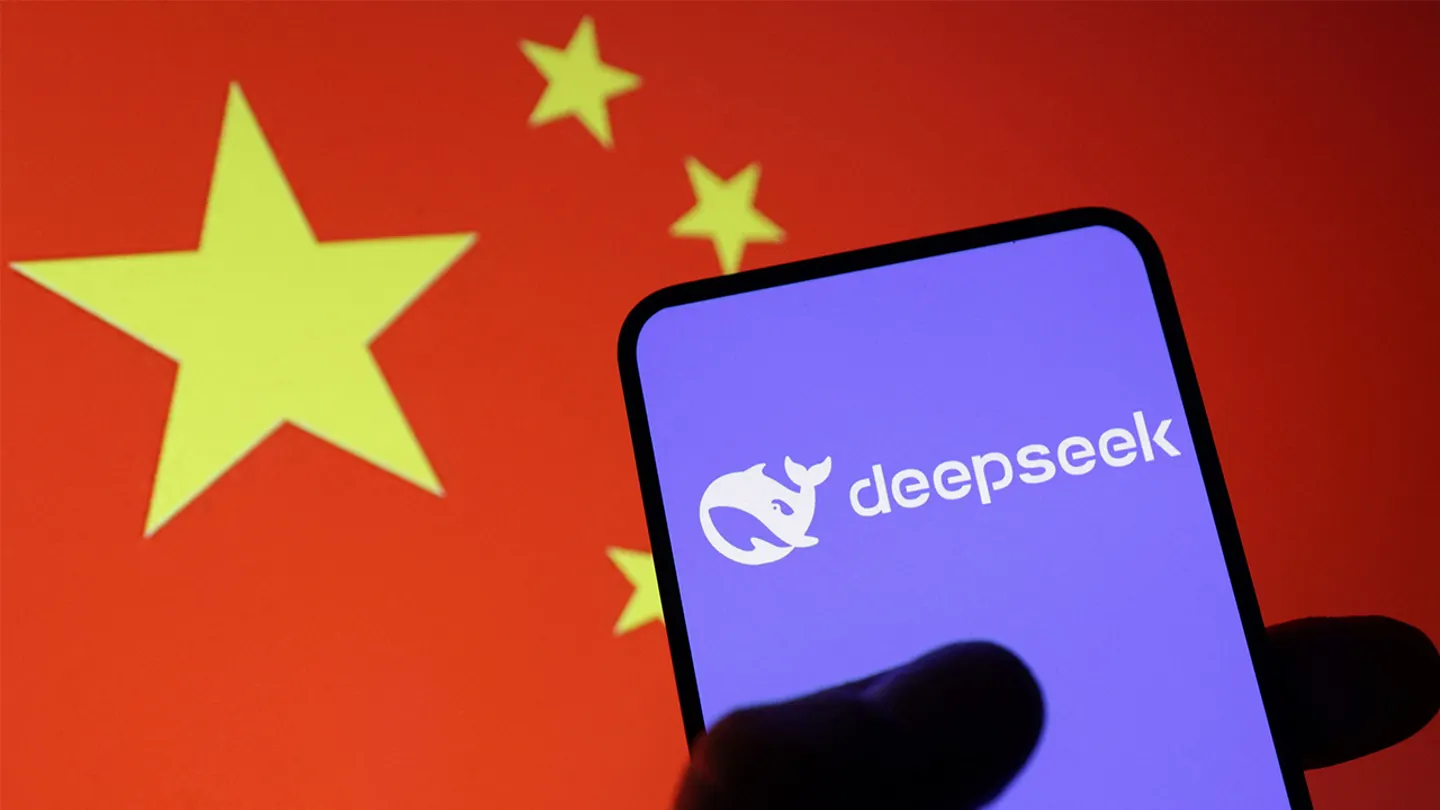
What Is DeepSeek and Why Did It Disrupt Global AI Economics?
DeepSeek, a Chinese AI company founded in May 2023 with approximately 200 employees, triggered a global repricing of AI infrastructure economics with the release of DeepSeek-R1 on January 20, 2025. The model achieved performance comparable to OpenAI’s o1 on mathematics and coding benchmarks — AIME: 52.5% versus 44.6%; MATH: 91.6% versus 85.5% — at a reported training cost of just USD 6 million, compared to the USD 100 million-plus typically required for comparable frontier models. The release caused a 17% single-day drop in Nvidia’s share price on January 27, 2025, and a 3% Nasdaq decline.
Backed primarily by High-Flyer Capital Management, a Chinese quantitative hedge fund, DeepSeek now generates an estimated annual revenue run rate of USD 220 million. It has reached 96.88 million monthly active users (as of April 2025) and charges just USD 0.55 per million tokens for API access — a fraction of what comparable Western frontier models cost. DeepSeek’s founder, Liang Wenfeng, made Forbes China’s top 100 wealthiest list in November 2025 with an estimated net worth of USD 11.5 billion.
How Does DeepSeek-R1 Achieve Frontier Performance at a Fraction of the Cost?
DeepSeek-R1’s architectural innovation is a pure reinforcement learning approach that develops chain-of-thought reasoning, self-verification, and reflection without explicit instruction. The 671-billion-parameter Mixture of Experts model activates only 37 billion parameters per forward pass, dramatically reducing inference costs while maintaining benchmark-leading performance. Released under an MIT open-source licence, the model has become the most widely deployed base model for fine-tuning across China and internationally.
The cost breakthrough has profound implications for Asia’s AI landscape. DeepSeek demonstrated that frontier-level reasoning capabilities can be achieved without the massive compute budgets that were previously considered essential. This finding directly supports the viability of sovereign AI programmes across Asia, where most countries lack access to the tens of thousands of Nvidia H100 GPUs that characterise American AI labs. If competitive models can be trained for single-digit millions rather than hundreds of millions of dollars, the barriers to entry for national AI programmes drop by an order of magnitude.
What Is DeepSeek’s Impact on Asia’s Sovereign AI Movement?
DeepSeek’s success accelerated an already-strong sovereign AI trend across the region. Before DeepSeek-R1, the conventional assumption was that only organisations with access to massive US-manufactured GPU clusters could produce frontier models. DeepSeek proved otherwise, and its open-source release gave every AI lab in Asia a high-quality starting point for domain-specific and language-specific fine-tuning.
The ripple effects are visible across multiple Asian markets. South Korea’s Naver intensified development of HyperCLOVA X Think, which scored 48.9 on the KoBALT-700 Korean-language benchmark — substantially ahead of competitors. India’s Krutrim, valued at over USD 1 billion as the country’s first AI unicorn, open-sourced its 12-billion-parameter Krutrim-2 model trained on 22 Indian languages. Singapore-based Sea Group developed Sailor2 LLM (1B, 8B, and 20B parameter variants) trained on 400 billion Southeast Asian language tokens.
The “DeepSeek effect” also reshaped competitive dynamics among China’s own AI giants. Alibaba’s Qwen series and Baidu’s ERNIE models face pressure to match DeepSeek’s cost efficiency. Baidu, despite generating RMB 33.2 billion in AI Cloud revenue (up 17% year-on-year in 2025), saw its core online marketing revenue decline 5% year-on-year as traditional search revenue erodes. The company’s iRAG technology and Wenku document analysis tools represent efforts to differentiate beyond raw model capability.
What Does DeepSeek Mean for the Future of AI Development?
DeepSeek has effectively democratised frontier AI reasoning capabilities. Its valuation has reached approximately USD 15 billion (Forbes, November 2025), remarkable for a company that has maintained full independence and declined outside investors. The strategic question for the industry is whether DeepSeek’s cost-efficiency breakthrough represents a one-time disruption or a permanent shift in AI economics.
The evidence favours permanence. DeepSeek faces domestic competition from Alibaba’s Qwen series and ongoing pressure to maintain its open-source leadership, creating a competitive dynamic that keeps pushing costs down. For enterprises across Asia evaluating AI deployment, the DeepSeek effect means that the cost barrier to implementing sophisticated reasoning capabilities has fallen dramatically — making AI adoption viable for mid-market companies and smaller economies that were previously priced out of the frontier.
Read the full AI Ecosystem Across Asia 2026 report — market data, country analysis, company profiles, investment landscape, and 2026–2030 outlook → digitalinasia.com/reports
Also Read
- Asia’s $102 Billion AI Market in 2026: Country-by-Country Breakdown
- China’s 30,000 Smart Factories: Leading the World in Industrial AI
Data sourced from the Digital in Asia “AI Ecosystem Across Asia 2026” report. Last updated: March 2026.
Read more: the Asian AI chip race and Asia’s AI market in 2026 country-by-country
Sources & Further Reading
Discover more from Digital in Asia
Subscribe to get the latest posts sent to your email.
