
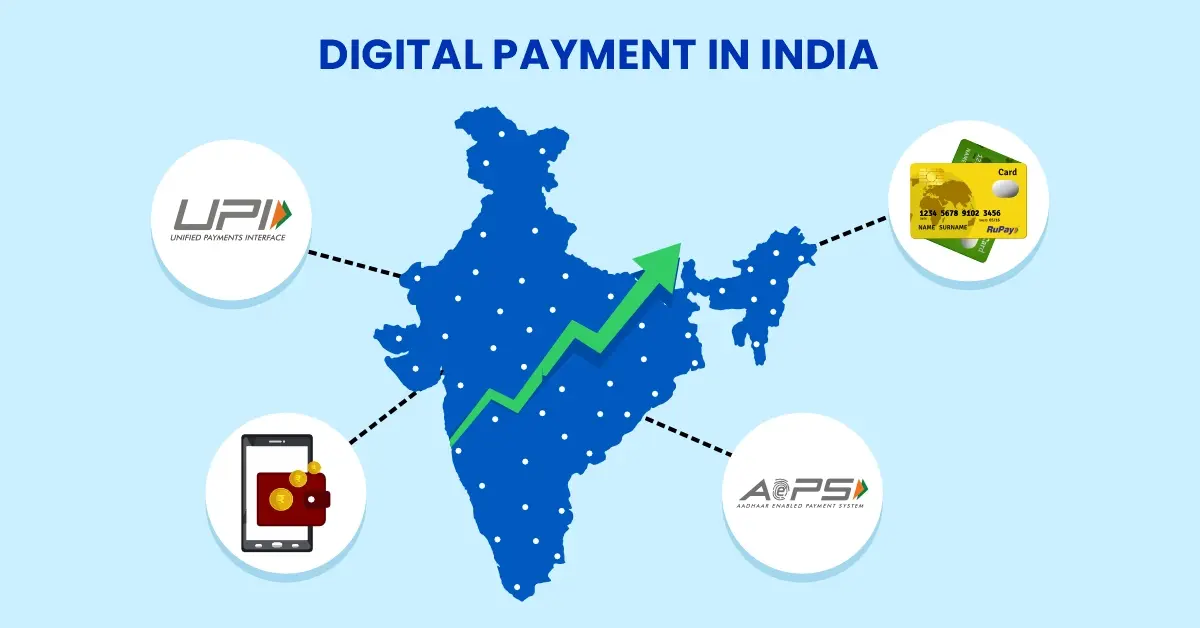
In the space of a single decade, India built the world’s largest real-time payments network, enrolled 1.34 billion citizens in a biometric identity system, and created an open-finance data-sharing framework that dwarfs anything deployed in Europe or North America. This is not incremental progress. It is a civilizational-scale experiment — and by every measurable indicator, it is working.
Digital in Asia’s India Fintech & Digital Payments 2026 report, coming soon, maps the full scope of what is happening: the numbers, the companies, the regulatory architecture, and — critically — where the next wave of value creation lies.
Here are the seven findings that matter most.
1. UPI Now Processes Half the World’s Real-Time Payments
The Unified Payments Interface processed 228.3 billion transactions worth USD 3.4 trillion in calendar year 2025. That single-country payment network now accounts for approximately 50% of all real-time digital payment volume globally — a share no other payment system in any country has come close to matching.
For context: global e-commerce was approximately USD 6 trillion in 2024. UPI’s annual transaction value is already more than half that figure. UPI is projected to reach 1 billion transactions per day by FY2028.
2. The Payments Business Generates Almost No Revenue — and That Is the Entire Opportunity
India’s zero-MDR (merchant discount rate) policy means the largest payment network in the world generates virtually nothing for its participants. The government subsidizes processors to the tune of INR 1,500 crore annually in lieu of fees. The industry estimates that a 0.1% MDR on UPI’s FY2025 value would generate USD 3.1 billion in annual revenue — revenue that currently does not exist.
This constraint has created an intense race to monetize payment relationships through adjacent products. PhonePe’s financial services revenue — insurance and lending — grew 206% year-over-year in FY2025. The companies that convert payment users into multi-product financial services customers will capture the bulk of Indian fintech’s next decade of value.
3. India Has a USD 291 Billion Credit Blind Spot
Fintechs have captured 47% market share in unsecured personal loans and 73% of loans below INR 100,000. Yet India’s MSME credit gap alone stands at INR 25 trillion (USD 291 billion). Household debt-to-GDP is approximately 40%, versus 75–80% in advanced economies. Credit card penetration sits below 8% of the adult population.
The Account Aggregator framework — India’s consent-based Open Finance infrastructure — facilitated USD 19.5 billion in loans in FY2024–25 alone, connecting 2.2 billion financial accounts across 570+ regulated entities. This is the mechanism that unlocks credit for the 700 million adults previously invisible to formal lenders.
4. Insurance and Wealth Penetration Are Structurally Broken — and That Is Structurally Investable
India’s insurance penetration sits at 3.7% of GDP — exactly half the global average of 7.3%. Per-capita insurance spend is USD 97 versus a global average of USD 943. That is a 9.7x gap. InsurTech is projected to grow at 55.4% CAGR through 2030.
On the wealth side, demat accounts grew from 39.4 million in 2019 to 215.9 million by December 2025 — a 5.5x increase in six years. SIP contributions to mutual funds hit a record USD 38.8 billion in 2025. Yet equity participation remains below 10% of adults, against 55–60% in the United States. The runway here extends for decades.
5. The Regulatory Regime Has Grown Up
The collapse of Paytm Payments Bank in early 2024 demonstrated that regulatory risk in India is existential, not merely operational. But the subsequent rehabilitation arc — PA license restored in August 2025, return to quarterly profitability — also demonstrated that recovery is possible.
Since then, the RBI has issued the Payment Aggregator Master Direction (September 2025), the FREE-AI Framework for responsible AI in financial services (August 2025), and the DPDP Rules (November 2025). This is not a regulator retreating. It is one moving from reactive crisis management to proactive standards-setting — which raises compliance costs while cementing the competitive advantages of well-capitalised, rule-following incumbents.
6. India’s Fintech Companies Are Finally Going Public
Groww listed in November 2025 at a USD 11 billion market cap. Pine Labs listed the same month at USD 3.3 billion. PhonePe filed its DRHP targeting USD 15 billion — what would be India’s largest technology IPO in history. Razorpay, CRED, and Navi are in various stages of preparation.
Annual fintech funding remains USD 2.4 billion — 71% below the 2021 peak of USD 8.3 billion. But the companies that survived India’s funding winter did so by becoming profitable. Zerodha sustained 47.9% net margins. Groww posted FY2025 profit of INR 1,824 crore. These are not growth-at-all-costs stories anymore.
7. India Stack Is Becoming a Global Export
NPCI International has expanded UPI to 11 countries, joined Project Nexus as a founding member alongside Singapore, Malaysia, Thailand, and the Philippines, and helped build domestic payment systems in Peru, Namibia, and Trinidad & Tobago. India receives USD 135.46 billion in annual inward remittances — the world’s largest — providing the commercial logic for continued international expansion.
Cross-border UPI transactions grew 1,936% year-over-year in FY2024–25. The ceiling relative to current achievement is very high.
The Bigger Picture
India in 2026 is not a single fintech market. It is a continent-sized collection of simultaneously investable sub-markets at different stages of maturity. Payments are commoditized. Credit, insurance, and wealth remain dramatically underpenetrated. The infrastructure — Aadhaar, UPI, Account Aggregator, ONDC, e-Rupee — is the delivery mechanism that makes capturing those opportunities tractable at scale.
The question is no longer whether the infrastructure works. It does. The question is who builds durable businesses on top of it.
