
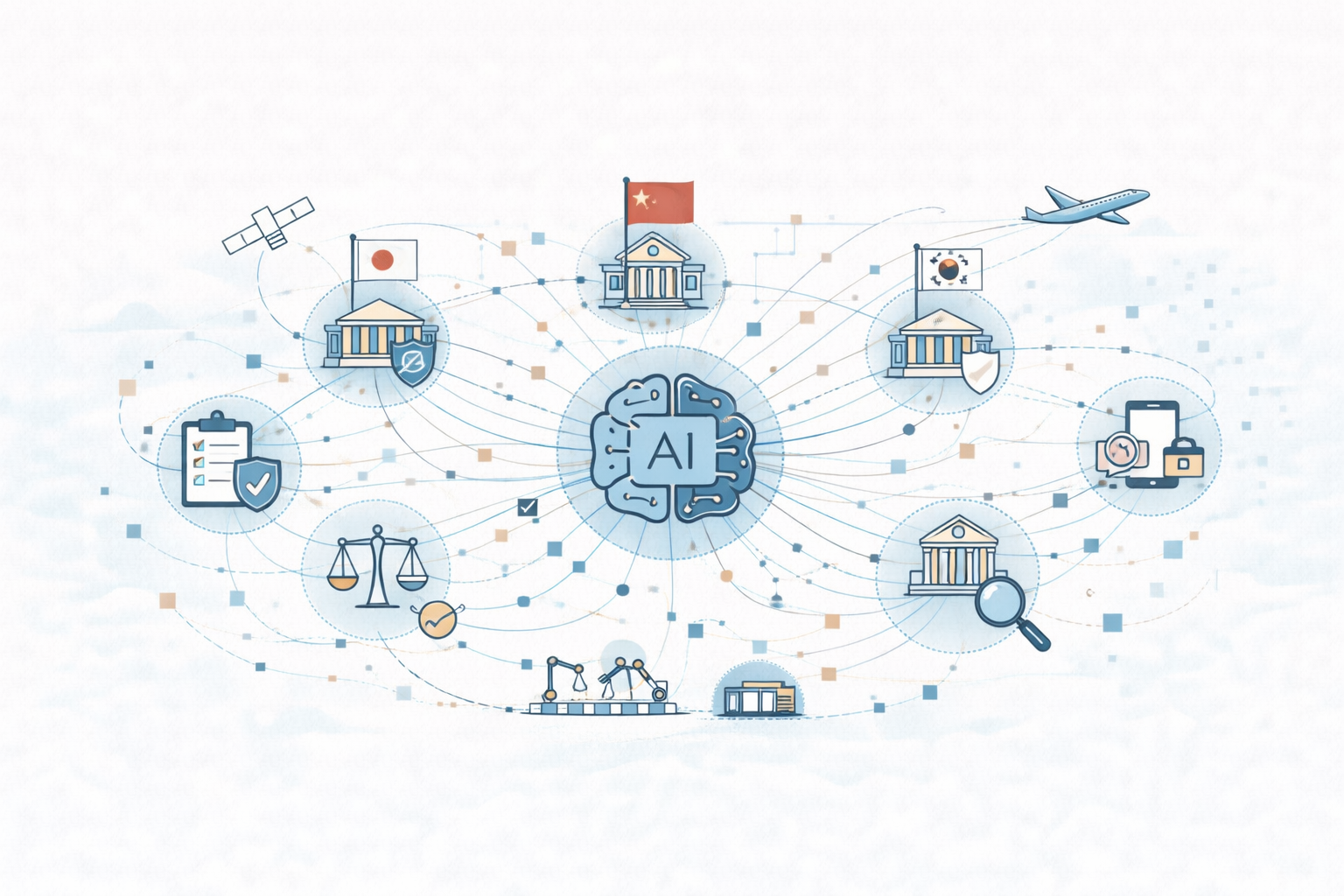
At least ten major Asian economies now have dedicated AI legislation or comprehensive national AI strategies in place, with several more in active development. The approaches vary enormously — from Japan’s ambition to become “the world’s most AI-friendly nation” to Vietnam’s risk-based compliance framework modelled on the EU AI Act, to China’s state-backed push for open-source AI dominance. What they share is urgency. Every government in the region has concluded that AI isn’t a sector to observe from a distance. It’s infrastructure.
This tracker covers the current state of AI policy across Asia’s major markets, updated as of Q2 2026. It’s designed as a reference for companies operating across the region, investors evaluating regulatory environments, and anyone trying to understand how Asia’s AI governance landscape actually works — because it doesn’t look like Europe’s, and it doesn’t look like America’s.
China: Open-Source Strategy as Industrial Policy
China’s AI strategy is the most ambitious and the most coherent in the region. The government has committed roughly $98 billion toward AI development and framed open-source AI as a strategic national asset — not just a development methodology, but a tool for global influence.
Since DeepSeek’s R1 model shocked global markets in January 2025, China’s approach has crystallised. Premier Li Qiang declared at the 2025 World Economic Forum that China’s innovation is “open and open-source” and the country is “willing to share indigenous technologies with the world.” The government’s AI+ Initiative calls for state support of AI products with open-source development as a priority. More than 90% of Chinese enterprises now use open-source technologies, and derivatives of Alibaba’s Qwen model family have become the largest open-weight model ecosystem on Hugging Face, with over 100,000 derivatives (USCC, 2026).
China’s consumer-facing AI regulations require compliance from market-facing applications, but companies focused on research — like DeepSeek — can operate with lighter regulatory oversight. The practical effect is a two-tier system where frontier research runs fast and consumer deployment follows with more governance.
Key entities: DeepSeek, Alibaba (Qwen), Baidu (Ernie), ByteDance (Doubao/Seedance), Tencent (Hunyuan), Huawei (Ascend chips, MindSpore framework), Zhipu AI (GLM), Moonshot AI (Kimi).
What to watch: The tension between open-source global distribution and tightening US semiconductor export controls. DeepSeek received conditional approval to purchase NVIDIA H20 chips but has been encouraged by authorities to adopt Huawei’s Ascend chips for training. The chip question shapes everything — including which models can run where across Asia.
Japan: The AI Promotion Act and the “Most AI-Friendly Nation” Ambition
Japan passed the Act on the Promotion of Research, Development, and Utilisation of AI-Related Technologies (the AI Promotion Act) on 28 May 2025, making it the second major Asia-Pacific economy to enact comprehensive AI legislation after South Korea. Most provisions took effect on 4 June 2025, with chapters establishing the AI Strategic Headquarters and the National AI Basic Plan taking effect on 1 September 2025.
The gap Japan is trying to close is stark. Private AI investment in Japan totalled just $0.93 billion in 2024, compared to $109.08 billion in the US and $9.29 billion in China (Stanford AI Index, 2025). Public AI utilisation stands at 26.7%, versus 68.8% in the US and 81.2% in China. Only 9% of individuals and 47% of companies in Japan were using generative AI as of 2024.
The AI Promotion Act doesn’t impose penalties for non-compliance — it’s a promotional framework, not a punitive one. The legislation establishes the AI Strategic Headquarters as a cabinet-level body coordinating policy, mandates a national AI strategy, and aligns deployment with Japan’s “Human-Centred AI Society Principles.” A supplementary resolution specifically addresses AI-generated deepfake content, with enhanced content removal protocols and victim protection measures.
Japan’s AI market is forecast to reach $10.15 billion in 2026 (Statista). The country’s distinctive strength lies in industrial AI, robotics, edge inference, and manufacturing applications — areas where Japan’s existing hardware and engineering capabilities create natural advantages.
Key entities: Toyota Research Institute, Preferred Networks, Sony, Fujitsu, RIKEN, NEC.
What to watch: Whether Japan’s promotional approach — incentives without penalties — can close the adoption gap fast enough. The National AI Basic Plan, adopted in December 2025, sets measurable targets. Sector-specific guidelines are expected throughout 2026.
South Korea: The 2026–2028 AI Action Plan
South Korea’s National AI Strategy Committee finalised the “Republic of Korea Artificial Intelligence Action Plan” in February 2026. The plan serves as the country’s Basic Plan for AI from 2026 to 2028 and includes 99 execution tasks and more than 300 policy recommendations developed through public consultation and interagency collaboration.
South Korea was the first major Asia-Pacific economy to enact comprehensive AI legislation with its Framework AI Act. The country’s AI ecosystem combines strong semiconductor and hardware capabilities — Samsung and SK Hynix are global leaders in memory chips — with major internet companies like Naver and Kakao investing heavily in AI models and services.
The 2026–2028 Action Plan goes beyond AI technology into adjacent areas. It includes reforms to modernise government digital infrastructure, stronger data centre safety standards, expanded disaster recovery systems, and increased use of private cloud for sensitive public data. A cybersecurity roadmap introduces a vulnerability reporting and disclosure system, encouraging collaboration with white-hat hackers.
The “K-Moonshot” strategy — approved alongside the AI Action Plan — uses AI to accelerate scientific discovery in biotechnology, energy, semiconductors, and space. South Korea’s AI Strategy Committee endorsed this as a national mission programme with dedicated funding.
South Korea has also launched a dedicated Agriculture and Rural AI Transformation (AX) Strategy, making AI support available across the entire agricultural production cycle. The plan deploys AI-based disaster-risk maps, drone-based disease monitoring, and smart machinery sharing centres to ensure no farmer is excluded from AI benefits regardless of farm size.
Key entities: Samsung, SK Hynix, Naver, Kakao, LG AI Research, the Korea Advanced Institute of Science and Technology (KAIST).
What to watch: The country’s “I-Korea 4.0” plan and its successor initiatives are designed to make South Korea a top-three AI nation. The 99 execution tasks in the 2026–2028 plan provide unusually granular targets — making it one of the most measurable national AI strategies anywhere.
India: The IndiaAI Mission and Sovereign LLM Ambitions
India’s AI strategy centres on the IndiaAI Mission, channelling INR 10,372 crore (approximately $1.25 billion) into indigenous large language models designed for local language needs. India launched its sovereign LLM at the AI Impact Summit in February 2026, marking a significant step toward national AI self-sufficiency.
India’s AI fingerprint is distinctive. Investment and startup activity concentrate in fintech, edtech, health technology, and agricultural applications — reflecting the country’s economic structure and development priorities. India ranks among the top five countries globally for AI startup formation, and US tech giants have pledged billions in Indian AI infrastructure investment, positioning the country as a key node in the global AI supply chain.
The core policy challenge is different from Northeast Asia’s: India must ensure AI enhances labour-absorbing sectors and supports its massive population of small and medium enterprises, rather than simply substituting for labour. The country’s digital public infrastructure — including the Aadhaar identity system and the Unified Payments Interface — provides a foundation for AI deployment that few other developing economies can match.
Key entities: Tata Consultancy Services, Infosys, Wipro, Reliance Jio, Ola Krutrim, Sarvam AI.
What to watch: Whether India’s cost-effective innovation model and engineering talent pipeline can translate sovereign LLM ambitions into production-grade, multilingual AI systems that work across the country’s extraordinary linguistic diversity.
Vietnam: Asia’s First Standalone AI Law
Vietnam enacted its Law on Artificial Intelligence in December 2025, effective from 1 March 2026. The legislation is among the most comprehensive dedicated AI laws anywhere in the world — 36 articles covering risk-based classification, transparency requirements, AI incident management, and state oversight of AI activities.
The law introduces a three-tier risk classification system (low, medium, high) with escalating compliance requirements. Foreign AI providers must appoint a legal representative in Vietnam. High-risk AI systems require impact assessments, data security protocols, and human oversight mechanisms. Maximum administrative fines reach VNĐ 2 billion (approximately $76,000) for organisations, with serious violations potentially fined at up to 2% of the preceding year’s revenue.
Vietnam has also established a National AI Development Fund offering grants, loans, and preferential financing to startups and SMEs. A voucher scheme allows startups to access high-performance computing services — cloud GPUs from Viettel or VNPT — directly reducing model development costs. Regulatory sandbox mechanisms allow AI applications to be tested under relaxed compliance conditions.
Vietnam ranks sixth in the WIN World AI Index 2025 and has enacted a companion Law on Digital Technology Industry (effective January 2026), which establishes the country’s first comprehensive legal framework for semiconductors, digital assets, and data services alongside AI.
Key entities: FPT Corporation, Viettel, VNPT, VinAI (VinGroup), Zalo AI (VNG Corporation).
What to watch: Implementation. The law is ambitious and the compliance timeline is tight — legacy AI systems have 18 months to meet new requirements. The quality of implementing decrees and the government’s willingness to use sandbox mechanisms flexibly will determine whether the framework encourages or constrains investment.
Singapore: Regulatory Sandboxes and AI Governance Innovation
Singapore doesn’t have a single landmark AI law but has built the region’s most sophisticated governance infrastructure through regulatory sandboxes, sectoral guidelines, and institutional coordination. The Monetary Authority of Singapore’s FEAT principles (Fairness, Ethics, Accountability, and Transparency) for AI in financial services have become a regional reference standard.
Singapore has pledged over S$1 billion for AI-related infrastructure investment and launched studies into nuclear energy potential — a striking move for a city-state that has historically relied entirely on imported natural gas and a small solar contribution. The National AI Strategy 2.0, released in late 2024, targets AI as a transformative force across healthcare, education, and urban planning.
Key entities: AI Singapore (AISG), GovTech, Sea Group, Grab, Shopee.
What to watch: Singapore’s role as a regulatory innovator and testbed for governance approaches that other ASEAN markets then adapt.
Malaysia: AI-Only Data Centre Approvals
Malaysia’s most consequential AI policy decision isn’t a national AI strategy — it’s the restriction of new data centre developments to AI-related projects only. Prime Minister Anwar Ibrahim confirmed in February 2026 that all non-AI data centre applications have been stopped. In Johor, state authorities have imposed tighter requirements on water and power usage.
Malaysia’s 2026 budget allocated approximately $490 million for a sovereign AI cloud. The country has also revived its nuclear energy programme with a 2031 target, driven substantially by data centre power demand.
What to watch: Whether the AI-only policy creates a genuine AI industrial cluster in Johor or simply relabels existing cloud projects as “AI-related” to meet approval criteria.
Thailand: Cloud First and BOI Incentives
Thailand’s AI positioning is primarily driven through infrastructure investment incentives rather than dedicated AI legislation. The Board of Investment offers eight-year corporate income tax exemptions for data centre and AI infrastructure projects that meet Tier III standards and energy efficiency benchmarks.
Microsoft certified 150,000 Thai workers in AI skills as part of its $1 billion infrastructure commitment. Google’s Bangkok cloud region, launched in January 2026, is expected to contribute THB 1.4 trillion ($41 billion) in economic value over five years. Thailand’s “Cloud First” policy positions the government as a driver of cloud and AI adoption.
What to watch: Whether Thailand can convert infrastructure investment into a domestic AI ecosystem, or whether it remains primarily a location for foreign-owned compute capacity.
ASEAN: Regional Coordination Emerging
ASEAN as a bloc has begun developing regional AI governance principles, though progress is incremental. The ten-member group’s diversity — from Singapore’s sophisticated governance infrastructure to Myanmar’s minimal digital regulation — makes unified standards challenging. The ASEAN Guide on AI Governance and Ethics provides a voluntary framework, but implementation varies enormously across member states.
What to watch: Whether ASEAN’s AI governance framework becomes a genuine regional standard or remains advisory. The EU’s AI Act is already influencing individual ASEAN member states (particularly Vietnam), potentially creating a de facto regulatory convergence that bypasses the regional process entirely.
The Big Picture
Asia’s AI governance landscape in 2026 is defined by three competing models. China’s state-backed open-source strategy prioritises speed and global distribution. Japan and South Korea are building promotional frameworks designed to close adoption gaps without constraining innovation. And Vietnam has moved directly to comprehensive risk-based legislation that mirrors European thinking.
The absence of a unified approach isn’t a failure — it reflects genuinely different starting positions, economic structures, and strategic priorities. But it does mean that companies operating across the region face a patchwork of requirements that will only become more complex as implementing regulations cascade through 2026 and 2027.
DIA will update this tracker quarterly.
